 Victory
Parade
Victory
Parade
Victory
Parade
|
||||||||
Schools and Libraries BY HOWARD L. HUGHES I. Early Schools
THE
first settlers in this vicinity were Quakers and it may be presumed
from Quaker practice elsewhere that some elementary schooling was
soon provided. That there was a schoolhouse seems to be indicated
by the following entry in the minutes of the Chesterfield Monthly
Meeting of Friends, December 1, 1693 : "It is Aggree’d
by this meeteing that A weeke day meeteing be kept every fourth Day
of ye weeke at ye falles in the Schoole hous." Beyond this vague
reference to a schoolhouse at the Falls nothing is known of educational
activity among the Quakers for the next hundred years. THE
FIRST COMMON SCHOOL Trenton's
first venture in public education, public in the sense that it was
a semi-community effort, occurred under curious circumstances in 1753,
when a lottery was advertised in The Pennsylvania Gazette, April 26, 1753, as follows:
We whose names are hereunto subscribed, sons of some
of the principal families in and about Trenton, being in some measure
sensible of the advantages of Learning, and desirous that those who
are deprived of it thro' the poverty of their parents, might taste
the sweetness of it with ourselves, can think of no better or other
method for that purpose, than the following
Scheme Of a Delaware‑Island Lottery, For raising 225 Pieces of Eight towards building a
house to accommodate an English and Grammar-school, and paying a master
to teach such children whose parents are unable to pay for schooling.
It is proposed that the house be 30 feet long, 20 feet wide, and one
story high, and built on the South east corner, of the Meeting-house
yard, in Trenton, under the direction of Messieurs Joseph Reed, Benjamin
Yard, Alexander Chambers, and John Chambers, all of Trenton aforesaid.
[Here follows a list of the prizes.]
The managers of the lottery
are Reynald Hooper, son of R. Lettice Hooper, Esq; Joseph Warrell,
junior, son of Joseph Warrell, Esq; Joseph Reed, junior, son of Andrew
Reed, Esq; Theophilus Severns, junior, son of Theophilus Severns,
Esq; John Allen, junior, son of John Allen, Esq; William Paxton, son
of Joseph Paxton, Esq; deceased; and John Cleayton, son of William
Cleayton, Esq ; who hereby assure the adventurers in this lottery,
that the prize money shall be paid by the persons hereafter appointed
to sell tickets, immediately after the lottery is drawn, without any
deduction; and such prizes as are not demanded in three months after
the lottery is drawn, shall be taken as generously given to the school.
The drawing will be on the 11th day of June next, on the Fish-Island,
in the river Delaware, opposite to the town of Trenton: and the money
raised by this lottery shall be paid into the hands of Moore Furman,
of Trenton, merchant, who is under bond for the faithful laying out
the money for the uses above. And we the managers assure the
adventurers upon our honour, that this scheme, in all its parts, shall
be as punctually observed, as if we were under the formalities usual
in lotteries; and we flatter ourselves, the publick, considering our
laudable design, our age, and our innocence, will give credit to this
our publick declaration. Tickets are to be sold at Seven
Shillings and Sixpence each, at Philadelphia, by Andrew Reed, Esq
; and at Trenton, by Moore Furman merchant, Reynald Hooper, Joseph
Warrell, junior, Joseph Reed, junior, Theophilus Severns, junior,
John Allen, junior, William Paxton, John Cleayton. A
later notice in the same newspaper indicates that the lottery was
actually drawn July 2,
1753. As the laws of New Jersey
prohibited lotteries, it was perhaps a polite evasion to hold the
lottery on an island, Fish Island being little more than a gravelly
bar, partly now included in Mahlon Stacy Park. Probably for the same
reason, the lottery was advertised in the name of minors, who in their
"innocence," and considering their "laudable design,"
will readily be forgiven for this circumvention of the law. The proceeds
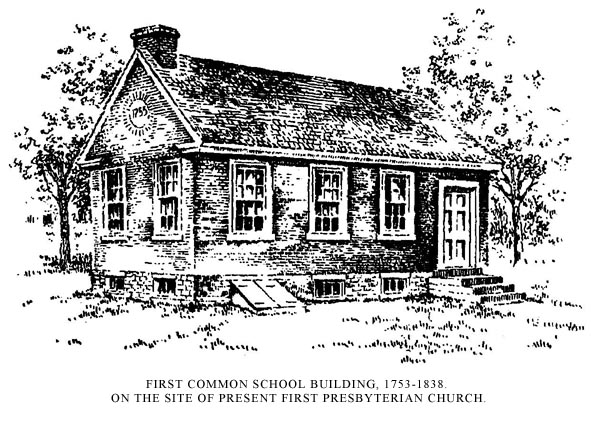
of this lottery permitted the erection of
a brick schoolhouse in 1753
on what is now the site of the First Presbyterian Church, a little
to the east of the church of that time. Little is known about the management of this school.
Built on Presbyterian grounds it was principally under the control
of that congregation. The pastor, the Rev. David Cowell, seems to
have had correspondence with President Burr of the College of New
Jersey in 1753 regarding a schoolmaster. The minutes of the trustees
in 1765 record that Alexander Chambers and Benjamin Yard were elected
by the congregation "Directors of the School-House." 1 The Episcopalians also shared in the management
as is shown by an entry in the minutes of the vestry of St. Michael's
Church, August 12, 1771, which reads, "The Rev. William Thompson
and Danl. Cox Esqs are chosen Trustees for this Congregation to Visit
the Free-school and do all such things as to them shall appear serviceable
for sd. school in this town." 2
An
advertisement in the New Jersey Gazette, February 23, 1780, tells what was expected
of the schoolmaster: A VACANCY, A VACANCY, In the SCHOOL of Trenton, for a Master qualified to
teach Reading, Writing, Arithmetick, and some of the branches of the
Mathematicks. A person so qualified, and bringing a good recommendation
with him, will meet with great encouragement (as the school is large)
by applying to the Printer. N.B. A single man, or one with a small family, will
answer best, and the sooner the application the better. 1 Hall, History of the Presbyterian Church, p. 72 2 Schuyler, A History of St. Michael's Church, p. 58. A joint meeting of the Legislature was held in this
school building March 17, 1780.
Trenton, November 28, 1781.
3
3 New Jersey Gazette,
Vol. IV, December 12, 1781.
THE
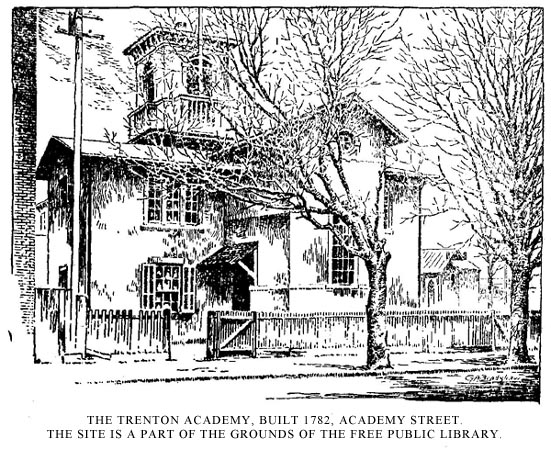
TRENTON ACADEMY Trenton's most important early
institution of learning was the Trenton Academy which first opened
in 1782 and continued until 1884. Among its trustees, teachers and
students are to be found the names of many citizens distinguished
not only at home but throughout the State and nation. The story of
the Academy is told at some length by Dr. John Hall in a series of
newspaper articles in the State Gazette in April and May 1847 and also by William L. Dayton in a pamphlet entitled
"Historical Sketch of the Trenton Academy, read at the centennial
anniversary of its foundation, February 10, 1881." A brief summary
must suffice for these pages. On February 10, 1781, twenty
citizens of Trenton and its vicinity formed an association "for
the purpose of erecting a School. House in the said Town, and keeping
up a Regular School for the Education of Youth, to be conducted under
the Firm of the Trenton School Company." The twenty original
proprietors were Joseph Higbee, David Brearley, James Milnor, Jr.,
Rensselaer Williams, Joseph Paxton, Stacy Potts, Isaac Smith, Isaac
Collins, William Tucker, James Ewing, Conrad Kotts, Stephen Lowrey,
Abraham Hunt, Moore Furman, Robert Neil, Micajah How, Jacob Benjamin,
William Churchill Houston, John Neilson and Francis Witt. Messrs.
Potts, Furman, Ewing, Collins and Houston were elected the first
trustees. The capital stock consisted
of £270,
divided into thirty‑six shares of £7 10s. each, which were subject
to additional assessment to finish the school building. Each shareholder
had the right to send a child to the school without any charge for
the use of the building. Other students were charged, besides tuition,
a half dollar for rent. All students were subject to extra charges
for incidentals. On May 20, 1781, the trustees bought for
£15
the lot on Fourth (afterward Academy) Street where the school was
built. Additional adjacent lots were bought in 1783, 1788 and 1854.
The building, two stories high, twenty by twenty‑six feet, costing
£444, was far enough along on February 11, 1782,
to permit the opening of the school. James Burnside was the first
teacher, and the students during the first quarter numbered forty. The studies were
at first elementary but soon grammar‑school courses were added
under the charge of George Merchant. On January 1, 1783, the trustees
advertised in the New Jersey Gazette for "a writing master
and accountant" who must be "well qualified to teach writing,
arithmetic and bookkeeping," and "be well recommended for
sobriety, industry and capacity." The school was
soon further strengthened by subscriptions and by increasing the number
of stockholders, and two additional rooms were added in 1783. The
quarterly examinations including public speaking were held publicly
in the Presbyterian Church and attended by distinguished citizens
and visitors. On November 10,
1785, the school was incorporated by an act of the Legislature under
the name "The Proprietors of the Trenton Academy." A girls' school
was added in 1787 under the care of Mrs. John Mease, and in the same
year the Rev. James F. Armstrong, pastor of the Presbyterian Church,
was engaged to act as superintendent of the Academy, which position
he held until 1791. One of the pupils at this time was Charles Ewing,
afterward chief justice, who was prepared for Princeton College, where
he graduated with first honors in 1798. The Academy in 1794 obtained permission from the Legislature
to hold a lottery which added considerably to the funds. In 1800 the girls' school was moved to the brick schoolhouse
in the Presbyterian churchyard, this building being leased at $1.00
per year for the purpose and a second story added.
The first Sunday school of
the Methodists was conducted in the Academy building in 1816. The Academy seems to have enjoyed
its most flourishing period in the '50's. David Cole 4 was the very successful principal
from 1851 to 1857. Samuel Backus was a much respected teacher during
this period. He acted as vice-principal from 1847 until he succeeded
to the principalship in 1857, but he died shortly afterward. A catalog
of 1851-52 shows among the students Charles C. Abbott, S. Meredith
Dickinson, Ion H. Perdicaris, Washington and Ferdinand Roebling, William
S. Stryker, Clark Fisher and Alexander C. Yard. George S. Grosvenor
was principal from 1859 to 1875. Mr. Grosvenor, now (1929) in his
ninety‑eighth year, lives at Nice, France. 4 David Cole was an important
educational leader in the State at this time. An interesting chapter
written by him on school matters 1853-58, entitled "Educational
Reminiscences," appears in Murray's History of Education
in New Jersey. He was appointed a member of the first board of
trustees of the State Normal School at Trenton and was professor of
ancient literature at the same institution from 1857-58. In 1858 he
entered the ministry of the Dutch Reformed Church. The development of the State
Model School and‑ the public schools gradually caused a decline
in the number of pupils attending the old Academy. In 1884 its doors
were finally closed and its affairs settled under the receivership
of Barker Gummere. Clark Fisher purchased three of the lots and the
building in order to obtain the old bell. The property continued in
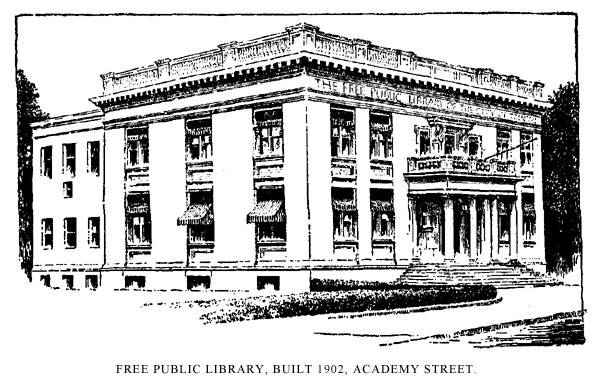
his possession until sold to the trustees of the Free Public Library
in 1900. During the Fisher ownership the building was used as a public
school annex and as a temporary abode for the School of Industrial
Arts.
II.
Public Schools
It must be remembered that
all municipal support of schools by taxation had to be authorized
by legislative action. We cannot here trace the growth of the public
school through the succession of Acts, Amendments, special Acts, and
Charter Provisions of subsequent years, except in a few instances.
The "Act to establish common schools" passed in 1829 and amended in 1830 seems to have induced Trenton's first step in public
education. The "Act to establish public schools" passed
in 1838 is important in that it removed
the pauper stigma from public schools. New Jersey settled the question
of public education in 1875 by
the following amendment to the Constitution: "The Legislature
shall provide for the maintenance and support of a thorough and efficient
system of free public schools for the instruction of all the children
in this State between the ages of five and eighteen years."
TRENTON'S FIRST PUBLIC SCHOOLS
5 Annual reports of the board of education of later years refer to the Free School Act passed in 1835, doubtless an error for 1829 or 1830, and name the earliest school trustees as Thomas J. Macpherson 1835-36, James Skirm 1835-39 and Benjamin F: Vancleve 1835-36. The earliest newspaper notice about a public
appropriation for the education of poor children, as permitted by
the Act of 1820, appeared
in the Trenton Federalist, April 16, 1827, when
it was stated that:
The township of Trenton, at
the late annual town meeting, voted 300 dollars for the schooling
of poor children. In the same newspaper a week later there appeared the
following statement:
Those indigent inhabitants of
Trenton, who wish to avail themselves of the benefit of the late appropriation
for schooling poor children, are requested to report their names,
residence and number of children, to either of the School Committee‑Gen.
G. D. Wall, Charles Parker, Charles Burroughs, William Potts and James
Hamilton. As the Act of 1820 did not
provide for the building and organization of schools, the money appropriated
was doubtless used to pay the fees of indigent children while in attendance
at some of the small private schools. Dr. Hall 6 says that for a time "the public schools" were under the direction
of Mr. and Mrs. Joseph Lancaster whose "contract was to teach
eighty children for one year, and supply books and stationery, for
two hundred and seventy‑five dollars." 6 History of the Presbyterian Church, p. 247. The Act of 1829 went farther
and permitted the building and organization of public schools. The
following notice in the Trenton
Federalist on May 4, 1829, probably announced Trenton's first
public school. Although tax‑supported it was doubtless for the
poor only.
The Trenton Free School is now
open for the reception of Scholars. Persons who wish to send children,
are requested to make application to Mrs. Kitchen, at the building
lately occupied by Joseph Lancaster, as a School‑house. A notice in the
State Gazette on April 17,
1830, calling a meeting of the school committee of the township of
Trenton, when studied with other later notices, indicates that the
city of Trenton for school purposes was considered a part of the
larger township of Trenton, which was divided into five districts,
and that each district elected a school committeeman. Each district
had also three trustees, and the city of Trenton as then bounded was
district no. 1, of the township of Trenton. A news item a few weeks
later, May 1, 1830, in the State
Gazette, states that
Trenton township,
at the late town meeting, voted 400 dollars for the support of Common
Schools. The amount receivable by the township, this year, from the
State fund, 7 is 400 dollars. This, we understand,
includes this and last year's dividend. The annual amount which Trenton
township is entitled to draw [from the State fund] is 200 dollars.
7 The School Fund, established
by the Legislature in 1817, was New Jersey's first action toward a
system of public education. This fund has increased from $100,000
in 1818 to $11,126,416 in 1928. From the income annual appropriations
are made and apportioned to the Counties for public schools. This
annual appropriation has been increased from $20,000 in 1829 to $500,000
in 1928. Apportionment is now made on the basis of days' attendance.
Trenton's apportionment from the State Fund in 1928 was $12,299.
The next notice continues the story
COMMON SCHOOLS The Trustees for the district
comprising the city of Trenton, appointed under the act to establish
Common Schools, hereby give notice that they expect to have one or
more Schools open for the reception of scholars to be taught at the
public expense, on or about the first of June ensuing - and request
all those who may wish to send any children to said Schools to make
application with as little delay as possible to the trustees -that
they may know how many scholars to provide for. CHARLES.BURROUGHS
JOHN WILSON Trustees 8 8 State Gazette,
May 22, 1830. The same trustees, in the State Gazette of September 11, 1830, gave
notice that
The Schools supported by the
Public Funds, have commenced another quarter, and are not yet full
- those of the Trenton district wishing to send Children will please
to apply to Charles Burroughs for Tickets of admission.
In 1831 David Johnston was
elected school committeeman for the first district and the trustees
were John McCully, Joel Gordon and Charles C. Yard. A notice in the
State Gazette May 7, 1831, shows that there was to be opened on May
9 in the first district "the male school . . . under the tuition
of Mr. Charles Rice and the Female school . . . under the tuition
of Mrs. Kitchen." In May 1832 the trustees, Thomas
J. Stryker, Charles C. Yard and William P. Sherman, gave notice of
the opening of "the School for girls, and for colored Children"
on May 8 and at the same time they advertised for a teacher for "the
School for boys" which was to be opened on the twenty-third. The first published financial
report of Trenton's public schools submitted by Treasurer William
P. Sherman appeared in the State
Gazette on March 30, 1833:
The total receipts were $522.89 The expenditures were To Charles Rice, balance due
him for teaching male school in 1831
$92.40 To Elizabeth Kitchen, balance
due her for teaching female school in 1831 16.60 To James B. Stafford, balance
due him for teaching colored school in 1831 20.75 To Mrs. Gordon, for one quarter's
rent of room for white male school in 1831 6.oo To George Cole, for two quarters'
rent of room for colored school in 1831 6.oo To Charles C. Yard, Wm. Merseilles
and James Faussett, for re- pairs to room of white male school 5.35 To Charles Rice for benches
and desks for white male school
6.25 To George Sherman for printing
admission tickets for the year 1832
2.00 To Robert Parry for teaching
white male school one quarter, in the year 1832 70.00 To Daniel Coleman for teaching
do. part of succeeding quarter 8.00 To Mrs. Gordon for two quarters'
rent of white male school room in the year 1832, at 6 dols. per quarter 12.00 To Mrs. Fenton for teaching
white female school in 1832, two Quarters 150.00 To
Miss Stafford for teaching four children one quarter 6.00 To James B. Stafford for teaching
colored school two quarters, in 1832 116.75 To George Cole for two quarters'
rent of room for colored school, at 3 dolls. per quarter 6.00 Total amount paid
$524.10 Deduct amount received $522.89 Balance due treasurer $ 1.21 The trustees for the years
beginning May 1833 and 1834 were James Skirm, Benjamin S. Disbrow
and Joseph G. Brearley. It
was necessary again to advertise for teachers. Such were the beginnings of Trenton's free public schools.
So far they were conducted in rented rooms, and for the poor
only. Doubtless they were not largely attended because of the reproach
of pauperism. Ellis claims for Trenton "the honor of having
established the first free school in New Jersey," naming a school
organized in the old Masonic Hall in 1833 "where all the pupils
received free tuition." He attributed his information to Thomas
J. Macpherson who had been a teacher in that school. In view of the
above notices of 1829 and 1830 it is doubtful in what respect the
Masonic Hall school may claim to be the first. As mentioned above, the Act
of 1838 removed the pauper feature from public schools, and it seems
that thereafter for several years a small quarterly fee was charged,
because as Dr. Skelton complains, "the sums appropriated, and
allowed to be raised by tax, were so small that [free] provision could
only be made for those in extreme destitution." The following
notice, appearing in 1842, gives a rather full picture of our school
system at that time:
The schools will be opened on the first Monday in April. In the school
under the care of Mr. F. Kingman, at the State Bank building [corner
of Warren and Bank Streets], the [quarterly] rates of tuition will
be as follows For spelling, reading, writing,
defining, Arithmetic, Geography
$1.50 For these, with Grammar, History,
Rhetoric, Botany, Mathe‑ matics, Natural Philosophy or
Chemistry
$2.00 Music will be taught as a regular
branch of information, without extra charge; but not to such a degree
as to interfere, with the other studies of the school. Exercises on the
black board and slates, in Geography, Drawing, Orthography, Etymology,
Elements of Geometry, and Natural Philosophy, will form part of the
duties of each week; thus affording to every pupil an opportunity
of acquiring a practical knowledge of those branches without the expense
of text books. In the female
school under the care of Miss Mary Johnston, at the school house in
Perry St., the terms will be as follows For spelling, reading, writing,
defining, Arithmetic, Geography
$1.25 For these, with Grammar, Natural
Philosophy, History, Rhetoric and Botany
$1.75 A school will be opened at the
School House in Perry Street, under the are of Mrs. Mary Hunt, in which
the youngest white children, of both sexes, will be taught spelling
and reading. The terms in this school will be $1.00.
In the school for colored children, in Hanover Street,
under the care of Mr. Elymus Rogers, the terms
will be: For spelling and reading
$1.00 For
these, with writing, arithmetic and geography
$1.25 For
these, with other higher branches
$1.75 The number of scholars in each school is limited to fifty. By order of the Trustees, JAMES T. SHERMAN, Secretary.9
9 State Gazette, March 22, 1842. In the same year we note the
advent of the first "high" school in the following:
The schools will be opened,
for the next quarter, on Tuesday, the 5th of July. At that time will be commenced
in the upper room of the State Bank a
PUBLIC HIGH SCHOOL under the superintendence of
William M. Hough, late Principal of the Norristown Academy. The terms
of tuition in this school will be as follows For reading, writing, arithmetic, and geography, $1.50
a quarter. For English grammar, composition, rhetoric, mathematics, natural philosophy and chemistry, $2.00. In
natural philosophy and chemistry, frequent lectures will be given,
illustrated with experiments, for which an apparatus is provided. Mr. H. will also
teach the Latin, Greek and French languages; but the Trustees do not
feel authorised to apply the public moneys to the support of a classical
school; and, therefore, the terms of tuition in these studies will
be $7.00 a quarter. . . . The school room
is large and airy, and has been painted and furnished so as to be
comfortable and attractive to the scholars; and the Trustees confidently
expect that this school will acquire general respect and approbation.
. . 10
10 State Gazette, June 30, 1842.
In 1844 the high school under
Mr. Hough and, shortly afterward, the primary departments were moved
to the old town hall 11 building on Academy Street. 11 This building served as the
town hall and jail from 1809 to 1838. The site had been purchased
by the city in 1808 from Peter Hunt, with the proviso that it was
to revert to his estate when no longer used for its original purpose.
The city acquired a clear title to the property in 1843 from William
E. Hunt for $100. It was in front of this building that the whipping
post stood until it surreptitiously disappeared one night in 1839. In 1848, according to Dr. Skelton,
the Trenton public schools were made free to all without fee.
THE
FIRST FREE PUBLIC SCHOOL BUILT ON CENTRE STREET We turn back now to that portion of Nottingham Township
which as South Trenton was annexed to Trenton in 1851, to quote from
Dr. Skelton who had been since 1842 a member of the school committee
of that township, and school superintendent 12 in 1847. 12 The early meaning of this term
is explained on p. 737. The school built on Centre
Street was, in Dr. Skelton's opinion, excepting the "pauper"
schools, "the first free public school established in our city,
and I believe, the first really free public school in our State."
He tells its story as follows: In the spring of 1843, the school
committee of the township [of Nottingham] recommended to the voters
to raise, by tax, eleven hundred dollars; six hundred to build a house,
and five hundred to support the school, which sums were voted almost
unanimously. The people said they were willing to raise any amount
necessary to support public schools, but not a dollar for pauper schools.
The opponents of public schools here raised legal questions and set
aside the proceedings of the town meeting as illegal. The school committee and the
citizens, then applied to the Legislature, to be allowed to raise,
by tax, one thousand dollars for the support of public schools, and
after much contention, succeeded in getting the privilege to raise
six hundred dollars for that purpose, and five hundred to build a
house. At the annual town meeting of 1844, the school committee recommended
to raise, by tax, the full sum allowed by the special township act,
and to appropriate the interest on the surplus fund of the general
government, and the tax on dogs, to the support of public schools,
which recommendations were carried by a large vote; the committee
had saved the two years' appropriation from the State fund, amounting
to about three hundred dollars. Thus the committee found themselves
in possession of less than two thousand dollars for the purpose of
building a house and supporting a public free school; and resolved
to proceed, immediately, to erect a suitable house. Here was the first
triumph of the friends of public education, and this too, after a
desperate struggle of two
years; and although the
sum raised was exceedingly small for the purpose of building a
house and supporting a school for over six hundred children, yet it
was a victory . . . . The committee then purchased
a lot, one hundred feet square, on Centre Street, near the First Baptist
Church, for the sum of one hundred and sixty dollars. They made a
contract with Mr. William Johnson to build a brick house, thirty by
fifty feet, two stories high, to contain four rooms, with seats in
each room for seventy‑five children. The cost of the building
furnished, and lot, was about twenty‑four hundred dollars.
When the building was finished, the committee found themselves in
debt about fifteen hundred dollars. Thus far they had proceeded without
taking legal advice, and now, they were informed, by a celebrated
lawyer, that their proceedings were illegal, and that they had no
right to borrow money and mortgage the house for the payment of the
money. A town meeting was called, and the people, by a vote directed
the town committee to mortgage the house and pledge the faith of the
township for its redemption; accordingly the money was raised, and
the difficulty settled. About the first of September, 1844, 13 four teachers were employed,
to take charge of the schools - Mr. Joseph Roney, as principal, and
the following named ladies as assistants: Miss Susan S. Albertson,
Miss Hannah Carlin and Miss Sarah Joycelin. The first at an annual
salary of four hundred dollars, and the others at one hundred and fifty dollars each. The
first day the schools were opened, over four hundred children presented
themselves for admission, about half of whom had never attended school
of any kind. Here was serious practical difficulty‑how shall
this surplus of applicants be disposed of; shall they be crowded into
the rooms, one hundred in each room, or shall they be sent home, and
thus deprived of the blessings of education? The committee concluded
to meet this difficulty by a general rule. The State law admitted
all over five years of age; the committee made a rule to exclude all
under seven years of age, and thus give the oldest the first privilege,
and let the younger come in as they advanced in years. This rule worked
well, and left in attendance about three hundred children. After three
days of incessant labor, order was brought out of confusion, and the
gratifying spectacle was presented of three hundred children seated
at their desks pursuing their studies with cheerfulness and good order.
This result was highly gratifying to the friends of education; and
now, after the lapse of thirty‑one years, the recollection returns
with vivid pleasure. Nottingham township at that time contained over
six hundred children, capable of attending school; not over one hundred
of whom had been attending any school. Hundreds of children were educated
in this institution who would otherwise have grown up in ignorance,
and many in vicious habits; many of these, then children, are now
heads of families, prosperous and happy. Much clamor was raised against
building a house so large and fine; a brick building two stories high,
containing four rooms, was evidence of a spirit of extravagance that
was sure to ruin the country. On looking back, we, at this time [1876],
think it very strange, that such objections should have been urged
against such a building. Mr. Joseph Roney, the principal, introduced
music at the organization of this school; he led on the violin and
sang appropriate school songs. Music had great influence here, in
harmonizing discordant and unruly feelings, at the same time it enlivened
the feelings of the children and enabled them to make more rapid progress
in their studies. 13 This date should read 1845.
An article in the State Gazette
April 25, 1845, tells of this building as about to be built. This
is confirmed also by Dr. Skelton's reference below "and now,
[1876] after the lapse of thirty‑one years."
This school was first known
as the Centre Street School. Two additional rooms were built in 1856.
When in the early '7o's further addition was contemplated, it was
decided to erect an entirely new building which was completed in 1876.
This building is still in service. In r89i it was fittingly renamed
the Charles Skelton School.
THE
ACADEMY STREET SCHOOL We must return
again to Dr. Skelton to whose persistent efforts so much of the early
public school progress was due. In 1847 he moved into Trenton proper
and for the next three years was elected superintendent of schools
in Trenton. His story of the first school building in Trenton, erected
on the site of the old town hall and jail building, follows: This school in the old jail
[on Academy Street] had for some years been under the control of the
Common Council, and was not free, except to the destitute; but each
pupil was required to pay a tuition fee. The fee policy was changed
in 1848, and all the children were admitted without charge. The free
system, and a change in the organization of the schools, largely increased
the number of applicants for admission, and created a necessity for
more rooms and more teachers. In the spring of 1849, the trustees
and superintendent recommended to the citizens to vote for making
a loan of six thousand dollars, to pay for the erection of a new school
house. The vote was accordingly taken, and carried by a large majority.
Legal difficulties were raised by the opponents of public schools,
and the Common Council refused to raise the money. The trustees and
superintendent, at the next session of the Legislature, applied for
authority.to make a loan of six thousand dollars to build a school house, and to raise, by tax, any sum not
to exceed two thousand dollars, to support the schools. In the spring
of 1850, the citizens voted to make the proposed loan, and to raise,
by tax, the full amount allowed by law for the support of the schools. The trustees and superintendent
immediately resolved to pull down the old jail, and to build on the
lot where it stood, a house suited to the wants of the city. The lot
adjoining on the east, was purchased at a cost of $737.50. A plan
was drawn by the superintendent and adopted by the trustees, to put
up a building three stories high, with a basement for a lecture room,
and four rooms above, on each floor. This plan the trustees were obliged
to reduce by taking off the basement and third story, in consequence
of the sum of money in their possession being too small to pay for
the building on the original plan. This change was much to be regretted,
as it marred very much the beauty of the building, and deprived the
city of four good school rooms and a large lecture room. A contract
was made with James Hammell, and the building erected at a cost of
$4,723. The building was opened for the reception of pupils on the
first day of October, 1850, and immediately filled. Six hundred children
were seated under the tuition of the following named teachers: G[eorge]
G. Roney, as principal, and Miss P. S. Vancleef, Miss L. H. Tucker,
Miss S[usan] S. Albertson, Miss Sarah] P. Yard, Miss Mary Johnson,
Miss M. J. Mitchell and Miss M[aria] W. Thomson, as assistants. The Academy Street School has
continued to serve the purposes of public education from that day
until this. The third story was added in 1876. For a short period
it was called the Charles Skelton School, but in t89i was renamed
in honor of Joseph Wood who was the mayor of Trenton from 1856‑59.
The principal of this school from 1874 until his retirement in 1913
was Lewis C. Wooley. A special Act of the Legislature
in 1850 made the city of Trenton one school district and enabled the
trustees to take title to land, erect buildings and accept trusts,
and another special Act in 1856 enlarged the powers of the trustees;
making them more independent of Common Council. A brief chronicle must suffice
for the years from 1850 to 1888. During these years the public schools
grew steadily in strength and numbers but the growth was slow and
painful. There were always pupils on the waiting list for admission
and many makeshifts were adopted. Nearly every year rooms and annexes
were rented for school purposes here and there about the city. The
school system was crudely organized and weak both in business methods
and in pedagogy. The superintendents and trustees, without remuneration,
gave what time they could take from their business and private affairs. The outstanding superintendents
were Abram R. Harris 1851‑57 and 1859‑63, who succeeded
Dr. Skelton; William S. Yard 1857‑59; Thomas J. Corson 1863‑68;
Dr. Cornelius Shepherd 1868‑76 and 1881‑84; and Edward
S. Ellis 1884‑85. Among active supporters of
public schools during this period was David Naar, 14 editor and proprietor of the
True American. He was a member of the board of trustees 1854‑55
and 1860‑68. Through the columns of his paper and in public
addresses he ably championed the cause of public education both at
home and elsewhere in the State. His printed address of 1862 to the
trustees and teachers shows that public schools were still much on
the defensive, particularly on the subject of tax support. 14 For further
reference in this chapter to David Naar, see p. 746. He was the father
of Joseph L. Naar.
THE
NEXT SCHOOL BUILDINGS The next new school building was erected in 1857 on
Bellevue Avenue, then Higbee Street, for the accommodation of colored
children. 15 The colored children were later
transferred to a rented building on Belvidere Street and in 1872 to
a new school building on Ringold Street, which was sold in 1883, on
the completion of the Lincoln School on Bellevue Avenue. The Higbee
Street School was in 1896 named the Nixon School in honor of Judge
John T. Nixon. The building is now used as a carpenter shop, it having
been discarded for school use a few years ago.
15 Mention of a public school
for colored children on Hanover Street has been made previously. As
far as is known this was the first school for colored children. The
building had been a meeting house for colored people for many years
before. Because of complaints about its dilapidated condition, this
building, then popularly called "Nightmare Hall," was sold
by the city in 1855 for $21 and removed. The Young Women's Christian
Association now occupies the site. The next new building was the
Market Street School on the corner of Market and Cooper Streets. It
was opened in 1859 with Charles Britton as principal. In 1896 it was
renamed the Cooper School in honor of Peter Cooper. The Union Street School was
dedicated in 1869, and in 1896 named the Parker .School in honor of
Clara Parker, an early school teacher in that vicinity. The Rose Street School was opened
in 1870. Marcia M. Wright served as principal from 1870 to her retirement
in 1902 In 1896 this school
was named the Livingston School in honor of New Jersey's first governor
after independence was declared. In 1872 a new school was opened
on Grant Avenue. It was later named the U. S. Grant School. Kate Weeks
was principal from the opening until her retirement in 1895.
THE
SCHEDULE OF EARLY SALARIES A glance at the early salaries
of teachers is of interest. In 1860 the list was as follows
Joseph Roney, principal Academy
.Street School $800 Charles Britton, principal Market
Street School 700 Charles Sutterley, principal
Centre Street School 660 William H. Brace, teacher 475 19 "lady" teachers,
each 250
In 1871 the following schedule
was adopted:
First, Second and Third grades
$450 Fourth grade $1,100 male, $500 female Fifth grade (presumably male)
$1,200
In 1861 two supervising principals
were appointed, and a northern and southern division designated with
the Assunpink Creek as the boundary. Joseph Roney was appointed for
the northern and Charles Britton for the southern district. Each,
of course, continued his previous duties as a school principal and
teacher. In 1864 Joseph Roney was elected supervising principal of
all schools at a salary of $1,000 but after a year he resigned to
take a similar position in Scranton. Night schools were first opened
in 1864 in the Academy Street and Market Street Schools, with a total
average attendance of 150. The Young Men's Christian Association
pledged $50 to furnish books and stationery. Night or evening schools
have been conducted at intervals ever since, but their early years
were marred by the invasion of hoodlums and rowdies and there was
no definite program of instruction.
THE
FIRST HIGH SCHOOL BUILDING The year 1874 was memorable
in Trenton's annals in that it saw the completion of the first high
school, an event which superintendents, trustees and intelligent citizens
had been advocating ever since it was first urged in 1858 by William
S. Yard, then superintendent. After several refusals, Common Council
in 1873 granted an appropriation of $7,000 for the purchase of a lot
of one hundred feet frontage on Mercer Street. The new school, costing
in all about $30,000, was opened
in October. It had seats for 304 pupils and there were 296 pupils
the first year. William H. Brace, then principal of the Academy Street
School, was appointed the first principal, in which office he continued
to serve until the next high school was opened in 1902. A list of
the first teachers and their subjects follows:
William H. Brace, Principal,
and Teacher of Classical Literature.
SENIOR DEPARTMENT Joseph R. Encke, Mathematics and Natural Sciences.
JUNIOR DEPARTMENT Harriet Dickinson, Mathematics and History.
The principal and Mr. Encke
received annual salaries of $1,200 each and the other teachers $500
each.
The board of
education in 1887 first began to provide free text‑books, a
policy which was rapidly extended to include all schools and all grades.
In 1894 an Act of Legislature made this compulsory throughout the
State.
OTHER NEW SCHOOLS Between the opening
of the new high school and the year 1888 a number of school buildings
were erected or otherwise acquired. The Mott School on Centre Street
was built in 1881. At first called the Sixth Ward School, it was in
1896 renamed in honor of General Gershom Mott who once lived about
where the school stands. It was considerably remodelled and enlarged
in 1912. Previous to 1881 there was another
school nearby on Second Street which had been built for Nottingham
township in 1854. The first Lincoln School was
built on Bellevue Avenue in 1883 for colored children. The principal
from that time until his retirement in 1913 was Spencer P. Irwin. The Peabody School, built in
1882, was first called, from its location, the West Hanover Street
School. In 1896 it was named in honor of George L. Peabody. The present Administration Building
was first a private school known as the Institute. It was bought by
the city in 1884 and called the Stockton Street School. In 1896 it
was named in honor of Commodore Richard Stockton. In 1912 this building
was enlarged and devoted entirely to administration purposes. By the annexation of Millham
in 1888 the school on Girard Avenue was acquired. It was named in
1896 in honor of Stephen Girard. It was built in 1884 by district
no. 20, and first called the Millham
Public School. With the annexation of Chambersburg,
Trenton acquired in 1888 the Centennial, Washington and old Franklin
Schools. The old Franklin School is on
the corner of Liberty and William Streets. The first school on this
site was built in 1857 but replaced in 1880. Known then as the Hamilton
School and also as the Academy, it was upon annexation named the
Franklin School. It has now outlived its usefulness. Adjacent to
it is the new Franklin School built in 1913. The Washington School was built
in 1867 by the trustees of district no. 34. Numerous additions and
alterations have been made. Before annexation it was known as the
Chambersburg School and also as the "White" School from
its coating of white rough casting. The Centennial School on Whittaker
Avenue was built in 1876 by the trustees of district no. 34. Additions
were made in 1878 and 1887. The Monument School on Pennington
Avenue was opened in 1889 and enlarged in 1895.
B.
C. GREGORY BECOMES SUPERVISING PRINCIPAL A new epoch in
Trenton school history began in 1888 when the board appointed Benjamin
C. Gregory to the position of supervising principal of the Trenton
schools, a fortuitous choice which we owe to a committee of the school
trustees consisting of Frank O. Briggs, John A. Campbell and George
W. Macpherson. These gentlemen reported that "the necessity for
this officer was very pressing. The members of the Board are all men
engaged in active business and not versed in the science of teaching.
They have neither the time nor the training to decide all the technical
questions arising in the management of our schools. We believe that
the citizens of Trenton wish the schools of this city run on business
principles: that a school system without a practical school man at
its head is in the same condition as any other business without a
proper head." After the first year of the Gregory administration
the committee felt that "as a result, a strong homogeneous, efficient
system is being evolved from the old ones [the High School, the Northern
District, the Southern Districts and the recently annexed Chambersburg
and Millham Schools]‑a system that will be a power in the development
of the city and a source of pride to its inhabitants." Gregory set about at once to
reorganize the school system and to lift it out of its provincialism.
He was gifted with a genius for inspiring leadership and he brought
to his work culture, urbanity and wide experience. He kept not only
abreast but ahead of the times and he was always alert to bring to
Trenton the best methods and practices that experience elsewhere had
developed. He was intensely though sensibly modern and he would have
been considered so even today without much alteration in the point
of view he held over a quarter of a century ago. Gregory rightly felt that his
most important task was to develop better teaching. He found standards
low and that little regard had been given to teaching ability when
teachers were employed. Only a high school education was required
of a beginning teacher and she learned her art generally by unsupervised
practice on her unfortunate pupils. In a short time the requirements
were raised to include a normal or training school education. The
Hewitt Training School was soon instituted where a class of pupil
teachers could both observe the best teaching in actual practice
and take courses in teaching methods, psychology and kindred pedagogic
subjects. Meetings and conferences of both teachers and principals
were introduced and the supervising principal gave a great deal of
his time to helpful visiting of the school rooms. A monthly round
table, a voluntary reading circle and a consulting library of professional
books were established. Teachers were urged to take summer courses.
Every effort was made to encourage continued study and self improvement
on the part of all teachers.
Gregory had the courage to "import" occasionally a teacher
from elsewhere, for he found the teaching force anemic from the lack
of new blood. Attention was given to the salary schedule. Gregory
found teachers' salaries very low and without relation to improvement
or length of service. The average teacher received $45 per month, whether good, bad
or indifferent, whether just appointed or of long experience. In
time new schedules improved salaries and related them to ability and
length of service. Limited space permits mention
of only a few of the progressive undertakings of the Gregory administration.
The high school was strengthened by moving the junior section, the
seventh and eighth grades, from the high school to the grammar schools.
A commercial course was introduced which became at once popular and
successful. Agitation for a new high school was begun which in 1901
culminated in the new high school on the corner of Hamilton and Chestnut
Avenues. The project was approved by popular vote in 1896, 3989 "for"
and 2243 "against," but legal
and financial difficulties stayed progress for several years. Gregory gave immediate attention
to improving the evening schools. He found that "what should
be taught was left to the caprice of the teacher. No plan of work,
no one was responsible for the work, few if any books, no organization
and poor discipline." Systematic courses were provided, successful
and experienced teachers chosen, and order and discipline were required
and maintained. The employment of a special officer helped considerably.
The following report of efficient Officer B. Sholes in 1893
gives
an interesting picture of conditions:
I reach the schools about 6:45
p.m., and generally find many boys around making considerable noise.
As soon as I arrive there is less noise. I remain there until school
opens and see that there is as little confusion as possible; stay
awhile after school commences, and if any are there that do not belong
to the school I drive them away. These are the persons who want to
stay around and call and whistle to their friends inside. When all
is quiet I go to another school, and generally find outside boys around.
I drive them away and remain until school is out, and see that all
are away before I leave . . . . I reach all the different schools
every other night; the oftener they see me, the better the order is.
An evening high school was established for the first
time in 1890, in rented rooms on the third floor of 120 North Broad Street. The supervisor
of evening schools from 1896‑1916 was Eva Ellis. Gregory gave constant attention
to improving the comfort, attractiveness and sanitation of the school
buildings. There was general rejoicing in 1912 when the board contracted for one clean towel for every
class room each day. Slates and slate‑pencils about this time
gave way to paper, lead pencils, pen and ink. Many innovations such as art,
music, physical education, manual training and kindergartens, which
we may be sure conservative citizens decried as fads but which no
self‑respecting public school would be without today, were urged
by Gregory. For some of these he merely prepared the way for their
establishment under his successor. An accomplished musician himself,
Gregory particularly urged and developed the study of this art. Some
attention had been given to music previously. Joseph Roney from September
1855 to April 1856 had been engaged to teach music, and in 1875 Gertrude
Deckrow was appointed for the same purpose. The first supervisor was
Lottie G. Johnston who acted in this capacity from 1891 to 1894. This
luxury was forgone then until 1897 when Lella Parr acted as supervisor
for a year. In 1898, Catherine M. Zisgen, then a teacher in the Washington
School, was appointed supervisor of music, a position which she has creditably held ever since. The first mothers' meeting
in Trenton at the Cadwalader School in 1900 and the organization of
a Parents' Society in the same school in 1901‑02, marked the beginning of these endeavors which have had much to do with
bringing schools and parents into closer cooperation and understanding.
Another step in this direction had been previously adopted by Gregory
in the institution of monthly reports on each pupil to his parents. In 1902 Dr. Gregory resigned
to become school superintendent of Chelsea, Mass. During his administration
the enrolment had increased from 5,631 to 9,119, the number of school
rooms from 124 to 211, the seating capacity from 6,000 to 10,067,
the number of teachers from 124 to 220, and the high school pupils
from 285 to 589. SCHOOL
BUILDINGS ACQUIRED DURING THE GREGORY ADMINISTRATION The John A. Roebling School,
on a plot bounded by Home Avenue, Beatty and Orange Streets, was opened
in 1889. It was destroyed by fire in 1902 and immediately rebuilt. The Columbus School, on the
corner of Brunswick Avenue and Mulberry Street, was opened in 1892.
A considerable addition was built in 1913. The Hewitt School, bounded by
Washington, Roebling and Emory Avenues, was opened in 1891. It was
originally called the Hewitt Training School, and was named for Charles
S. Hewitt. The Cadwalader .School, on the
corner of Murray and Boudinot Streets, was opened in 1893. It had
its origin in a rented room on the corner of Montgomery Place and
West End Avenue (then Philemon Street). Additions were made in 1897
and 1907. The Hamilton School on the corner
of Hamilton Avenue and Anderson Street, was opened in 1897. Through the annexation of Wilbur
in 1898, Trenton acquired the William G. Cook and the James Moses
Schools. The Cook School is on Cuyler Avenue and was first opened
in 1891 and the Moses School on Park Avenue was first used in 1897. The annexation of a part of
Ewing township in 1900 brought in the Hillcrest School and Brookville
School. The latter; named the Dorothy Dix School, was afterward abandoned.
THE
NEW HIGH SCHOOL An outstanding event of the Gregory administration
was the achievement of a new high school building on the corner of
Hamilton and Chestnut Avenues. It was dedicated April 8, 1901, and
its total cost was about $138,500, representing efforts of the trustees
and commissioners for a period of ten years.16 The first principal
was Dr. William A. Wetzel, who today in the same position is busy
with plans for Trenton's next new high school shortly to be begun.
The growth and improvement of the high school, its courses and instruction
under Dr. Wetzel, are matters well known to thousands of Trentonians
who have profited thereby. The city of Trenton has had no more faithful,
untiring and efficient public servant than Dr. Wetzel. In 1906 an
athletic field was acquired by funds solicited by the pupils, large
contributors to which were Ferdinand W. and Washington A. Roebling.
In 1911 a pipe organ, the first of its kind in any public high school,
was installed at a cost of $5,000, which amount
was raised by the school.
Unfortunately as early as 1905 the number of pupils began to exceed
the seating accommodations and the operation of the high school ever
since has been increasingly handicapped by lack of space. Today the
old building and a part of the adjacent Carroll Robbins School accommodate
together only the eleventh and twelfth grades. The whole tenth grade
is crowded temporarily into junior High School No. 3. 16. A full report of the dedicatory exercises and a
description of the building is given in the biennial report of the
board, 1902. To mention some members of
the board is perhaps unfair to others and yet at the time of the struggle
for the new high school and for some years afterward Trenton had two
especially capable and diligent servants on its school board. Deserving
of special mention in a record of this kind are the intelligent services
of Carroll Robbins, a member from 1895 until his death in 1907, and
the long and faithful work of Samuel H. Bullock, a member from 1898
to 1919, during which period he almost never missed a meeting of the
board.
THE
MACKEY ADMINISTRATION Ebenezer Mackey
was called from Reading, Pa., to succeed Dr. Gregory as supervising
principal on September 1, 1902. Dr. Mackey held this office until
his death in 1919. In 1910 the title "supervising principal"
was changed to "superintendent of schools." Dr. Mackey was
a capable, kindly and faithful public servant, of the finest spiritual
qualities, who devoted himself without stint to his duties. The rapid
growth of school needs seems always to have kept ahead of the foresight
of school authorities and yet the Mackey administration was marked
by many important developments and improvements.
KINDERGARTENS Action by the
school board on June 4, 1903, authorizing the equipping of five school
rooms for kindergartens, may be considered the actual beginning of
this important addition to the public school program. One kindergarten
had been opened in the Charles Skelton School in 1888 through the
efforts of Nellie Bodine, a teacher in that school, and the principal,
Thomas M. White. This kindergarten was transferred to the Hewitt Training
School in 1891. Dr. Gregory made repeated recommendations for the
establishment of more kindergartens but nothing further was done until
the action mentioned above in 1903. Mary E. Windsor was the first
supervisor of kindergartens and her successors have been Stella McCarthy
and Bertha M. Barwis.
MANUAL
TRAINING In 1888, Frank O. Briggs, then
a member of the board, first suggested the appointment of a committee
to investigate and report on the subject of manual training. The subject
continued to be considered at intervals for the next eighteen years
and Dr. Gregory frequently recommended action. Finally, in 1906, manual
training was introduced in the high school. It has since been extended
down to include the fifth grade. Its importance in correlating the
training of the hand with that of the mind is clearly recognized,
especially since the training afforded by the old‑fashioned
household chore has been lost. Alvin E. Dodd was the first supervisor
of manual training. Sewing was added in 1907 and cooking in 1908,
at which time Louise Kingsbury was appointed the first supervisor
of domestic science.
ART
EDUCATION Drawing had been taught in
the schools for some time, depending on the ability of the classroom
teachers to handle the subject. In 1901 Eva E. Struble was appointed
the first supervisor of drawing. Later a supervisor of industrial
arts in the primary grades and a supervisor of fine arts for the upper
grades and the high school were appointed.
PHYSICAL
EDUCATION A system of "physical
culture" was urged by Dr. Gregory in 1890 and some attempt was
made in 1893 to introduce it. Ella A. Macpherson, vice‑principal
of the high school, was supervisor of physical training from September
1895 until December 1904, performing the duties of this office after
the close of the daily session of the high school. In 1906 Helen R.
Levy was appointed the first supervisor to give full time to the
subject.
SPECIAL
CLASSES The first special classes for
mentally retarded and incorrigible pupils were begun in 1905 by Principal
Thomas M. White at the Skelton School. As these classes have developed
they now provide only for pupils who are mentally retarded. At the
present time there are 22 such classes in the city giving this type
of individual attention to 312 pupils. During the present school
year (1928‑1929) a survey is being conducted by several experts
from outside the school system to determine what further plans should
be made for pupils thus handicapped.
MEDICAL
INSPECTION Medical inspection was introduced
in 1909, when six physicians and a school nurse were appointed. This
service has been gradually increased. At the present time the department
consists of five physicians who give part of their time; fourteen
school nurses, and two full‑time dentists.
SUMMER SCHOOLS The
first summer vacation schools were opened in 1910. Classes were in
two buildings and there were 228 pupils and 7 teachers. The next year
there were classes in ten buildings with 1374 pupils and 43 teachers.
Summer schools have been maintained ever since. Pupils who have fallen
behind in their work are enabled to make up by summer school attendance,
while a few attend to gain advanced standing.
THE
SIX‑THREE‑THREE PLAN Until 1914 the public school
system consisted of elementary schools of eight grades and a high
school of four grades. About this time educational leaders began to
urge a change of organization to eliminate the sharp break between
elementary and high schools and also to provide a more varied and
effective education for pupils of the adolescent age. The proposed
new plan provided for an elementary school of six grades, a junior
high school of three grades (7, 8 and 9) and a senior high school
of three grades (10, 11 and 12). It meant that the junior high school
grades would ultimately be placed in new buildings planned with facilities
for the new kind of education proposed. Dr. Wetzel ardently advocated the plan, while Herman C. Mueller, then president of the board of education, immediately saw the educational value of the proposed shop work and insisted that the first step in the achievement of the new plan was to erect junior high school buildings. The plan was officially adopted in 1914 and shortly afterward the old Almshouse plot of seven acres on Princeton Avenue was acquired and Trenton's first junior high school was opened in October 1916. A year later the Carroll Robbins School, previously the Training School, was opened as junior High School No. 2.
SCHOOL
BUILDINGS ACQUIRED DURING THE MACKEY ADMINISTRATION The old high school on Mercer
Street was converted to elementary school purposes in 1901 and named
the William McKinley School. Additions were made in 1911. The Harrison
School on Genesee Street was built in 1903, the McClellan School on
Fillmore Street in 1904 and the Jefferson School on Brunswick Avenue
in 1905. The latter was considerably enlarged in 1923. The Carroll Robbins School on
Tyler Street was built in i9og and to it was transferred from the
Hewitt School the training school for teachers. The training school
was abolished in 1917 and this building designated as junior High
School No. 2, for which purpose it was used until 1926. At the time
of this writing the building is used .by elementary grades and for
"overflow" classes from the senior high school. This was
the first public school building in Trenton to contain a gymnasium. The B. C. Gregory School on
Rutherford Avenue was built in 1912 and the new Franklin School in
1913 on a tract bounded by Liberty, William, Dayton and Woodland Streets. Junior High School No. 1, opened
in 1916, has been mentioned above.
CHANGES
IN THE SUPERINTENDENCY Dr. Mackey died in 19I9 and
he was succeeded by Zenos E. Scott, who at the time of his appointment
was an assistant commissioner in the state department of education.
Dr. Scott resigned after a year to accept the superintendency of
Louisville, Ky. He was succeeded by William J. Bickett, who came to
Trenton from Bernardsville, N.J. THE
BICKETT ADMINISTRATION 17 Shortly after Dr. Bickett became superintendent several
fortunate new appointments to the board of education and firm progressive action on the art of the new superintendent
indicated an aggressive handling of many pressing problems that
had been held in abeyance during the war years. Dr. Bickett immediately
surveyed the building situation and formulated plans for future development.
A further survey under the direction of the United States Commissioner
of Education approved Dr. Bickett's recommendations and suggested
a considerable strengthening of the supervisory and business staff.
The board of education adopted many of the recommendations, made the
superintendent the responsible executive officer of the board, abolished
the cumbersome system of standing committees, enlarged the supervisory
and business staff and began to take active steps for the acquisition
of sites and the erection of new buildings.
17 Further comment on recent public
school matters will be found in Chap. XIX, below, by James Kerney.
Within a
few years three new schools, adequate, generous, handsome and modern
were opened. They have, in addition to the usual classrooms, cafeterias,
gymnasiums, libraries, swimming pools, shop space and auditoriums,
and each is placed on spacious grounds. The first was the new Lincoln
School for colored children of both elementary and junior school grades,
opened in 1923 on North Montgomery Street on a site of four and a
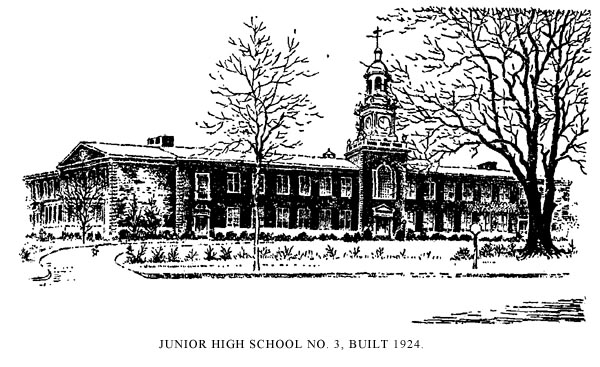
half acres. Then in 1924 followed junior High School No. 3 on a seven‑acre
plot owned by the city on West State Street and Parkside Avenue, and
in 1926 Junior High School No. 4 on a site of eight acres on Dayton
and Grand Streets. Today Trenton is one of a few large cities that
accommodates all of its seventh, eighth and ninth grade pupils in
modern buildings specifically designed for junior school purposes. A site of thirty‑six
acres, on Chambers Street, between Hamilton and Greenwood Avenues,
was purchased in 1922 for the location of a new Senior High School.
There is room also on this site for a future junior school. Plans
for the first units of the new Senior High School are now completed.
Other sites have been purchased for future elementary schools. Never
before in the history of Trenton public schools has so much generous
foresight been exercised and future generations will bless the wisdom
of the present city commission, board of education and superintendent
of schools. A new salary schedule for the
teaching force, adopted by the board in 1925, provides, for the first
time in many years, reasonably adequate remuneration and protects
the Trenton school system from having its best teachers attracted
elsewhere. During the past few years much attention has been given
to a thorough revision of the courses of study for all grades from
kindergarten through the high school. Classroom teachers have been
called upon to contribute their ideas and to assist the superintendent
in this task. The intensive study consequently given by the teachers
to their problems has contributed to better teaching. Trenton's new
courses of study have been widely recognized throughout
the country as an outstanding accomplishment.
Important progress in the evening
schools was made in 1926 when an evening high school was organized
to enable pupils to obtain a diploma equivalent to that granted by
the day high school, on the basis of completing the same number of
courses. Evening high school students now attend five evenings per
week for the entire school year and follow a program leading to a
definite end. Trenton is one of four cities in the State offering
this kind of an opportunity in its evening schools.
SUMMARY,
1850‑1928 From 1850 to 1856 the official
body in charge of public schools was known as "the trustees of
the public schools of the city of Trenton." In 1856 this title
was changed to "the Superintendent and Trustees of the Public
Schools of the City of Trenton." From 1850 to 1892 the superintendent
and trustees were elected by popular vote, the trustees, two from
each ward, and the superintendent by the city as a whole. In 1892
the organization was changed from twenty‑two elected trustees
to eight members appointed by the mayor who was an ex‑officio
member and the board was entitled "the Commissioners of Public
Instruction of the City of Trenton." In 1902 "the Board
of Education of the City of Trenton" became the official title
and in 1911 it appears that the membership of the board was increased
to nine, and the ex‑officio membership of the mayor discontinued.
The superintendent, who in the early days was the chief business and
fiscal officer of the schools, was elected by the board from 1892
to 1902. The office in that sense was abolished in 1903. When in 1910
Dr. Mackey's title was changed from supervising principal to superintendent
of schools, the latter title meant, as it does today, the professionally
trained executive officer of the board. From 1892 the board has elected
a salaried secretary from without its number. Robert C. Belville has
served continuously in this office since 1897. A complete list of the public
school trustees or board members, superintendents and officers 1835‑1912,
may be found in the Report of the Board of Education for 1912. The first woman member of a
Trenton board of education was Hannah L. Longmore, who served 1919
to 1923. The presidents of the board
from 1850 to 1928 have been as follows
Stacy G. Potts 1850‑1851 Benjamin S. Disbrow 1851‑1854 David Naar 1854‑1855, 1861‑1862,
18666‑1868 Roswell Howe 1855‑1856 Charles J. Ihrie 1856‑1859 Andrew Dutcher 1859‑1861 John Woolverton 1862‑1866 Edward H. Stokes 1868‑1870, 1871‑1874 William M. Lenox 1870‑1871 Lewis Parker 1874‑1878 Robert S. Woodruff 1878‑1879, 1895‑1896 Cornelius Shepherd 1879‑1880 Charles Megill I880‑I88I, 1883‑1884 Morris C. Werkheiser 1881‑1882 William H. Mickel 1882‑1883 J. Fletcher Dickson 1884‑1885 Frank H. Lalor 1885‑1886 George W. Macpherson 1886‑1887 Frank O. Briggs 1887‑1888 John A. Campbell 1888‑1890 Charles M. Hattersley 1890‑1891 Leslie C. Pierson 1891‑1893 J. Howard Ronan 1893‑1894 Joseph K. Beans 1894‑1895 Carroll Robbins 1896‑1899 Samuel H. Bullock 1899‑1901, 1918‑1919 Charles W. Howell 1901‑1905 Willard H. Young 1905‑1908 Joseph Stevenson 1908‑1909 John A. Hartpence 1909‑1910 Charles H. English 1910‑1912 Joseph L. Bodine 1912‑1914 Herman C. Mueller 1914‑1918 James S. Messler 1919‑1921, 1928- Hannah L. Longmore I921‑1922 James Hammond 1922‑1923 William G. Wherry 1923‑1926 John P. Dullard 1926‑1928
The following figures from
reports of the Board of Education give a statistical picture of the
growth of the Trenton public school system since 1850:
BUILDINGS
EXPENDITURES
VALUE OF OWNED BY
FOR SCHOOL YEAR BOARD TEACHERS PUPILS MAINTENANCE PROPERTY 1850 1 6 355 $ 7,199 1855 2
10
912
6,213 1860 5 26
1,506 10,627 1865 5 28
1,571 16,894 1870 7 35
2,010 29,266 $
75,000 1875 10 62
2,286 46,840 150,000 1880 11 66
2,436 41,565 130,000 1885 16 78
3,024 63,219 154,000 1890 18
135 5,454
106,022 337,338 1895 21
160 6,351
135,699 478,906 1900 25
204 7,986
207,555 570,589 1905 29
294 11,495 262,699 890,815 1910 31
377 13,380
417,431 1,067,107 1915 31 494 16,667 602,254 1,491,891 1920 32 555 17,764 951,698 2,110,909 1925 33 673 19,943 1,843,084
4,088,535 1928 34 711 20,288 2,209,791
6,092,842
The year 1929 finds Trenton
close to the achievement of a thoroughly adequate and modern public
school system. One who looks back over the century it has taken to
accomplish this is impressed by the devoted efforts of hundreds of
faithful teachers and executives and of scores of public‑spirited
members of official boards. A retrospective glance at the sarne time
reveals the more important background of the picture, an ever‑increasing
stream of young people passing through our schools and out into citizenship
with lives made richer, fuller and more fruitful because of the privileges
of our free public schools.
III. Private and Sectarian Schools
UNTIL the middle of the last century small private schools of varying degrees of proficiency were the principal source of whatever schooling, usually elementary only, that most children received. As the public schools developed the small private school began to disappear, although several excellent ones remain. Over one hundred of these private schools are known, but space will permit the mention of only a few.
BEFORE
1800 The earliest newspaper advertisement
of a school in Trenton was the following: The Subscriber,
hath lately opened a School in Trenton, and teaches the English Grammar,
Reading, grammatically, Writing, Arithmetick, Vulgar and Decimal &c,
agreeable to the newest Rules, and truest Method, practised by the
best Teachers, and approved of by all good judges; and being indefatigably
diligent, he expects Encouragement from all who love the Improvement
of Youth in Virtue and Learning. JOHN REID.
18 The Pennsylvania Gazette, September 13, 1764,
Joseph Toy, who founded the
Methodist society in Trenton in 1771, was here from that year until
1776. He advertised as follows:
The Subscriber
begs Leave to inform his Friends and the Public, that he has opened
a Boarding School in Trenton; it being a healthy pleasant situation,
on a public post Road; where he teaches the English Language grammattically,
Writing, Arithmetic, Bookkeeping, after the Italian Method, Geometry,
Trigonometry, Mensuration, Surveying, Gauging and Navigation. The Advantages
of such an Education are too obvious to need repeating here; and having
himself been educated in that well known School at Burlington, and
taught therein for several Years, hopes himself the better qualified
for that arduous Task. Those who please
to favour him with the Care of their Children, may depend on his exerting
his utmost Abilities to facilitate their Learning, instruct their
Morals, preserve their Health, and, in every Respect, to approve his
Conduct to God and Man.
N.B. Proper Care will be taken
of their Clothes, &c.19
19 The Pennsylvania
Gazette, January 9, 1772.
It is possible that both the
Reid and Toy Schools were conducted in the brick building on the Presbyterian
lot. A gravestone in the pavement
of the First Presbyterian Church reads "To perpetuate the memory and the modest worth
of Mrs. Mary Dunbar, this marble is placed over her grave, a tribute
of the grateful and affectionate remembrance of her pupils, whom
for three successive generations as schoolmistress she had taught
in this city." She died December 9, 1808, aged 76 years. Miss Mary Dagworthy, a sister
of General John Dagworthy, at the time of the Revolution lived and
taught school in the building on South Broad Street later known as
the Eagle Hotel. She afterward became the (second) wife of Abraham
Hunt. The Rev. William Frazer, rector
of St. Michael's Church from 1788‑95, conducted a boarding school
for boys about this time, probably on Pennington Avenue. Among his
pupils was Philip, the son of Alexander Hamilton.
IN
THE EARLY 1800'S About 1800 a Mr. Coles kept
a school on the north side of East State Street. His successor, Joshua
Slack, taught in the same building. There was a Mrs. Hopkins' Boarding
School in Bloomsbury in 1805. Jared D. Fyler kept a "select
school" in a building west of the State House. It was one of
the principal schools of the time and attended by the children of
many distinguished families. Fyler came from the South and was here
about twenty years. He was succeeded by a Mrs. Nottingham in whose
school Dr. F. A. Ewing was a teacher for several years. Dr. Ewing
later conducted a school of his own on Chancery Court. "In October, 1827, the
celebrated Joseph Lancaster established his residence here and opened
a school. In the next year a girls' school was taught by Mrs. Lancaster,"
according to Dr. John Hall. A Mrs. Carr "opened an
Infant School, on the Pestalozzian Method . . . at the corner of Greene
and Market Streets." There was an old building used
as a school for many years on the rear of a lot on Broad Street opposite
Livingston Street. William S. Yard said that it was built before 1776
and that the Mullins, Wellings, Boyers, Collins's and Redmans taught
there. The building was also used for public school purposes in early
days. Mr. and Mrs. Ely's School, later
Mrs. Ely's boarding and day school for young ladies, was conducted
at 95 State .Street in the late 1840's. Hannah and Ann Newbold, daughters
of Joshua Newbold, had a young ladies' boarding and day school in
a one‑story building on what is now the site of the First Methodist
Church. The Mill Hill Academy was a
primary school in the second story of the market building on Market
Street fronting on Broad, before 1841. John Hazard's "select school"
is advertised at several locations over a period of twenty years. In the 1830's there was a school
in the old Masonic Hall on Front Street. Among the teachers were Robert
Pittman, Daniel Z. Wright, Xenophon J. Maynard and Thomas J. Macpherson. The Misses Mary F. and Emmeline
R. Johnston had a boarding and day school at their home in the northern
end of the Old Barracks, then a private house, from 1844‑68. One of the most noted schools
of this period was Roswell Howe's School for Boys. It was in a building
at the rear of a lot opposite the State House, the school itself being
near Quarry Alley. Mr. Howe was a prominent and highly respected citizen,
and a trustee of the public schools 1852‑54. Richard Lilley had a school
on Pennington Avenue in the 1830's and early 1840's. The Trenton Institute for Young
Ladies was on South Stockton Street from approximately 1864 to 1883.
Some of the teachers were Matilda Lewis, Eliza C. Morgan, Clara Bloodgood,
Adriana Bullman and Sallie M. Riley. The building was bought by the
board of education in 1884 and became the Stockton Street School and
later the Administration Building. Other schoolmasters at this
period were William C. Ivins, who had a school on his farm near the
present site of the McKinley Hospital on Brunswick Avenue, and George
Miller, who had a school in several locations and especially on Brunswick
Avenue opposite McKinley Hospital.
THE
PRESENT CENTURY The Bowen School was started
by Ida R., Verde M. and Maude V. Bowen at their home in Trenton Junction
in ioo4 with ten pupils. It was moved
to 214 West State Street in 1913. At present there are 38 pupils.
The courses include primary, intermediate and college preparatory
work. The Ireland Private School,
conducted by Anna M. Ireland, began in igo8 with four children. This
school has grown to number about one hundred pupils in 1928. Its classes
include a kindergarten and the first nine grades and the school is
located at 447 Chestnut Avenue. The Prospect Hill Private School
at 440 Bellevue Avenue was incorporated in 1917, not for profit. It
is a modern cooperative school for children
from the ages of four to sixteen, from kindergarten through the ninth
grade. The present principal is Edna V. Hughes, and the enrolment
about 125 pupils.
QUAKER
SCHOOLS As mentioned above, it is probable
that the Society of Friends made some provision for elementary schooling
in Trenton from the earliest times, but there are no records to prove
it until 1807 when it is stated in the minutes of the Chesterfield
Monthly Meeting that:
There is a school at . . . Trenton,
superintended by a committee of the Preparative Meeting and taught
by members of'the Society.
In 1817 the minutes of the
Trenton Preparative Meeting record that: The following named Friends
are appointed Trustees to Friends' School in this place: Joshua Newbold,
Samuel Coleman, Joseph Decou, Joseph Shirm and Lewis Evans, who are
desired to pay the necessary attention thereto.
Later in the same year this
committee reported that: . . . as there are but very few children that are members
of our society at the school [we] think it is a disadvantage and improper
to keep a school in the Meeting house as this house is much dirted
and the yard and fence much injured.
Occasional references to a
school continue down to about 1842. Doubtless a number of Quaker children
were sent to the Trenton Academy which included among its founders
in 1781 such prominent Friends as Isaac Collins and Stacy Potts. Among
teachers known to have conducted school at the Trenton meeting house
were Robert Pittman, Abel North and Hannah Furman, Jr.
ROMAN
CATHOLIC SCHOOLS The extensive system of Roman Catholic parochial schools
now in Trenton had its beginning in 1854. In that year the Rev. John
P. Mackin established a school in the basement of St. John's Church
which stood on the site of the present Sacred Heart Church. The first
teachers were Anna McCaffrey and a Miss Scanlan. The first male teacher
who was later employed was Peter P. Cantwell. In 1861‑62 a small frame
building for older boys was erected on Cooper Street in the rear of
the church. Teachers in this building, which was used until 1876,
were Peter P. Cantwell, Thomas Kehoe, John Dunphy, John Madden, Mr.
McKeon, John McMahon, Patrick A. Hogan and William Roche. Mr. Hogan
also conducted a night school at his home. The cornerstone of St. John's
School, a large brick building with sixteen rooms and an assembly
hall, on Lamberton Street, was laid in 1874. There was a convent for
the sisters at one end of the building and at the other a home for
the Brothers of the Holy Cross. Classes began in 1876‑77. After
a short period the brothers were succeeded by lay teachers for grown
boys and the following were successively principals: D. J. Wallace,
Reni Rocfort and William J. Connor. The whole work of teaching was
afterwards assumed by the Sisters of Charity. The Lamberton Street
building was abandoned in 1923 when a new St. John's School was built
adjacent to the Sacred Heart Church. The first teaching nuns, who
were of the order of the Sisters of Charity, came to Trenton in 1861,
at the invitation of the Rev. Anthony Smith, to take charge of an
orphan asylum on Broad Street, and to conduct classes for girls in
the basement of St. John's Church. Outstanding among the sisters of
this order, and still affectionately remembered by their pupils, were
Sisters Monica, Veronica and Emiliana. St. Francis' School began in
a frame building on Market Street, built in 1856 by Father Gmeiner
in the rear of the first Catholic Church. The school was at first
in charge of the Sisters of Notre Dame. In 1869 the Sisters of St.
Francis took charge. Meanwhile the church organization was moved to
Front Street to the present St. Francis' Church, which building previously
had belonged to the Methodists. The present St. Francis' School building
on Front Street was erected about 1875. In 1868 the Rev. Anthony Smith
purchased lots on the corner of Bank and Chancery Streets and sometime
later commenced the building of a school. St. Mary's School was first
opened in October 1871 with about 170 pupils under the care of three
Sisters of Charity. At the same time a high school was established
with 40 pupils in connection with St. Mary's School. At first it included
only grades through the ninth. In 1911 a complete four‑year
high school course was adopted and officially approved as meeting
the requirements of the State board of education. In 1921 Bishop Thomas
J. Walsh designated the Cathedral High School as the central Catholic
high school for the diocese. The enrolment in 1928‑29 was 725
pupils, representing twenty‑five parochial schools. General,
classical and commercial courses are offered. St. Joseph's School was built
on Sherman and St. Joe's Avenues in 1882. In 1891 a new school was
erected and the old one became the dwelling of the Sisters of Charity.
The school is now under the care of the Sisters of Mercy. The first school in the Immaculate
Conception Parish was a college for young men preparing to join the
Franciscan Order, which was built in 1875 on Chestnut Avenue. In the
same year a parish school was opened in the basement of the convent
and was continued there until i88o when a new school was built. Additions
were built in 1897 and new buildings in i9o6 and 1921. The Sisters
of St. Francis are in charge. The old college building was replaced
by a modern brick building in 1898. A high school was established
in this parish in 1921 and its courses were extended to meet the requirements
of the State board of education in 1925. The enrolment in 1928‑29
was 243 pupils. The following parishes, treated
more fully in a section of Chapter VIII on the Roman Catholic churches
by John J. Cleary, also maintain parochial schools: St. Mary's Greek
Catholic, St. Stanislaus', Holy Cross, SS. Peter and Paul, St. Joachim's,
St. Hedwig's, St. Stephen's, Blessed Sacrament and St. James'. Altogether the Roman Catholic
parochial schools of Trenton have about 9,000 pupils.
THE
GERMAN LUTHERAN SCHOOL The German Evangelical Trinity
Lutheran Church has at various times conducted a school mostly in
elementary subjects including both German and English. The first school
was opened in the old church building in May 1849 and taught by the
pastor, the Rev. Christian K. A. Brandt. In 1863 additional land,
fronting on Cooper Street and in the rear of the church, was acquired
and two years later a small school building was erected. From 1868
to 1884 and from 1889 to 1893 Carl F. Lebtien was the teacher in charge. In 1896 the pastor, the Rev.
Hugo R. Wendel, aroused new interest in the school and in the following
year the old building was torn down and replaced by a new one accommodating
200 pupils. The congregation, however, found the school a heavy financial
burden and many parents preferred to send their children to the public
schools. In 1899 the building was rented to the city board of education
and used as an annex' to the public school system until 1926.
THE
HEBREW SCHOOL In the late 1890's or early
1900's a school called the Talmud-Torah was organized, and sessions
were held on the second floor of the Lavine Department Store on Union
Street. The attendance reached 180 and at times there were three
instructors. When larger quarters were sought
the Congregation of the Brothers of Israel became interested and decided
to sponsor a movement for the erection of a school building. In 1904
a lot was purchased opposite the synagogue on Union Street, and a
school building erected. This school flourished for a time and then
waned. The building was sold to the board of education and used as
an annex to the Parker School. A frame dwelling, near the
center of the Jewish community, was then acquired at 49 Union Street
and the Hebrew school moved there. It was found that the school regained
some of its attendance in the new location but that larger accommodations
and wider backing were necessary. Funds were raised, a new group
took over the property from the Brothers of Israel and the building
was considerably enlarged. This new school was opened formally in
October 1926. The school is in session from 4 to 8 p.m. on week‑days
and from 10 to 12 a.m. on Sundays. The Hebrew language, traditions
and precepts are taught. The outstanding figure in the movement for
this school was Rabbi Isaac Bunin, and the institution is named the
Dr. Theodor Herzl's Zion Hebrew School. IV. Other Schools
NEW JERSEY'S first Normal School, authorized by an
Act of the Legislature in 1855, was opened in Trenton in the same
year.20
20 This was a period of educational
renaissance throughout the State, and among Trenton leaders were David
Cole, principal of the Trenton Academy, and David Naar, editor of
the True American. For further reference to
David Cole, see p. 712. Of David Naar, John Bodine Thompson writes
as follows in Murray's History of Education
in New Jersey: "The acknowledged leader of the most powerful
political party of the State, he used all the weight of both his political
and personal influence to forward the educational movements of the
day. Naturally a ready and popular speaker, he possessed a remarkable
talent for foreseeing the ultimate as well as the immediate effect
of public measures. Hence he threw himself with all his energy into
the effort to provide for the future of the Republic by the education
of the people. He was for many years an active member of the school
board of the city of Trenton, where his counsels were as wise as they
were in the conclaves of his political party. Rising high above all
selfish considerations, it was owing more to his influence than to
that of any other one man that educational affairs in New Jersey were
kept entirely aloof from the corrupting influences of party politics,
and that the board of trustees of the Normal School and the State
Board of Education were thoroughly nonpartisan so long as he lived."
See also p. 786, below.
There were then less than a
dozen normal schools in the United States. The Act provided for a
board of trustees, one of whom was David Cole of Trenton, who were
authorized to seek proposals for grounds and buildings throughout
the State. The trustees decided upon Trenton as the place for the
new school, both because of its convenient location and because a
group of public‑spirited citizens of Trenton raised funds for
the first building. This building on North Clinton Avenue, still in
use, cost $17,000 and was erected on land leased from William P. Sherman.
THE
STATE NORMAL SCHOOL BEGINS FIRST TERM, 1855 The first term of the State
Normal School at Trenton began October 1, 1855, in the Trenton City
Hall. The next week the school moved to temporary accommodations in
a building owned by Dr. John McKelway on the corner of Hanover and
Stockton Streets. The second term began March 17, 1856, in the new
school building. At the same time in the new building a "model"
or "pattern" school was opened so that Normal School
students might have the
opportunity of observing the "model" practices in teaching
and school management. At the end of the first year there were 43
students in the Normal School and 125 pupils in the Model School.
In 1857 a group of citizens purchased an adjacent lot and erected
a separate building for the Model School. The total cost of land and
building was $30,000. In 1865 the Legislature appropriated $38,000
for the purchase of both properties which had cost an association
of Trenton citizens over $50,000. The Boarding Hall, opened in
1865, was due also. to the enterprise of private citizens, and in
1867 it was purchased by the State for $32,080. The Boys' Hall was
erected in 1873, and in 1890 an additional building, containing the
auditorium and connecting the Normal and Model school buildings. The
gymnasium was built in 1893 and other additions in 1904 and 1914. The principals have been: William
F. Phelps, 1855‑65 ; John S. Hart, 1865‑71; Lewis M. Johnson,
1871‑76; Washington Hasbrouck, 1876‑89; James M. Green,
1889‑I9I7; Jerohn J. Savitz, 1917‑23 ; Don C. Bliss, 1923
to date. The Trenton Normal School has made a profoundly important
contribution to the cause of public education in New Jersey, and the
long succession of capable educators comprising its faculty has added
much to the enrichment of Trenton's intellectual life. The Model School was for many
years an important elementary, secondary and preparatory school.
Hundreds of Trentonians have profited by its excellent teaching.
Its students were always charged fees, sufficient in total to pay
the running expenses of the school, making it to that extent a private
school. It was discontinued in 1917 and a public practice school,
including kindergarten and the first six grades, established in its
place. There were 709 students in
the Normal School and 232 pupils in the training school in 1928. During
its history the Normal School has graduated over 9,100 students. In 1891 the management of the
Normal School was transferred from a board of trustees to the State
board of education, while in 1926 the control was given to the commissioner
of education, subject to the State board's approval of general plans
and policies. There is no charge for tuition
to those students who agree to teach at least two years in New Jersey.
The general program of study has been a two‑year course. Besides
training teachers for general elementary schools, courses have been
offered in recent years to prepare teachers in the special fields
of commercial work, manual training, health and physical education
and music. In 1925 the Normal School was
empowered to grant the degree of B.S. in Education on the successful
completion of the four‑year course then offered. After September
1929 all Students preparing to teach in elementary schools will be
required to take a three‑year course, those preparing for junior
or senior high school work, a four‑year course. In 1929 the title of the school
was changed to the "State Teachers' College and State Normal
School at Trenton." A new site of about one hundred
acres on the Pennington Road at Hillwood Lakes was purchased for this
school by the State in 1928. The erection of new buildings will shortly
be begun, and the old site and buildings ultimately abandoned.
THE
SCHOOL FOR THE DEAF New Jersey's school for the
deaf was the result of an Act of the Legislature in 1882. The school
was opened October 16, 1883, in the buildings on Hamilton Avenue,
between Chestnut Avenue and Division Street, which had been built
by the State at the close of the Civil War and occupied by the Soldiers'
Children's Home. From 1821 until 1883 the State had made provision
for the education of the deaf children by appropriations enabling
them to be sent to institutions in other States. The school was first
called "The New Jersey Institution for the Deaf and Dumb of New
Jersey." In 1884 this title was changed to "The New Jersey
School for Deaf Mutes" and in 1903 to "The New Jersey School
for the Deaf." From its establishment until
1891
the school was administered
by a board of trustees of eleven members, including the governor,
the comptroller and the superintendent .of public instruction. This
board was abolished in 1891 and the school was placed under the control
of the State board of education, making it a part of the public school
system of the State‑a boarding school for deaf residents between
the ages of six and twenty‑one. From time to time the State
made improvements and additions to the buildings, but as they became
increasingly inadequate it was decided to build anew. By an appropriation
in 1917 the board was enabled to buy a tract of one hundred acres
on Sullivan Way, near Trenton Junction. Subsequent appropriations
permitted the erection of the handsome group of buildings now occupied.
Those for the primary department were completed in 1923 and those
for older pupils in 1926. The Hamilton Avenue property was then abandoned. The new school plant is the
most modern and best‑equipped school for the deaf in the United
States. The pupils are at once taught speech and lip reading and all
communication in the classroom is oral. In the industrial department
the pupils have the opportunity of learning the fundamentals of a
trade. Every effort is made to train the deaf children of the State
to become intelligent self‑supporting citizens. The pupils have
increased from 90 in 1882 to 315 in 1928. The superintendents of the
school have been Weston Jenkins, 1883‑99; John P. Walker, 1899‑1916;
Walter Kilpatrick, 1916-17; Alvin E. Pope, 1917 to date. The old stone house now used
as the superintendent's residence was once the home of the Rev. Eli
F. Cooley, pastor of the Ewing Presbyterian Church, through whose
efforts the State in 1821 made its first appropriation for the education
of the deaf.
THE
SCHOOL OF INDUSTRIAL ARTS The School of Industrial Arts
grew out of the Evening Drawing School conducted on North Broad Street
(Bergen Building) by the commissioners of public instruction, as
the school board of that time was called. The Evening Drawing School
was established November 3, 1890, under the direction of Joseph Crampton, an earnest and
skilful teacher whose "interest was unremitting and not confined
to stated hours of service." Over a period
of ten years Charles E. Roberts, counsellor‑at-law, who had
been a teacher in the evening schools, kept before the public the
need for establishing an art school in Trenton and finally, as a result
of his efforts, Mayor Welling G. Sickel in 1897 appointed a public
committee to consider the matter. This committee in reporting on January
3, 1898, called attention to the Evening Drawing School under Mr.
Crampton and also to a State law on industrial education passed in
1881. This law provided that when a school board appropriated, or
private citizens donated, money for industrial education, the State
would supplement the fund by an equal amount up to $5,000 in one year.
The school having expended $883.60 on the Evening Drawing School,
it was believed that an equal amount could be obtained from the State.
The law provided also that the school board could associate with itself
in the administration of such a fund and such a school a number of
persons not exceeding ten representing the donors. The committee
recommended that the school commissioners, having in fact a school
of industrial arts already, should take action based on this law.
This recommendation, after further conferences, was followed. The
Evening Drawing School became "The Trenton School of Technical
Science and Art" and was formally opened as such April 4, 1898.
Charles F. Binns, a ceramist of long training and experience, was
the first principal. The school commissioners created an advisory
board consisting of Walter S. Lenox, G. D. W. Vroom, John A. Campbell
and Frank O. Briggs. The school was continued for the rest of the
school year in the same quarters. On September 12 it was reopened
in the old Trenton Academy building, which the board rented for the
purpose. There were classes both afternoon and evening. Later in the
same year Archibald Maddock, Charles E. Roberts, Edward C. Stover,
Welling G. Sickel and Dr. Thomas H. Mackenzie were added to the advisory
board of which Mr. Campbell was elected chairman. Mr. Binns resigned
in 1900 and was succeeded as principal by John Ward Stimson who in
turn was succeeded in 1901 by Henry McBride. Mr. McBride was designated
"director" and he served in that capacity until 1906. During the year 1901‑02 the school was conducted
in the Union Library Building and then it was moved to 219 East State Street. On December 12, 1901, the name
was changed to "The School of Industrial Arts." In 1903 the control of the
school was transferred from the board of education to a board of trustees
appointed by the governor. Frank Forrest Frederick, the present director
of the school, was appointed in 1906, and during his administration
the enrolment and scope of the school have been considerably increased. Henry C. Kelsey, who for many
years was secretary of state in New Jersey, had for some time observed
the work of the school and in agog he offered to erect a suitable
building for the art school in memory of his wife, Prudence Townsend
Kelsey. Needless to say, his offer was accepted by the trustees with
the enthusiastic approval of the city. A site was acquired on the
southwest corner of West State and Willow Streets and the present
building was erected in 1910 at a total cost of $142,000, all of which
was borne by Mr. Kelsey. Cass Gilbert was the architect. In March
1911 the school moved into its new quarters which have ever since
been a matter of pride to the city. In 1919 by appropriation from
the city commission the trustees acquired a lot on Quarry Street
and built a shop building, permitting a further extension of this
kind of work. Considerable addition was made to the shop building
in 1924. In 1912 a "day technical
course" was added to the curriculum. The school continues to operate
under the Act of 1881 and subsequent amendments. The official title
of the governing body is the "Board of Trustees of Schools for
Industrial Education of the City of Trenton," which on January
1, 1929, consisted of Frank S. Katzenbach, Jr. (president), John A.
Campbell, Thomas F. Riley, John S. Broughton, J. Osborne Hunt, Herman
C. Mueller and Albert E. Schoeller. Robert C. Belville is secretary.
The faculty at present consists of the director, 10 fulltime and
44 part‑time instructors. The appropriation for 1928 was $44,100
from the city and $30,000 from the State. There were 1,442 students
on January 1, 1929, about four‑fifths of whom are enrolled in
evening classes. Altogether over 15,000 persons have availed themselves
of the privileges of this school during its existence. As the current catalog states,
The School offers day and evening
courses in fine art, industrial art or fine art applied to industries,
in several of the art‑crafts, in dressmaking and millinery,
and for the training of artisans in clay, wood and metal. It offers,
in evening classes, to men and boys employed during the day, vocational
courses for the machine, building, automobile, electrical and ceramic
trades; and, in day classes, courses for boys who wish to fit themselves
for careers in the industries. In addition, it conducts classes for
teachers and for children on Saturday mornings.
RIDER
COLLEGE For over a half century Trenton
has had the good fortune to have one or more excellent schools giving
training for commercial work, formerly known as "business colleges." The first of such schools was
established 1865, in Temperance Hall, by Bryant and Stratton, a firm
that had similar schools in several other cities. The next year Andrew
J. Rider, then of Newark, was placed in charge, and the location changed
to 20‑22 East State Street. Shortly
afterward Mr. Rider
and Joseph A. Beecher acquired ownership,
Mr. Rider continuing as principal until 1873. Mr. Beecher then sold
his interest to William B. Allen. At this period the school was called
the Capital City Commercial College. In 1878 Mr. Rider acquired full
control and returned to the active management of the school. It was
incorporated in July 1893 and was then generally known as the Rider
Business College. For a time it was located in the former Masonic
Temple on the corner of State and Warren Streets, and later in the
Ribsam Building on the corner of Broad and Front Streets. In 1898
Mr. Rider sold his interests to Franklin B. Moore and the school took
the name of Rider‑Moore Business College. The Stewart and Hammond Business
College was organized in 1883 by Thomas J. Stewart and William P.
Hammond. Two years later Mr. Stewart became the sole owner and principal,
and the name of the school was afterward changed to the Stewart Business
College and School of Shorthand and Typewriting. Its location for
many years was 10 South Broad Street. In 1901 Mr. Stewart sold his
interests to John E. Gill. In the same year, 1901, Messrs.
Moore and Gill decided to consolidate
the two schools under the name Rider‑Moore and Stewart Schools
of Business. In 1920 the owners built a large and well‑equipped
school building on the corner of East State and Carroll Streets, and
the school took the name Rider College. At the same time the curriculum
was considerably improved and extended. In 1922 the State board of
education granted Rider College permission to confer the degrees of
Bachelor of Accounts and Bachelor of Commercial Science, and in 1927
the State board permitted the conferring of Masters' degrees in the
same subjects for postgraduate work. In addition to general business
training Rider College gives courses leading to the Bachelor degree
in accountancy, business administration, secretarial science and
commercial teacher training. The enrolment for 1928 was 1,938 students,
representing 34 States and 11 countries. Franklin B. Moore is president
and John E. Gill vice-president and dean.
V. Public Libraries
THE modern free public library,
owned by the municipality and supported out of taxation, is largely
a development of the last fifty years. The beginning of the public
library, however, may be traced back to Benjamin Franklin, who relates
in his of the famous Junto Club, the
members of which for a time clubbed their books in a common library.
In 1731 Franklin drew up proposals for a subscription
library and procured fifty subscribers at an initial subscription
of forty shillings each and ten shillings per year thereafter. Thus
was founded the Library Company of Philadelphia, which, Franklin goes
on to say, "was the mother of all the North American subscription
libraries, now so numerous." It was a "public" library
in a sense. Any one of proven respectability was eligible to acquire
a share of stock and become a subscriber. Further more, the librarian
was, by the rules, allowed to permit "any civil gentleman to
peruse the books of the library in the library room, but not to lend
to or suffer to be taken out of the library by any person who is not
a subscribing member, any of said books." Thus in a limited way
the Philadelphia Library became a public reading‑room.
TRENTON
LIBRARY COMPANY FOUNDED IN 1750 One of the earliest known children
of this mother library was the Trenton Library Company founded in
1750 by Dr. Thomas Cadwalader, who gave f500 for that purpose. Dr.
Cadwalader had been one of the original incorporators of the Philadelphia
Library and one of its directors at intervals from 1731 to 1774. From
1743 to 1750 he lived in Trenton, serving as chief burgess under the
royal charter of that period. His gift appears to have been made shortly
before he returned to reside again in his native city of Philadelphia.
Through this benevolence Trenton has the honor of the first "public"
library in New Jersey. We have little record of the
Trenton Library Company, its rules and form of organization, until
its reorganization in 1797, although we may presume it was a stock
company following rather closely the scheme of the Philadelphia Library
Company. It is likely that each subscribing member bought one or more
shares of stock and paid a stated annual amount toward upkeep. The
books were probably housed in a rented room which was opened at certain
hours once or twice a week. Notices published in the Pennsylvania
Journal and the Pennsylvania
Gazette indicate that an annual meeting of the members was held
the second Monday of April for the election of directors and a treasurer
and the transaction of business. A few of these newspaper notices
follow.
Trenton, March 27, 1759. MOORE FURMAN, Secretary 21
21
Pennsylvania Journal, March 29, 1759.
Ten of the Clock in the Forenoon, in order to make their Eleventh Annual Payment, chuse Directors and Treasurer, and settle the Company's Accounts. By Order of the Directors. SAMUEL TUCKER, junior, Secretary.22
22
Pennsylvania Gazette, March 12, 1761.
Trenton, May 13, 1765.
Whereas several of the Members
of the Trenton Library Company have been deficient in making their
annual Payments, which is very prejudicial to the Growth of so valuable
an Institution; the said Delinquents are hereby earnestly requested
to discharge their Arrearages by the first Day of July next, otherwise
the Directors will proceed to make Sale of their respective Shares
to discharge the same, agreeable to the Articles. And any of the Members,
or others, who have either of the following Books belonging to the
said Library, viz., Oldmixon's History of England; first Volume of
Granville's Works; Pomfret's Poems; Trail of the Witnesses; first
Volume Independent Whig; several Volumes Plutarch's Lives; Presbyterian
Loyalty; third Volume Pope's Works; Life of the Dutchess of Marlborough;
second Volume Rambler; Harvey's Meditations, both Volumes; Mundrell's
Travels; or any other of said Books, which have been out longer than
their respective limited times, are desired to return them to the
Librarian as soon as possible, or they may expect to be proceeded
against. Signed, by Order of the Directors, by Stacy Potts, Secretary
and Librarian. 23
23
ibid., May 23, 1765. Trenton, April 7, 1766.
The Members of the Trenton Library
Company are desired to meet at the House of Isaac Yard, in Trenton,
on the 14th Day of this instant April, at Two o'clock in the Afternoon,
to choose a Treasurer and Directors, and make their Sixteenth Annual
Payment, agreeable to their Articles. And as it is expected the Company
will order the Shares of the Delinquents to be disposed of, the Members
are requested generally to attend. Per Order, STAGY POTTS, Secretary 24
24
ibid., April l0, 1766.
Samuel Smith's History of
New Jersey, in enumerating
some of the merits of Trenton in 1765, says that "the inhabitants
have a public library." The Revolution then came and
with it disaster. The library seems to have been almost wholly destroyed
by the British in December 1776. Force's American
Archives states, under date of December 31, 1776, that the enemy
"have degraded themselves beyond the power of language to express
by wantonly destroying," among other things, "an elegant
public library at Trenton." Some of the books survived, probably
those that happened to be out of the library at the time of the ravages.
There are no records of any activity in the Trenton Library Company
during the next few years, but as the successful culmination of the Revolution loomed ahead, efforts were
apparently made, as the following notices indicate, to revive this
worthy institution.
The Members of the Trenton Library
Company are desired to meet at the House of Renssalaer Williams, Esquire,
in Trenton, on Monday the fifteenth Day of this Instant, at two o'clock
in the afternoon. January 3, 1781.25
25 New Jersey State Gazette, Vol. IV, January 3, 1781.
Trenton, State of New‑Jersey,
Jan. 31, 1781.
R. WILLIAMS, Libr.
26 ibid., Vol. IV, January 31, 1781.
We have no further record until
1797, except that, at the annual meeting of the company in 1796,
a committee was appointed to collect the amendments that had previously
been made to the constitution. In 1797, at a meeting of the members
held at Drake's Tavern, an effective reorganization is indicated by
the survival of a quaint old pamphlet entitled "Laws and Regulations
of the Trenton Library Company agreed to by the Said Company on the
First Monday in May, 1797." The pamphlet was printed in Trenton
in 1798 by Matthias Day. One copy is preserved in the Trenton Free
Public Library and another in the library of the Historical Society
of Pennsylvania. In addition to the "laws and regulations"
the pamphlet contains the "rules made by the Directors . . .
on the second Monday in May, 1797, respecting the Attendance on the
Library and the lending and hire of Books," a list of the proprietors
at the time and a catalogue of the books in the Library. According to the "Laws
and Regulations" any person approved by the directors might
become a member or proprietor by paying the value of a share. A member
might have "as many shares as he may think proper" but he
was entitled to only one vote. Every member was required to pay one
dollar per year for each share that he held and penalties were provided
for being in arrears. A member two years in default forfeited his
stock and "shall be considered no longer a member." An
annual election was to be held on the second
Monday in May, and the officers to be chosen were a "Treasurer
and five other members to be Directors for the year ensuing."
The directors were required to "meet at least once in two months"
to attend to the routine business of the company, including the choosing
of books for the library. "The said Directors shall also, from
time to time, when necessary, appoint a Secretary and Librarian, and
such other officers and servants as they may find necessary, with
such wages and allowances as they may think adequate to their services." The "rules" numbered
ten and a quotation of some of them will show the library practice
of that time.
RULE 1 27 The Librarian to give attendance
at the Library Room Wednesdays and Saturdays, every week, from eleven
till one o'clock, on said days; to keep a book, ruled column‑wise,
in which is to be entered the name of the person borrowing, the title
of the book, the number, the time for which the book is lent, the
day when to be returned, the sums received for the hire of books,
and the forfeitures arising from defaults.
27 The actual record of books issued
as required by the above rule, covering the period November 12, 1831,
to April 25, 1855, is now in the possession of the Free Public Library.
RULE 2 No borrower to be entitled to
more than one book at one time, to be returned, if a folio, in four
weeks, a quarto, in three weeks, octavo, and others of a smaller size,
in two weeks, unless the borrower be a member living upwards of one
mile from the Library, in which case he may retain any of the books
four weeks, without being subject to a penalty; and no borrower shall
be at liberty to take out the same book a second time, if application
has been made to the Librarian by any other person before the return
thereof.
RULE 5 Every borrower, not being a
member of the company, shall deposit with the Librarian double the
sum marked in the catalogue, against the book he borrows, as a security
for returning the book without damage, within the limited time for
books of that size, and paying the hire thereof, and shall pay one
shilling per week for folios, and six‑pence per week for books
of a smaller size, for the benefit of the Library.
The list of the proprietors
or stockholders includes so many of the prominent Trentonians of that
period that it is reprinted herewith:
Abraham Hunt Isaac Collins Philemon Dickinson Lambert Cadwalader Ephraim Olden Aaron Howell Aaron D. Woodruff Richard Howell Aaron Dunham George Anderson Pontius D. Stelle
Willis Pearson Archibald W. Yard James Mott Nathan Combes Rebecca Frazer Joseph Milnor Benjamin Smith Peter Gordon Benoni Waterman Matthias Day Alexander Chambers, jun. Nicholas Belleville
Joseph Brearly Nathan Beakes William Green Israel Carle John Beatty William Tindall Samuel Moore, jun. James F. Armstrong Isaac Smith John Chambers Moore Furman John Potts John Rickey James Ewing William Smith Philemon Hunt John Allison William S. Moore Samuel Leake Robert Pearson Maskell Ewing Abraham G. Claypoole Jacob Benjamin Jonathan Doan James B. Machett Richard Throckmorton Bernard Hanlon Thomas M. Potter John Vandegrift John C. Hummel Lucius H. Stockton Randle Rickey Mary and Sarah
Barnes
John E. Spencer Joseph Brumley Lewis Evans John Rutherford
The "Catalogue of Books"
is naturally of interest as indicative of the tastes and available
literature of the day. The titles are listed according to size. There
were 2 folios, 6 quartos, 94 octavos and 140 duodecimos. One of the
folios, History of Edward III, presented by Maskell
Ewing, may still be examined, though in a much crumbled condition,
in the present Free Public Library, as well as about thirty others
of the actual volumes listed in this catalogue. The quaint bookplates
identify the respective volumes in accordance with the numbers assigned
by the catalogue. The selection of books was
of a high order of excellence and of wide variety, and some comment
thereon may be worthy of inclusion. The fare for the novel‑reader
was scant but hearty. It must be remembered that in 1797 the English
novel was in its infancy. Most of the fathers of the art now so prolific
were then still living or but lately passed away. Samuel Richardson,
the first of English novelists, is represented by Pamela
in four volumes, Clarissa
Harlowe in eight volumes, and Sir
Charles Grandison in seven volumes. Henry Fielding's offering
was Tom Jones. Tobias Smollett
was represented by Roderick Random, Peregrine Pickle and Humphrey Clinker; and Laurence Sterne by his Works in seven volumes. Sterne's imitator, now long forgotten, Henry
Mackenzie, was credited with The
Man of Feeling, The Man of the World and Julia de Roubigne. The Vicar of Wakefield by Oliver Goldsmith is listed.
It had then proved itself a classic by thirty years of existence and
it has continued to be read by each successive generation. Other novels
are Evelina, Cecilia and Camilla by Fanny Burney
(Madame D'Arblay) ; The Monk
by Matthew Gregory Lewis; Romance
of the Forest and The Italian,
thrillers by Mrs. Anne Radcliffe. Translated from other languages
are Don Quixote by Cervantes, Gil Blas by Le Sage and Telemachus by Fenelon. Among the poets
are found Ossian, Milton, Prior, Young, Pope, Cowper and Burns, the
latter two then contemporary. The liberal mindedness of the directors
is shown by the inclusion of William Godwin's Political
Justice and Tom Paine's Works.
There was apparently no censoring of radicals. Dr. Samuel Johnson,
who died in 1784, is represented by The
Adventurer, The Rambler, Journey to Scotland, Journal of a Tour to
the Hebrides and Lives of the English Poets, while Boswell's
Life of the great doctor,
then a comparatively new book, was available. Periodicals include
four volumes of The Tatler,
eight volumes of The Spectator, three volumes of Gentleman's Magazine, thirteen volumes
of The Monthly Review and
three volumes of The Mirror.
Travel is numerously represented, likewise history, including
Hume and Gibbon. Among practical books are found Clarks's
Farriery, Peters's Agriculture, Logan's Agriculture and Gallatin on Finance. There are plays, essays, biography, a few sermons
and other religious works. Among perennial masterpieces are Lady
Montagu's Letters; Adam
Smith's Wealth of Nations, a new book in 1776;
and The Federalist, first
published in book form in 1788. Each entry in
the catalogue includes the value of the book. Smith's History of New Jersey, of course in the first edition, is given a
value of $1.33. The collector who aspires to own this rare volume
today must be willing to pay at least $60.00 for the privilege. The
last title in the catalogue, "Crawford's Poems, presented by
the Author" is appraised, perhaps generously, at 25 cents. Of
greater value was Sermons to Asses, presented by Randle Rickey and valued at 66 cents. Another catalogue of the Trenton Library Company was
printed in 1804. 28 The number of volumes had now grown to seven hundred and they were
classified not according to size but by subject, in ten classes.
28 Murray, History
of Education in New Jersey.
Another similar catalogue was
issued in 1819, a copy of which is in the library of the American
Philosophical Society. On February 17, 1813, a number
of the stockholders petitioned the Legislature for permission to
erect a house on a part of the government lot 29 to be used as a library room. The building was not to exceed twenty
by thirty feet. Permission was granted, the House approving it on
the I9th and the Council on the 20th, but there is no evidence that
such a house was ever erected. The library doubtless continued to
be accommodated in a rented room.
29 The "government lot"
meant the grounds and site of the governor's mansion on West State
Street. The mansion is now the front part of the Hotel Sterling.
It would appear that the Trenton
Library Company continued to be active down into the 1830's and then
entered into a period of decline. At the annual meeting of the stockholders
in 1832 the matter of the sale of the library was discussed but no
action taken at the time. The previously mentioned extant record of
books issued from November 12, 1831, to April 25, 1855, shows diminishing
activity. In 1832, 717 books were issued; in 1837, 159 ; in 1842,
109 ; in 1847, 25 ; in 1852, 17. Apparently the active proprietors
of the flourishing days had died and no "new blood" filled
their places. New leaders arose in the community who deemed it better
to start a new organization to meet the reading needs of the day.
On May 20, 1855, after more than a century of service, the Trenton
Library Company wrote finis to its long and honorable career by transferring
its books to the recently organized Trenton Library Association.
THE
CHRISTIAN CIRCULATING LIBRARY In May 1811, Daniel Fenton,
bookseller and publisher, established at his home and place of business
in Mill Hill, the Christian Circulating Library. The following month
he moved to South Warren Street nearly opposite the Trenton Bank.
This Library at first consisted of religious books. It did not prosper
and Fenton increased its scope by adding secular literature. "It
is natural to suppose," his advertisement states, "that
the subscriber has a view to private interest in the line of his
business; but with this is truly combined a wish to improve young minds by giving an opportunity to
cultivate a taste for useful and general reading." He regrets
that not "every paragraph or part of a book can pass the inspection
of the conductor" but he promises that "no book shall be
put in circulation which shall not more or less have the apparent
tendency to promote the great object of religion, virtue and morality."
Still the Library did not prosper, and Fenton announced in March 1812
that he must either give up the project or raise the dues to subscribers
from $3.00 to $4.00 per year and increase the number of patrons to
one hundred, ministers being on the free list. Books were given out
Tuesdays, Thursdays and Saturdays. In December 1812 he announced additions
to the shelves. There is no later mention of the Christian Circulating
Library.
THE
APPRENTICES’ LIBRARY COMPANY The Apprentices' Library Company
was established in 1821, the opening exercises having been held on
the evening of December 31. The library was benevolently intended
for the young working men of the day, and one may infer that they
did not patronize the older Trenton Library Company, which must have
served principally the genteel and elite. Perhaps the organization
of the Apprentices' Library Company of Trenton was inspired by the
Apprentices' Library Company of Philadelphia, which was founded a
year earlier, in 1820, and is still in active operation. The first annual meeting of
the Apprentices' Library Company was held April 20, 1822. A few interesting
extracts from the report 30 which
was there presented are as follows:
30
Given in Raum's History of Trenton,
p. 226.
The board of managers of said
company respectfully report . . . that, on the evening of the 31st
of December, at the request of the board, and agree ably to public
notice, Charles Ewing, Esq., president of the society, delivered,
in the Presbyterian meeting‑house, to a numerous and attentive
audience, an appropriate and eloquent
address on the utility and importance of this and similar institutions.
31
31 Mr. Ewing in 1824 became chief justice of the Supreme
Court of New Jersey and this address here mentioned, has survived
in manuscript form and is preserved in the Free Public Library.
That, on the evening of the
1st of January, the library was for the first time opened, when thirty‑five
volumes were taken out by apprentices and other young persons. That, from a report of the librarian
to your board, it appears that the number of volumes taken out each
week, since the opening of the library, has been, on an average, about
seventy‑five, ninety‑three being the highest number in
any one week, and fifty‑five the lowest. From the same report, it appears
that the whole amount of fines incurred, for the detention of books
beyond the time allowed in the by‑laws, is but one dollar and
seven cents, of which all but fifteen cents have been paid; that all
the books borrowed (except two taken out two weeks ago, and those
taken out on Saturday evening last, all of which will he returned,
probably, this evening), have been returned, and all in good order. These facts are highly honorable
to our youth, and encouraging to this society. They prove that they
properly estimate our motives, and set a just value on this institution,
while they are a pledge to us that our continued and increased exertions
to place useful knowledge within their reach will not be in vain. Let it be further observed,
to their credit, that the library, from which they draw seventy‑five
volumes weekly, contains no novels, romances, or plays, which are
so apt to captivate juvenile imaginations, but is composed of works
of more sterling value and lasting usefulness‑on religion, morality,
and science, history, biography, travels, voyages, etc . . . . On the whole, the board offer
their cordial congratulations to the society on the experiment made
and the prospect presented, and earnestly hope that none who have
lent their aid to so good a work will become weary of well doing.
In December 1828, according
to a notice in the Trenton Federalist,
the Apprentices' Library was "placed in the hands of the
`Trenton Literary Society,' " and opened for the loaning of books,
"under the like guarantees as formerly," at the Trenton
Academy. Much later notices appear in the State
Gazette in April 1845 when "persons having books in their
possession belonging to the `Apprentices' Library' are requested
to return them immediately to the subscriber" who was B. S. Disbrow.
It was "proposed to place the Library in charge of a Society
recently organized, under whose direction, the books may be made useful
to a large portion of our citizens." When the Apprentices' Library
finally ceased operations, the books, according to Raum, continued
for many years in the possession of the librarian, Samuel Evans. They
were finally placed in the custody of the Y.M.C.A., along with the
books of several other defunct libraries.
THE
TRENTON LIBRARY ASSOCIATION The next "public"
library came about in 1852 in the organization of the Trenton Library
Association. It was first opened in the corner store of Temperance
Hall (now Goldberg's) and in the following year was moved to the second
story of Charles Scott's new building on Greene (Broad) Street, just
below State Street. A "Catalogue of the Trenton Library Association
with their rules and regulations" printed in 1853, as well as
many of the volumes listed therein, are in the present Free Public
Library. Some of the volumes continue in active circulation. The book
selection was of surprising excellence and totaled over 1,500 volumes.
The classification headings were Agriculture and Horticulture; Biography;
History; Travels, Voyages and Geography; Polite Literature; Speculative
and Political Philosophy; Physical Science; Natural History; Fiction;
Miscellaneous. In the fiction list we find represented Thackeray,
Dickens, D'Israeli, Cooper, Lever, Hawthorne, Kingsley, Borrow, Melville,
Marryat and Bronte. Harriet Beecher Stowe's recently published Uncle Tom's Cabin is
also listed. From the "Rules and Regulations"
one learns that
The Library and Reading Room
shall be open four times a week, on Tuesday, Thursday and Saturday
evenings, from 7 to 9 o'clock, and on Thursday afternoons, from 3
to 4 o'clock. Stockholders shall pay $1.50 annually, in half yearly
payments, in advance. Responsible persons, not stockholders,
shall be entitled to the use of the Library, whenever open, and to
take to their own houses, subject to the prescribed regulations‑one
octavo, or two duodecimo volumes at a time, on paying in advance fifty
cents every three months. And those under eighteen years of age, may
take out one book at a time, on their depositing with the Librarian,
sufficient security for the return thereof, in good condition; or
on presenting a written guarantee from a stockholder of this Association,
for the safe and proper return thereof.
Folios and quartos were issued
for four weeks, octavos and books of less size for two weeks with
privilege of renewal, unless requested by another stockholder or subscriber
or unless the book was a recent addition that had been in the library
less than two months. Overdue fines were three cents per day for folios
and quartos, two cents per day for octavos and smaller volumes. On
books overdue more than a week the above fines were doubled. In 1855 the directors of the Trenton Library Association
reported that there were 79 stockholders and 51 annual subscribers,
an annual revenue from these sources Of $220.50, and that, "as
nearly as can be ascertained," there were 1606 volumes in the
library. The annual expenses of the Association were estimated at
$175 without including the salary of the librarian (one hundred dollars),
which one of the directors had undertaken to raise by voluntary contributions.
The hours of opening had been increased since 1852, the library now
being "open daily, from ten o'clock till one in the mornings,
and from three till five in the afternoons, and on every Monday evening
from seven o'clock till nine." The report continues: There are many useful books
in the library, and it is to be regretted that the most useful are
the least read. If the community choose to sustain this institution,
enlarge its resources, and avail themselves of the instruction already
contained in its sixteen hundred volumes, it will be both creditable
and profitable to them .to do so. The present directors had, with
the aid of some liberal gentlemen, succeeded in paying off the old
debts and providing means for adding to the library when the fire
of December last occurred. It will now be necessary for the association
to pay for rebinding ,the books injured by the fire, and also for
buying new books. This may be easily done if the community will take
a proper interest in the prosperity of the library, and it is believed
that the same public spirit which has raised the institution will
sustain it and carry it on successfully.
The Trenton Library Association
found it a struggle to continue. A printed circular dated January
1, 1858, appeals to shareholders "for aid in sustaining the
Library, by using their influence to add to the number of subscribers,
and by promptly paying their dues to the Treasurer." A manuscript
roll book of stockholders, preserved in the Free Public Library, shows
no payments after January 1861, although among several extant notices
of indebtedness is one dated December 9, 1862. Probably preoccupation with
the Civil War had something to do with the demise of this Association.
Its collection of books afterward passed into the possession of the
Y.M.C.A.
THE
YOUNG MEN'S CHRISTIAN ASSOCIATION The Y.M.C.A. was organized
in Trenton in 1856. It is probable that one of its activities was
the maintenance of a public reading room, and, as previously mentioned,
it came into possession, probably in the late '60's, of the books
of the Apprentices' Library Company and the Trenton Library Association.
Raum, in 1871, says that the Y.M.C.A. "has a splendid library
of several thousand volumes, and various newspapers of the day are
to be found in its rooms. The rooms are now located at 20 and 22 East
State Street, over Titus and Scudder's dry goods store." A daily
register of readers who used the Y.M.C.A. reading rooms, January
1875‑September 1878, has come down into the custody of the Free
Public Library. The Y.M.C.A. subsequently went
into temporary eclipse. Hageman, in his History o f Mercer County, says "it quietly breathed its last
in 1879." However, it came to life again in 1886, as recorded
in Chapter IX.
THE
WOMEN'S CHRISTIAN TEMPERANCE UNION Trenton's orphaned; libraries
next, in March 1879, came under the kindly ministration of the W.C.T.U.,
which had been started in Trenton in 1876. For the next two decades
this organization strove to meet Trenton's library needs. At first
it continued in the same location where it succeeded the Y.M.C.A.,at
20 and 22 East State Street. The books which it took over numbered
about 3,500 volumes. Appreciating the need of more adequate quarters,
the W.C.T.U. in 1883 fostered the foundation of the Union Library
Company, a stock company with a capital of $30,000. The stock was
subscribed for by public-spirited citizens. Under the supervision of the
board of directors the building on East State Street adjacent to the
present postoffice was erected in 1885, the first floor being given
over to library use. Under the terms of the subscription the whole
building, still the headquarters of the W.C.T.U., was leased to this
organization for a period of ten years at the nominal rental of $1.00
per year. In 1885 there was printed a
"Catalogue of the Public Library, Union Library Building, East
State Street, Trenton, N.J." Mrs. L. E. Allen was librarian.
Subscription terms were $2.00 per year, $1.oo for six months, 50 cents
for three months, 25 cents for one month or five cents a book with
the privilege of keeping it one week. Subscribers were entitled to
one book at a time, which could be retained for two weeks. Additional
volumes could be borrowed for one week at a charge of five cents each.
The fine on overdue books was one cent per day. The library then contained
about 3100 volumes. In 1895 the library had grown
to about 7,000 volumes besides including many of the leading newspapers
and periodicals of the day. The Union Library was Trenton's "public"
library until the organization in 1900 of the present municipally
owned Free Public Library. The Union Library still maintains a small
rental library numbering about 1,500 volumes.
THE
STATE LIBRARY Trenton has been fortunate
in having in its midst the State Library of New Jersey, one of the
oldest of its kind in the United States. It takes its origin in a
resolution adopted by Legislature March 18, 1796, wherein Maskell
Ewing, clerk of the House of Assembly, was ordered to procure a case
in which to keep and preserve the books belonging to the Legislature. In 1804 the Legislature appointed
a Committee on Rules, which catalogued the library and found 168 volumes.
In 1813 the first "Act concerning the State Library" was
passed. In 1822 an Act provided for the appointment of a state librarian
annually by joint meeting. Previously the clerk of the House was charged
with the custody of the books. A law library, owned by the
Law Library Association of which Stacy G. Potts was treasurer and
librarian, had meanwhile been formed. It was kept in the Supreme Court
Room until 1837 when the Legislature authorized its consolidation
with the State Library. The Legislature by joint resolution
on March 11, 1856, granted to the clergymen of Trenton the same privileges
of using the books of the State Library as were already enjoyed by
the lawyers. The State Library today consists
of a law and general reference library with a legislative reference
department. The law library and the general library each number about
75,000 volumes. The general library is strong in political and social
science, history and genealogy, especially of New Jersey, public documents,
periodicals and newspapers. The State Library is under the control of a Commission
consisting of the governor, the chancellor, the chief justice, the
secretary of state, the state treasurer, the state comptroller and
the attorney general. Meetings are held at the call of the governor.
THE
TRENTON CIRCULATING LIBRARY The Trenton Circulating Library,
a private enterprise, of which George Fitzgeorge was proprietor, was
conducted for a number of years at 37 East Front Street. In 7868 it
had 5,000 volumes.
THE
CADWALADER FREE LIBRARY A small free library was established
October 27, 1897, in the old Cadwalader House on West State Street,
for the use of the residents of that section of the city. Cadwalader
Place was then just being developed. This little library was supported
by the voluntary subscriptions of the residents of the community.
Its book collection grew by gift and purchase to number about five
hundred volumes. Edmund C. Hill was the moving spirit and treasurer
of this library and the records continue in his possession. When
the Free Public Library was organized the Cadwalader Library was
discontinued and the books given to the Cadwalader School.
THE
FREE PUBLIC LIBRARY Several of the foregoing circulating
libraries have been designated "public" libraries, but
they were public only in the sense that they were generally open to
public users on payment of a small fee. None was public in the sense
of being municipally owned, supported and controlled. Under the leadership of Assemblyman
William Prall of Paterson the State of New Jersey enacted in 1884
the public library law, which has been subsequently widened and extended
by amendments. This law permitted city authorities to submit the question
of the establishment of a free public tax‑supported library
to a referendum of the citizens. If a majority vote was "for
a free public library," the law provided for the establishment
of a board of trustees and required that a tax of one‑third
of a mill on every dollar's worth of taxable property should be levied
for library support. As other cities began to establish public libraries
under this law, forward‑looking citizens from time to time urged
that Trenton take similar action. Trenton was slow to act, partly
because it had available the Union Library and the reference privileges
of the State Library, and partly because of the perennial worry over
the increasing tax rate. Union Library authorities were beginning
to feel that the city's needs were beyond their library's resources. In 1893 John Lambert Cadwalader
of New York, a great-grandson of Dr. Thomas Cadwalader, offered to
buy the Union Library, building and books, and present them to the
city as the beginning of a free public library, but the then mayor
declined the offer unless Mr. Cadwalader would add an endowment for
maintenance. In May 1897 Mayor Welling G.
Sickel formed a public committee of twenty‑five influential
citizens to study and promote the establishment of a municipal free
public library. When the committee met, Mayor Sickel was elected chairman
and Edmund C. Hill secretary. Sub‑committees were appointed
and subsequent meetings held but nothing came of the movement at
the time. The minutes of the various meetings have been preserved
by Mr. Hill, who for years was a staunch advocate of a free public
library. In 1900 matters were again
brought to a focus by Mayor Frank O. Briggs, on whose recommendation
Common Council on March 6 acted to have the question submitted to
referendum at the spring election. The newspapers supported the project
and it had the endorsement of such organizations as the Ministerial
Union, the Contemporary Club and the W.C.T.U. The election held on
April 10 showed that the free public library had been adopted by a
vote of 4,482 "for" to 1,052 "against." On May
15 Mayor Briggs sent to Common Council the following nominations
as trustees of the Free Public Library: John A. Campbell, John J.
Cleary, William M. Lanning, Joseph L. Naar and Ferdinand W. Roebling.
The mayor and the superintendent of schools, Leslie C. Pierson, were
by provisions of the law trustees ex‑officio. These nominations
were confirmed and the trustees at once organized, electing Mr. Roebling
president, Mr. Cleary secretary and Mr. Campbell treasurer. The newly organized board
of trustees began library service promptly by purchasing the books of the Union Library
as a nucleus of the new library's book collection and the Union Library
premises were leased and temporarily occupied. Sarah C. Nelson was employed
as cataloguer and temporary librarian for about a year and the first
assistants appointed were Alice M. Rice and Louise K. Hope. Meanwhile
the trustees were seeking a permanent chief librarian and they wisely
chose Adam Strohm, then of Chicago, who was appointed to begin his
duties here September 1, 1901. Adam Strohm brought to his task a rare
combination of ideals, scholarship and executive ability and the reputation
which the new Trenton Free Public Library afterward achieved both
at home and abroad was due in large measure to his librarianship.
The trustees immediately studied
the possibilities of a new library building. On their recommendation
Common Council appropriated $20,000 for the purchase of a lot on Academy
Street, which for more than a hundred years had been the site of the
Trenton Academy. Subsequent appropriations of $80,000 for the building
and $15,000 for furnishing and equipping it were made. The architect
was Spencer Roberts of Philadelphia. The new building was dedicated
June 9, 1902. Thus Trenton acquired a free
public library on a firm and permanent basis. Administered by a high‑minded
and highly respected board of trustees and under the immediate direction
of a trained, alert and progressive librarian, the new institution
began at once a popular and useful career. Nearly every subsequent
year has marked an increase in the book collection, in the home circulation
of books and in reading‑room patronage. Very soon it was evident that
the new library building was too small and annual reports of the board
began to mention the need for additional space. This was met in 1913
through the generosity of John Lambert Cadwalader, who offered to
build a considerable addition to the library and to make certain alterations
to the original building. Mr. Cadwalader's formal proffer was brought
to the attention of the board of trustees December 5, 1913. On January 14, 1914, the gift
was formally accepted, plans approved, and Mr. Cadwalader authorized
to proceed with the work under the supervision of an architect of
his own selection, Mr. Edward L. Tilton of New York. Mr. Cadwalader
was suddenly taken ill and died on the day that the contracts were
signed. His executors faithfully carried out his wishes both in letter
and in spirit. The completed improvements represented an expenditure
of about $45,000. The addition was formally dedicated on April 6, 1915, with appropriate
exercises at which the principal speaker was Henry W. Taft, a law
partner of Mr. Cadwalader's. The Cadwalader addition immediately relieved
the congestion and improved the library service, not to mention greatly
increasing the working comforts both of the patrons and the staff. At this writing it appears
that further enlargement of the building will shortly be required.
BRANCH
LIBRARIES ESTABLISHED Extension of library facilities
throughout the city by means of branch libraries has been undertaken
from time to time, in order that library privileges may be more equally
shared by residents of all parts of the city, especially the children. The
first branch library was established in igio in a rented
building on the corner of Hamilton and Chestnut Avenues, and straightway
received a heavy patronage. This branch has since continued to operate
in the same building, though the quarters have long since been outgrown.
It is expected that room for this branch will shortly be provided
in the new Senior High School, through the cooperation of the Board
of Education. The next branch was opened
in 1914, through the cooperation of the Board of Education, in a
room of the Columbus School on the corner of Brunswick Avenue and
Mulberry Street. This branch continues in the same place. The third branch was opened
in 1917 in the partially abandoned old Franklin School on the corner
of Liberty and William Streets. In 1926 this branch was temporarily
moved to rented quarters in the basement of St. Mary's Greek Catholic
School, on the corner of Grand and Malone Streets. In 1929 it is expected
that this branch will be moved into a new building, the first to be
built specifically for the purpose in Trenton, on the corner of South
Broad and Malone Streets. This site was purchased in 1927 by an appropriation
Of $28,000 by the city and in 1928 an appropriation of $60,000 was
made for a building. Construction is now under way. The fourth branch was opened
in 1926 in East Trenton in a rented portion of a building popularly
known as the Old Dickinson House, then used for community purposes,
on the corner of North Clinton and Girard Avenues. In 1928 the building
was bought by the library board at the cost of $10,000, the City Commission
having made a total appropriation of $16,000 to cover purchase and
improvements. The fifth branch was opened
in a rented store at 43 North Hermitage Avenue in 1927. These five branch libraries
now bring library privileges within a mile of practically every resident
of Trenton.
APPOINTMENTS
TO THE BOARD NON‑POLITICAL Successive mayors have kept
appointments to the library board free from party politics. Generally
a member whose term expires has been reappointed. The board at present
(January 1, 1929) consists of John A. Campbell, John J. Cleary, Edward
L. Katzenbach, the Rev. Hamilton Schuyler, Alfred P. S. Bellis and
ex‑officio members Frederick W. Donnelly, mayor, and William
J. Bickett, superintendent of schools. Messrs. Campbell and Cleary
were members of the original board appointed in 1900, Mr. Cleary having
served continuously as secretary since the board was first organized.
In 1910, on the resignation of Ferdinand W. Roebling from the board,
Mr. Campbell was elected president and has served continuously since.
He was succeeded as treasurer by Edward L. Katzenbach. In the meantime
others who have been members of the board between its original and
present composition are Henry W. Green, Nathan Stern, Harry G. Stoddard,
Frederick W. Gnichtel (both as mayor and by appointment), Frederick
C. Carstarphen, Mayors Frank S. Katzenbach, Jr., and Walter Madden
and School Superintendents Ebenezer Mackey and Zenos E. Scott. In 1911 Adam Strohm resigned as chief librarian and he was succeeded by Howard L. Hughes, at the
time assistant reference librarian of Princeton University Library
and formerly an assistant on the staff of the Trenton Free Public
Library. The Free Public Library has
been the recipient of many generous gifts, both of books and money.
Many items of local historical interest have been contributed to
the Library's collection of Trentoniana, the most cherished of which
is the original letter written by Washington acknowledging the courtesies
of the ladies of Trenton at his reception April 21, 1789. This was
placed in the custody of the Library in 1928 by William E. and Caleb
S. Green.
THE
SKELTON TRUST FUND The most valuable bequest that
has come to the Library was made before the present institution was
dreamed of. By the will of Charles Skelton, M.D., who died in 1879,
his real estate and certain other property was bequeathed, after the
life interest of certain relatives, to the superintendent and trustees
of the public schools of the City of Trenton. The will directed that
the net income from this property was to be spent each year for the
purchase of books, to be added to the nucleus of his personal library
of about nine hundred volumes, which also he gave to the superintendent
and trustees of the public schools of the City of Trenton. The will
further directed: That all the books purchased
by the aforesaid income of said property shall be strongly and plainly
bound, and shall consist of works, treatises on the arts and science,
especially in mechanics, engineering, mathematics, astronomy, geography,
natural philosophy, chemistry, architecture, history, travels, biography,
but no mere tales and works of fiction. Truth is always more profitable
than falsehood. Life is too earnest, and time too precious to be wasted
on fictions which give no knowledge. A single great practical truth
is of more value than all the fictions ever invented by novelists.
I acquired the property hereby devised by a life of honest industry,
frugality and temperance, and I desire that it may be employed to
inculcate these virtues, without which our republican institutions,
based on the sovereignty of the people, must soon perish. The donor specified that the gift was to be administered
"for the use of the teachers and pupils of the public schools
of said city, apprentices, mechanics, and such other persons, as the
said corporation shall deem expedient, and most conducive to the public
good." The Board of Education accepted
the trust but was handicapped by the lack of library space and other
facilities for administering the gift so that its fullest values
might be realized. After the organization of the present Free Public
Library, through the medium of a friendly suit, the Court of Chancery
transferred the whole Skelton bequest to the trusteeship of the library
board. It was realized that the new Free Public Library was equipped
to carry out more effectively the wishes of the donor. The transaction
is described in detail in the annual report of the Board of Education
1901‑02. When the library board took over the
Skelton property there was a net annual income of about $750. Today,
owing to an increase in values and judicious reinvestment of capital,
the net income is about $3,700 per year. The library board has purchased,
out of the Skelton Fund, some 25,000 volumes. These volumes have been read
and studied by thousands of persons while the value and extent of
the collection increases annually. By this benefaction Dr. Skelton
left an enduring monument to his interest in the education of the
people. Some idea of the growth of
the library may be had from the following table of figures in five‑year
periods, for the whole system:
ANNUAL CITY CIRCULATION APPROPRIATION OF
BOOKS VOLUMES 1903 $ 16,000 186,863
27,920 1908 19,000 217,993 42,701 1913 26,110 233,012 58,878 1918 34,821 322,689 85,171 1923 61,580 470,298 102,380 1928 108,806 788,451 159,060
The Library staff, January
1929, numbered 41 persons as well as 20
"pages," who were mostly high school students working
after school hours. In a world of shifting values,
that of reading good books remains universally accepted. Both as
a disseminator of good books and as a storehouse of facts, the public
library has taken its place alongside of the public school as a part
of our educational system. At a small annual per capita cost, the
modern public library makes available to all what in early days only
a few enjoyed free access to a garnering of the wisdom of mankind,
including the latest facts of science, commerce and industry, as well
as such spiritual riches of the ages as have been recorded in print.
VI. Biographical Sketches
Charles Skelton, one of the most valuable citizens Trenton ever had, was born in Bucks
County, Pa., April 19, 1806, the son of John .Skelton and Leah Doane.
His schooling was very limited and his early youth was given to the
toil of farm and quarry. 'Later he moved to Trenton where he served
an apprenticeship of three years in learning the trade of a ladies'
shoemaker. His spare time was largely devoted to reading and study,
the Apprentices' Library Company being doubtless the principal source
of his books. In 1829 he married Elizabeth Hutchinson. Filled with
the desire for learning he read assiduously and finally decided to
enter the medical profession. In the fall of 1835, when he was 29
years old, he moved his family, consisting of his wife and invalid
mother, to Philadelphia, and entered Jefferson Medical College, from
which he graduated in 1837. After entering college he found the support
of himself and family rapidly consuming his savings of about $2,000
and he made ends meet by working at his trade. When he received his
diploma (which is preserved in the Free Public Library) he was without
funds and much broken in health. He commenced medical practice
in Philadelphia, but his services were given entirely to the poor
from whom he asked no fees. He continued to support his family by
working at the shoe bench. In 1841 he returned to Trenton
and opened a ladies' shoe store, which included drugs and medicines.
His great sympathy for the poor drew him again to the practice of
medicine and, in addition, to giving freely from his medicines. Finally
he felt obliged to abandon medical practice entirely in order to support
his family by his shoe business. He soon became active in the interests
of public schools as related elsewhere in this chapter. Dr. Skelton later took an active
part in advancing the welfare of the workingman and reform measures
enacted by the State in 1850 and 1851 were largely due to his persistent
and untiring efforts. In 1850 he received unsought
the Democratic nomination to Congress, and so great was his popularity
that he overcame the usual Whig majority by nearly 1,000 votes. He
was elected a second time, serving in Congress altogether from 1851
to 1855. Twice the office of governor was within his reach, had he
cared to grasp it. He served in Common Council 1873‑75, and
as its president. He was a diligent reader all
his life. In 1875 he published an Essay
on Heat, Light, Electricity and Magnetism and in 1877 a pamphlet
on The Doctrine of the Immortality of the Soul,
Sustained by Modern Scientific Discoveries. He was one of the incorporators
of Temperance Hall Association and a stockholder in the Trenton Library
Association. He died May 20, 1879, and was buried in the Presbyterian
Burial Ground at Hamilton Square. 32
32 Transactions of the Medical Society of New Jersey, 1879, p. 211.
Edward S. Ellis was born in Geneva, Ohio, in 1840. He graduated from the State Normal
School at Trenton with the class of 1858‑59. He first became
identified with the Trenton public schools in 1864 when he was appointed
a teacher in a rented building on Montgomery Street. He was principal
of the Academy Street School from about 1865 to 1874. He was elected
a member of the board of school trustees from 1874‑78 and from
1880‑85, and he was superintendent during the year 1884‑85.
For a time he was editor of Public Opinion,
a Trenton newspaper. Ellis was well known to an earlier generation
as a writer for young people. He produced many thrilling Indian stories,
a number of books of history and several Masonic stories. He died
at Cliff Island, Me., June 20, 1916, and was buried at Montclair,
N.J.
Benjamin C. Gregory was born in New York City in 1849. He graduated from the College of the
City of New York in 1868. After a course at the School of Mines of
Columbia University and a few years' business experience he joined,
in 1873, the faculty of the College of the City of New York. From
1875‑88 he filled executive positions in .the public schools
of Newark, N.J. From 1888‑1902 he was supervising principal
of the Trenton public schools. During this period he was very prominent
in musical activities and he had a large part in the original organization
of the School of Industrial Arts. He organized the Arion Glee Club
of Trenton. He received an honorary degree of L.H.D. from Rutgers
College in 1901. Dr. Gregory left Trenton in 1902 to become
superintendent of schools in Chelsea, Mass., where he died in 1910.
William H. Brace was born at St. John's, Newfoundland, April 20, 1830, and graduated from
an academy there. He was a teacher in the Trenton Academy in the early
1850's. In 1857‑58 he conducted a classical school on Union
Street. His first appointment
as a teacher in the public schools of Trenton began December 1, 1858,
at the Sixth Ward (Mott) .School. During the next ten years he had
other school connections at intervals. He spent a year in study at
the Princeton Theological Seminary, 1861‑62, and was the first
county school superintendent of .Mercer County, 1867‑68. In
May 1868 Brace was appointed a teacher and shortly afterward principal
of the Higbee Street (Nixon) School, in January 1874 principal of
the Academy Street School, and later in 1874 principal of the new
high school on Mercer Street. He resigned in 1900, continuing afterward
for a period as a teacher of classics. Princeton University gave him
an honorary degree of A.M. in 1858 and of Ph.D. in 1894. He died .in
Trenton September 1, 1910.
John Lambert Cadwalader was born in Trenton, November 17, 1836. He was the
son of General Thomas McCall Cadwalader, the grandson of Colonel Lambert
Cadwalader and the great‑grandson of Dr. Thomas Cadwalader.
His mother was Maria C. Gouverneur. He graduated from Princeton College
in 1856, and took his Master's degree in 1859. In 1860 he graduated
from the Harvard Law School. He then entered the practice of law in
New York City. In 1874 he was appointed Assistant Secretary of State
under Hamilton Fish in the second administration of President Grant.
He was one of the founders of the Association of the Bar of the City
of New York and years afterward its president. He was chiefly instrumental
in the consolidation of various New York libraries into the present
New York Public Library, a tremendous task which President Taft said
"required genius and statesmanship." At the time of his
death Mr. Cadwalader was president of the board of .trustees of the
New York Public :Library. He was also a trustee of numerous other
public institutions, including Princeton University. He died in New
York City, March 11, 1914. 33
33 See John Lambert Cadwalader, an appreciation, by Henry
W. Taft, 1915; and Princeton
Alumni Weekly, March 18, 1914. An excellent sketch of the Cadwalader
family in Trenton by Alexander McAlpin Phillips appeared in the True American, July 13, 1901.
Ebenezer Mackey was born in Butler, Pa.,
August 14, 1857. He graduated from Mercersburg College in 1878 and
in June 1910 received the degree of Doctor of Pedagogy from Franklin
and Marshall College. He taught for a while in the school of St. Paul's
Orphan Home at Butler and in 1881 he came the principal and first superintendent of
schools in Butler. From 1889 to 1902 he was superintendent of schools
in Reading, Pa. In 1902 he was appointed supervising, principal of the public
schools of Trenton. Dr. Mackey was active in church and public affairs
and held several important offices in educational organizations. He
died in Trenton, June 11, 1919.
William A. Wetzel was born at Ackermanville, Pa., July 30, 1869. He graduated from Lafayette
College in 1891, following which he taught for a year at the Bordentown
Military Institute. He then entered Johns Hopkins University from
which he received the degree of Doctor of Philosophy in 1895. For
the next few years he .was superintendent of schools at Pen Argyl,
Pa. Dr. Wetzel entered upon his duties as principal of the Trenton
High School February 1, 1901.
Adam Strohm was born at Venersborg, Sweden, February 16, 1870. He graduated from the
University of Upsala, Sweden, in 1888 and came to America in 1892.
He studied at the Library School of the University of Illinois, graduating
in 1900 with the degree of Bachelor of Library Science. He had been
librarian of the Armour Institute of Technology for about a year when
he was appointed librarian of the Trenton Free Public Library. He
resigned in 1911 to become assistant librarian of the Detroit Public
Library. In 1913 he was made librarian. His administration of the
Detroit Public Library has been highly successful, that institution
ranking among the best in the United States.
William J. Bickett was born in Drumnagoon, Ireland, December 23, 1880. The following year
his family, which much earlier had lived in Parkesburg, Pa., returned
to America. Mr. Bickett graduated from the Normal School at West Chester,
Pa., and Grove City College. From the latter college he afterward
received the degree of Doctor of Philosophy. After several years'
experience as a teacher and principal in Pennsylvania and Delaware he was appointed superintendent of schools in Salem, N.J.,
and he held a similar position successively in Rahway and Bernardsville,
N.J. In 1920 Dr. Bickett became superintendent of schools in Trenton.
Frank Forrest Frederick was born at Methuen, Mass., October 21, 1866. He graduated
from the Massachusetts .State School of Art in 1890 and in the same
year was appointed Professor of Art and Design at the University of
Illinois. He took an active part in developing the study of art in
the public schools of Illinois. Two of his sabbatical years were spent
in study abroad, principally at the Royal College of Art in London.
Mr. Frederick was appointed director of the Trenton School of Industrial
Arts in 1906. |
Up To Top /
Home
The Society : About Us / Artifacts
Committee / Education Committee / Preservation
Committee / Membership / Contact
Us / Events
Our History : Sights & Sounds
/ 1929 History / Old
& New / Hill Diaries / Chronological
Indexes / Trenton Made / Documents
Your Ancestors : Research Services
/ Obituaries / City
Directories / High School Yearbooks /
Cemeteries
The City : Buildings /
Historic Districts / North
Ward Survey / Street Names / Local
Links
Search Our Site
Up
To Top / Home
The Society : Preservation
Committee / Artifacts Committee / Membership / Contact
Us / Events
Our History : Sights & Sounds / 1929
History / Old & New / Hill Diaries/ Chronological
Indexes / Trenton Made
Your Ancestors : Research Services / Obituaries / City
Directories / High School Yearbooks / Cemeteries
The City : Historic Districts / North
Ward Survey / Street Names / Local Links