 Victory
Parade
Victory
Parade
Victory
Parade
CHAPTER XVII Social and Fraternal Organizations BY ELMA LAWSON JOHNSTON I. Introduction ORGANIZED fraternal bodies have long been an important factor in the social life of Trenton. The first of them dates back to before the Revolution, when some of the city's most distinguished men united to establish the Grand Lodge of Masons in New Jersey. Informal fraternal groups apparently predominated in the early days, and the reason for this is clear. There were numerous taverns existing here during the years when Trenton was growing from just a small-sized village into a larger town, and in their public rooms the men of that day assembled for recreation and the exchange of political, financial and social news of the day. Consequently there was little need at that time for the formation of clubs or societies. As the town grew, however, and the population increased, activities became more varied and extensive. Then men of similar tastes and interests began to draw together into regular organizations. Earliest among these of which there seems to be any record, apart from the Masonic body, were the singing societies, organized by the music-loving German citizens. Since then, Trenton has had many clubs, social, fraternal, patriotic, civic and, not least in importance, the women's cultural, social and service organizations.
II. The Masonic Order MASONIC history, not merely in New Jersey, but in America, appears to have had its beginnings in Trenton. When, in 1730, upon the request of Masons living in the Provinces of New York, New Jersey and Pennsylvania, the Grand Lodge of England granted a deputation for the first provincial grand master of Masons in America, it was upon a Trentonian, Colonel Daniel Coxe, that the honor was conferred. Again, in 1786, when the Grand Lodge of New Jersey was formed, it was one of Trenton's most distinguished citizens, Chief Justice David Brearley who was selected as grand master. Since then through all the years to the present time, residents of New Jersey's capital have had an important part in the affairs of the order. Thomas Howard, Duke of Norfolk, grand master of Masons in England, in 1730, in acceding to the request of the New-World Masons for a provincial grand master, had selected for this high office Daniel Coxe, son of Dr. Daniel Coxe, one of the proprietors of West Jersey, a medical man and physician to Charles II. The deputation to Coxe was given at London, June 5, 1730. According to Masonic antiquarians, this deputation, of which the original record is in England, and a copy in this country, establishes the fact that Daniel Coxe was really the first appointed provincial grand master of Masons in the New World. Henry Price, provincial grand master of Massachusetts, did not receive his deputation until three years later, it is contended, - in April 1733. Furthermore Coxe is referred to in the records of the Grand Lodge of England in 1731 as the "Provincial Grand Master of North America." No records have been found either in England or America of any exercise of authority by Coxe, nor of anyone acting under his authority. It is believed that he simply did not make any report of the appointment of a deputy grand master or grand wardens, nor of the congregating of Masons into lodges. This was not an unusual circumstance, for it was not until 1768 that names of members of lodges abroad were sent to England. The New Jersey Grand Lodge was established at a meeting held December 1786, in New Brunswick, and David Brearley was elected right worshipful grand master. Chosen at the same time as deputy grand master was Robert Lettis Hooper, also of Trenton, vice-president of the Legislative Council of New Jersey. Both served the ancient order in these capacities for several years, Brearley until 1790 and Hooper until 1792. Maskell Ewing, of Trenton, then clerk of the General Assembly of New Jersey, was elected deputy grand secretary.
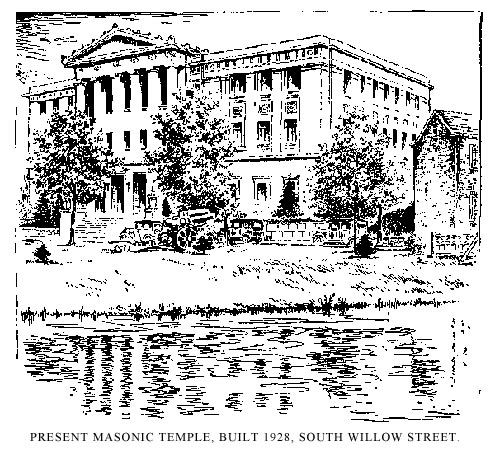
TRENTON LODGE NO. 5 During the grand mastership of David Brearley, the first lodge in Trenton was formed and justice Brearley was himself a member. The early records of this lodge, known then and now as Trenton Lodge No. 5, are replete with information of interest to all students of local and Masonic history. Grand Master Brearley, on July 4, 1787, issued a dispensation for the lodge, which was the fifth in the State. The dispensation was directed to Aaron Dickinson Woodruff. According to a minute of the lodge David Brearley, grand master, William Liddell, senior grand warden, Aaron Dickinson Woodruff and Anthony Reckless, master masons, assembled August 3, 1787, and a "Master Mason's Lodge was opened in due form." At a meeting ten days later, officers were appointed. They were: Aaron Dickinson Woodruff, worshipful master; Robert Lettis Hooper, senior warden; Thomas Bullman, junior warden; Hezekiah Stites Woodruff, Anthony Reckless and Maskell Ewing, secretary. The lodge continued under dispensation until December 20, 1787, when the Grand Lodge, meeting at New Brunswick, issued a warrant for the lodge to Aaron D. Woodruff, master, Thomas Bullman, senior warden and Anthony Reckless, junior warden. The one hundredth anniversary of Trenton Lodge was observed December 27, 1887. The Grand Lodge members attended, and Grand Master Robert M. Moore, Most Worshipful Past Grand Master Henry R. Cannon, historian of Grand Lodge, Past Master Lewis Parker, Past Master Barton B. Hutchinson and Right Worshipful Senior Grand Warden Jonathan M. Harris gave addresses. A banquet at the American House concluded the ceremonies. On April 3, 1924, the Grand Lodge met at Trenton, for the purpose of unveiling a tablet in memory of Most Worshipful Brother David Brearley. The members proceeded to St. Michael's Episcopal Church where the Bishop-Coadjutor the Right Rev. Albion W. Knight, the Rev. Samuel Steinmetz, rector of the Church and David McGregor, of Union Lodge No. 11, gave addresses. OTHER LODGES INSTITUTED Application for the second lodge in Trenton was presented January 4, 1858, by Edward W. Scudder, to whom the privilege of withdrawing from Trenton .Lodge No. 5, to form the new lodge, was granted. Mr. Scudder became worshipful master of the new body, known as Mercer Lodge No. 50. Egbert H. Grandin was elected senior warden and John R. S. Barnes, junior warden. Its warrant was issued January 13, 1858. The third lodge instituted in Trenton was Ashlar Lodge No. 76, which received its warrant January 18, 1866. The first officers were: James S. Aitkin, worshipful master; Dr. W. W. L. Phillips, senior warden; and Edward T. Green, junior warden. The warrant of Column Lodge No. 120 is dated January 18, 1872, and its first officers were James Nicklin, worshipful master; Levi I. Bibbins, senior warden; and Lewis C. Wooley, junior warden. Fraternal Lodge No. 139, whose warrant was granted January 21, 1875, had as its first officers: John G. Box, worshipful master; Robert Stewart, senior warden; and George W. Thomas, junior warden. The warrant for Loyal Lodge No. 181 was issued March 23, 1905. Its first officers were: Richard C. Chamberlain, worshipful master; John E. Gill, senior warden; and John R. Summerfeldt, junior warden. The latest lodge instituted is the True Craftsman No. 202, which received its warrant April 20, 1916. Edmund J. Levy was worshipful master; Norval H. Miller, senior warden; and Evin J. Green, junior warden. PAST MASTERS' ASSOCIATION The Past Masters' Association of Trenton Lodge No. 5 is composed of former presiding officers of the lodge. As soon as they have completed their terms of office, the past masters automatically become members of the Association. This organization was formed for social purposes November 16, 1891, with twenty-five charter members. Among them were Jacob B. Hartpence, then the oldest past master of the lodge, City Commissioner J. Ridgway Fell, Judge George W. Macpherson, Counsellor W. Holt Apgar, William A. MacCrellish, John F. L. Thompson, former Senator B, B. Hutchinson, William D. Sinclair, Charles Bechtel, William H. Brace, Lewis Parker, Edward S. Ellis, Samuel Brackett, Henry C. Case, George F. Butterworth, Samuel W. Thropp, Joseph T. Ridgway, James McCann, John L. Lindsay, Edwin F. Reppart, J. E. Stevenson, John G. Box, W. W. Stelle and Andrew Dutcher. It is the custom of the association to hold one meeting a year, which takes the form of a dinner. This is generally held on St. John's Day. YORK RITE MASONRY York Rite Masonry in Trenton has the following units Three Times Three Chapter, Royal Arch Masons; Gebal Council No. 3, Royal and Select Masters; Palestine Commandery No. 4, Knights Templar; New Jersey Grand Council, Royal and Select Masters; and Grand Commandery, Knights Templar. THREE TIMES THREE CHAPTER NO. 5, R.A.M. The Three Times Three Chapter No. 5, Royal Arch Masons, had its beginning in 1858, when the Most Excellent Grand High Priest William H. Doggett granted a dispensation to James N. Van Antwerp, Charles H. Higginson and Thomas J. Corson. Work was begun on this and continued until the meeting of the Grand Chapter at Burlington, September 8, 1858. At that time a warrant was granted to Mr. Higginson, Mr. Corson and John Woolverton. Members of the chapter at its organization were James N. Van Antwerp, most excellent high priest; Charles H. Higginson, excellent king; Thomas J. Corson, scribe; Charles L. Pearson, secretary; William R. Clapp, treasurer; John Woolverton, John F. Houdayer, John P. Nelson, William Eccles and Harper Crozer. GEBAL COUNCIL NO. 3, R.A.M. Records of the Grand Council of Pennsylvania, under date of March 16, 1860, show that Alfred Creigh, grand master, granted a dispensation to constitute Gebal Council No. 14, of this city. He appointed Thomas J. Corson as thrice illustrious grand master; Joseph H. Hough as deputy illustrious grand master; William R. Clapp as principal conductor of the work; Harper Crozer as treasurer; and John O. Raum as recorder. In 1862, Gebal Council began to hold meetings in rooms of Trenton Lodge No. 5, F. and A.M. Later, in 1866, meetings were held in rooms of the Three Times Three Chapter. Interest lagged for several years. In 1877, a resolution was presented before the Grand Council of New Jersey to consider the question of disbanding this body as a distinct Masonic organization. A motion was also made to have Gebal Council surrender its charter, but through the opposition of a few members, this was indefinitely postponed. In 1881 and 1882 drastic steps were taken to revive Gebal Council, and this movement resulted in new applications for membership and later in a revision of the by-laws. In July 1885, Gebal Council moved to the then new Masonic Temple, and conducted its meetings in the rooms of the Three Times Three Chapter and Palestine Commandery, K.T. From 1891 to 1900, the council declined once more, but from then until now the organization has recovered itself and has steadily prospered. Increasing membership brought up questions of enlarged quarters, and in 1911 a committee was appointed to confer with committees of other Masonic bodies on the matter of a new temple for the sole use of the Masonic organizations in Trenton. Out of this movement and similar action on the part of other Masonic groups resulted the present temple at Willow and Front Streets. THE PALESTINE COMMANDERY NO. 4 The Palestine Commandery No. 4 was organized under dispensation January 6, 1862, and instituted September 11, 1862. Joseph H. Hough was eminent commander; William R. Clapp, generalissimo; John Woolverton, captain general. NEW JERSEY GRAND COUNCIL, ROYAL AND SELECT MASTERS Cryptic Masonry in New Jersey seems to have begun with the establishment of three subordinate Councils, Kane No. 11, of Newark, New Brunswick No. 12, of New Brunswick, and Gebal No. 14, of Trenton. These, chartered by the jurisdictions of New York and Pennsylvania, united to form the Grand Council of New Jersey. Trentonians who have been among the grand masters of the Grand Council, Royal and Select Masters of New Jersey, are: Thomas J. Corson, 1861; John P. Nelson, 1864; Charles Bechtel, 1866; Joseph W. Pressy, 1874; Gilbert B. Slack, 1888; Linsley Rowe, 1890; Joseph Ashton, Jr., 1892; Isaac Lowenstein, 1895; David H. Lukens, 1899; Richard C. Chamberlain, 1906; Oscar F. Niedt, 1911; Harry Ames Putnam, 1914; John G. Brian, 1915 and William B. Thines, 1921. Grand recorders from Trenton were: Joseph H. Hough, 1860-62; Thomas J. Corson, 1863-79; Charles Bechtel, 1880-1902; and Harry A. Putnam, 1915 to the present time. Trentonians who served as grand treasurers were: William R. Clapp 1860-62; Charles Bechtel, 1874; John Woolverton, 1875-87; Gilbert B. Slack, 1888-1913; R. C. Chamberlain, 1914 to the present time. Of the correspondents, those who served from Trenton were: Joseph H. Hough, 1860-62; Thomas J. Corson, 1863-79; Charles Bechtel, 1880-83 and 1897-99; and Harry A. Putnam, 1917-22. THE GRAND COMMANDERY Since its organization five Trentonians have been head of the Grand Commandery, which was formed February 14, 1860, at Burlington, N.J. William H. Doggett was the first grand commander, and the Trentonians who have succeeded to this post are: T. J. Corson, 1861; Dr. John Woolverton, 1868; James McCain, 1895; William P. Hayes, 1915; and William M. Muschert, 1923. Residents of Trenton who have been chosen to the post of grand recorders of the Commandery are: C. G. Milnor, who served 1860-62; T. J. Corson, 1862-78; G. B. Edwards, 1879; Charles Bechtel, 1880-1903; T. H. R. Redway, 1904-08; and John M. Wright, 1908 and still serving. ANCIENT ACCEPTED SCOTTISH RITE The Scottish Rite branch of the Masonic order in Trenton consists of Mercer Grand Lodge of Perfection; Mercer Council, Princes of Jerusalem; Trenton Chapter of Rose Croix; and the Trenton Consistory. Mercer Grand Lodge of Perfection was formed April 21, 1863, with Joseph H. Hough as thrice potent master. Other officers were: Mr. Clapp, deputy illustrious master; William T. Nicholson, senior warden; David Naar, Jr., junior warden; John F. Houdayer, treasurer; and M. Robert Hough, secretary. William R. Clapp was the first sovereign prince of the Mercer Council, Princes of Jerusalem, organized May 19, 1864. The other original officers were: David Naar, deputy master; William T. Nicholson, senior warden; John F. Houdayer, junior warden; and Joseph H. Hough, secretary. Trenton Chapter of Rose Croix was formed April 17, 1868, with Charles Bechtel as most wise master. Those who served with him were: William T. Nicholson, senior warden; William R. Clapp, junior warden; Thomas J. Corson, orator; John O. Raum, treasurer; and Joseph H. Hough, secretary. The Trenton Consistory came into being September 20, 1906, when the Supreme Council meeting in Boston granted a charter for the local consistory. David H. Lukens was chosen commander-in-chief; Dr. Elmer Barwis, first lieutenant; Howard N. Richards, second lieutenant commander; John M. Wright, secretary; Richard C. Chamberlain, treasurer; Dr. E. H. Ginnelley, orator; Thomas W. Obert, chancellor; A. K. Leuckel, master of ceremonies; George A. Katzenbach, hospitaller ; Ira C. Leedom, engineer and seneschal; Harry F. Smith, standard bearer; Peter McGill, guard; and Lawrence J. Ayres, sentinel. ANCIENT ARABIC ORDER, NOBLES OF THE MYSTIC SHRINE The idea of the formation of Crescent Temple originated with an enthusiastic group of Shriners, mostly members of Lu Lu Temple, of Philadelphia, who had formed a Shrine Club in this city before there was a temple in New Jersey. CRESCENT TEMPLE In 1902 Salaam Temple was formed at Newark and given jurisdiction over the entire State. All candidates were required to go there for initiation. In December 1903 a meeting of the Trenton Shrine Club was called by Dr. Charles P. Britton, the president, for the purpose of making application for a charter for a temple to be located at Trenton, to be known as Crescent Temple. A petition was presented to the Imperial Council meeting held in Atlantic City July 14, 1904, at which time a dispensation was granted for the formation of the temple. Dr. Edwin H. Ginnelley was designated as the first illustrious potentate. On November 14, a meeting was held to select officers for the institution of the temple which resulted in the following elections: Illustrious potentate, Edwin H. Ginnelley; chief rabban, Charles G. Cook; assistant rabban, Paul L. Cort ; high priest and prophet, John W. Jones; oriental guide, George A. Katzenbach; treasurer, J. Allen Southwick; recorder, Linford D. Closson. The temple was instituted under dispensation November 17, 1904, by George W. Weidenmayer, of Salaam Temple and the first class of candidates, seventy-eight in number, was initiated. On June 23, 1905, the dispensation was surrendered and a regular charter granted. The following September 14, the temple was fully constituted, Potentate George Weidenmayer again acting as special deputy for the imperial potentate. At this time there were 332 charter members. Meetings were held in the Masonic Temple at State and Warren Streets until June 24, 1916, when the present Crescent Temple Mosque was completed and dedicated. At this time there were 1405 members and the building was considered large enough for all time to come. The growth of the organization has been remarkable and for several years the officers have realized that a larger mosque must be provided. As a result a new mosque is now in the course of construction, which will be one of the largest for strictly .Shrine purposes in North America, with a seating capacity for approximately four thousand persons, a banquet hall which will seat two thousand six hundred at one time, a stage 60 x 75 feet and other facilities in proportion. There are at the present time about seven thousand five hundred members on the roster. The potentates of Crescent Temple, with their terms of office are: Dr. Ginnelley, 1904-10; Harry E. Evans, 1911-12; Peter A. Caughell, 1913-14; J. Blair Cuthbert, 1915-16; Newton A. K. Bugbee, 1917-18; Alfred K. Leuckel, 1919-20; Howard J. Dudley, 1921-22; Barton T. Fell, 1923-24; Frederick P. Rees, 1925-26. Earl E. Jeffries, the present potentate, is now serving his second year. Linford D. Closson, who assumed office as recorder during the formation of the temple in 1904, has served in that capacity ever since. TALL CEDARS OF LEBANON From an old custom of Masons of New Jersey, who were members of the Grand Lodge, the Tall Cedars of Lebanon originated. David H. Lukens was the founder of the order in Trenton, having suggested that a Trenton Forest be established here, after he had been given the degree elsewhere. The Supreme Forest of Tall Cedars was incorporated March 18, 1902, and the first session was held in this city, February 6, 1903. The Tall Cedars is composed exclusively of Blue Lodge Masons. MASONIC TEMPLES Trenton has had three Masonic Temples. The latest one dedicated March 1, 1927, stands on the site of the first temple, erected in 1793 at Front and Willow Streets, by Trenton Lodge No. 5. Much of the history of the Masonic temples in Trenton is inseparably linked up with this lodge. THE FIRST TEMPLE Minutes of the old lodge reveal that for some time after organization meetings apparently were held at the homes of the various members, but in 1789 it was felt that the lodge was growing to such a size that suitable quarters should be obtained for it. In 1792 a committee composed of Aaron D. Woodruff, Richard Howell, Isaac DeCou and Bernard Hanlon was appointed to report on the expediency of building a hall or lodge room for use of the organization, together with an estimate of its cost. The committee reported favorably April 2, and another committee was appointed to devise means of raising funds to pay for the new building. In 1793, Mark Thompson, of Harmony Lodge No. 8, Newton, Sussex County, gave to Trenton Lodge No. 5 a plot of ground in Barrack Street, now known as Willow Street. Mr. Thompson was father-in-law of Mr. Woodruff, first master of Trenton Lodge. In view of this gift, plans were prepared for the proposed building, and Mr. Woodruff, with Messrs. Richard Howell, Stockton, Ewing and DeKlyn, was named as a committee for this purpose. The committee reported plans for a building costing~approximately £376, 15s, 10d, or about $1,900. The lodge was, it seems, financially able to appropriate £100 toward the building, and the Grand Lodge appropriated £75. Subscriptions had been pledged amounting to £185 15s., making a total of £364 15s. It was decided that with this amount available, the work on the building should proceed. On August 19, 1793, the committee announced that everything was in readiness for the laying of the cornerstone which occurred at "high twelve," August 26. Nineteen years later, Trenton Lodge felt the need for larger quarters, and inquiry was made as to the feasibility of enlarging the hall, but nothing apparently was done at that time. In January 1827 the matter of the lodge building was once more before the organization, and consideration was given to the purchase of a lot on which to erect a Masonic Temple, but nothing definite was done until many years had elapsed. In 1842 a tract of land in the rear of the hall was bought for $207.90, presumably for an addition, but no progress was made evidently because of financial difficulties. At its April meeting 1860, Trenton Lodge No. 5 unanimously resolved that the worshipful master, on behalf of the trustees of the lodge, should subscribe $2,000 to the Masonic Hall Association for one hundred shares of stock, for the construction of a new building. The only result, however, was the building of a brick addition on the side of the old building. At the meeting May 6, 1867, a committee was again named to seek more suitable quarters, and John Taylor, a member, offered a long lease for the third floor of Taylor Hall, later known as Taylor Opera House. The lease was taken for five years, and the new rooms were dedicated December 9, 1867, by Most Worshipful Grand Master Silas Whitehead. The committee reported January 6, 1868, that the old lodge property had been sold. The ancient building passed into friendly hands, and one of the best-known free schools was established there. Thomas J. Macpherson, father of judge George W. Macpherson, was master of the school, which he conducted in this building for five years. THE SECOND TEMPLE Some years after Trenton Lodge had located in the Taylor Opera House, a committee, composed of William D. Sinclair and Charles Bechtel, was appointed to investigate the possibility of erecting a new temple. The cornerstone of this second temple, at State and Warren Streets, was laid July 15, 1884, with the Grand .Lodge, Trenton lodges, and various other Masonic organizations in this section of the country in attendance. The building was finished in 1885, when the local lodges took possession of it. When the second temple was built, a stock company had been organized and shares were sold to members. This proved to be a fatal mistake, for through this very arrangement the fraternity was practically turned out of its home. It was not realized when the stock in the building was sold originally that, as the holders died, the stocks which did not pay any dividends might be sold and.thus the control of the property would pass from the hands of the Masonic organizations. This is exactly what happened, for the Trenton Banking Company had been quietly buying up these shares until it had a controlling interest. The purpose teas of course to acquire the property as the site for the new home of the banking company. THE NEW TEMPLE When the temple thus passed from the Masons, City Commissioner J. Ridgway Fell led the movement for a new building. He obtained options on the Willow and Front Street site and, with these options, one on the old First Masonic Hall, then being used as an upholstering shop. The original temple was bought in 1915 by a group of Masons, led by General W. F. Sadler, Jr., and presented to Grand Lodge. In 1916 S. E. Kaufman, J. Henry Fell and Edgar D. Coleman were named as a committee to call all the Trenton Masonic bodies together for a discussion of a new building. The committee met with representatives of all the Masonic groups, and from these sessions a Trenton Masonic Temple Association was formed. The Association was incorporated April 25, 1917, and the incorporators were: Alfred K. Leuckel, Trenton No. 5; Charles H. Crozier, Mercer No. 50; Thomas E. Raub, Ashlar No. 76; W. J. B. Stokes, Column No. 120; S. E. Kaufman, Fraternal No. 139; Absalom E. Clark, Loyal No. 181 ; and Samuel Freeman, True Craftsman No. 202. Each of the incorporators held one share of Founders' Preferred Stock for $2,000 in perpetuity for his lodge, so that the new temple will never pass from the lodges represented without dissolution of the Association and without the consent of these organizations.
Subscriptions were being successfully obtained for the new temple when the World War intervened, and nothing more was done until June 4, 1921, when at a meeting of all the representatives of the Masonic groups it was decided to resume activities. In successive campaigns the sum of $800,000 was raised to meet the cost of the temple. The cornerstone was laid October 9, 1926. Governor A. Harry Moore, of New Jersey, gave the main address. The building was finished and formally opened February 28, 1928. THE ORDER OF THE EASTERN STAR The Order of the Eastern Star is composed of women whose male relatives are members of the Masonic order, and there are five chapters in Trenton. The oldest of these is the Morning Star Chapter No. 22, organized July 19, 1898. Its first officers were: George W. Thomas, Sr., worthy patron; Mrs. Eva A. Wyckoff, worthy matron; Miss Virginia W. Houghtaling, assistant matron; Miss Kate Houghtaling, secretary. Fidelity Chapter No. 89 was instituted June 12, 1917. Its first officers were: Albert Rogowski, worthy patron; Miriam Eckstein, worthy matron; Fannie F. Freeman, associate matron; Rose Millner, secretary; Dorothy Goldman, treasurer. Victory Chapter No. 96 was instituted May 31, 1918, with Charles C. Brooks, worthy patron; Mrs. Kate E. Bozarth, worthy matron; Mrs. Stella S. Applegate, associate matron; Mrs. Ethel L. Brook, treasurer; Mrs. Stella E. Homan, secretary. There is also an Ashlar and a Trenton Chapter.
III. Other Fraternal Organizations INDEPENDENT ORDER OF ODD FELLOWS THE Independent Order of Odd Fellows was formed in this country in 1819, under the leadership of Thomas Wildey, the first lodge being self-instituted by five men who held membership in the parent body in England. On April 26, 1819, they formed Washington Lodge No. 1, at Baltimore, Md., and this lodge is still flourishing. The order is not an insurance society; it is not primarily a beneficial society. Its primary object is and always has been of a fraternal nature, with particular attention paid to the care of its sick and distressed members and their families. Application being made to open a Grand Lodge in this State and there being some rivalry between lodges, at the suggestion of Thomas Wildey, Trenton Lodge No. 3 was formed August 3, 1833, the same day the Grand Lodge of New Jersey was instituted in this city. Only a year after the institution of Trenton Lodge No. 3, Concordia Lodge No. 4 was organized in Trenton September 29, 1834, and it continued up to a few years ago when it was merged with one of the other lodges. At the present time there are six lodges in Trenton, with a membership of 1,847 and with invested funds of more than $130,000. These lodges are: Trenton No. 3; Mercer No. 34; Garibaldi No.102; Fred D. Stuart No. 154; Home No. 211; and Meni Lodge No. 217. Trentonians who have been grand master of the order in New Jersey are: William C. Branin, 1836-37; Sylvester van Syckel, 1838; John McCully, 1839; Samuel B. Scattergood, 1840; Henry C. Boswell, 1841; Marshall C. Holmes, 1842; Edward D. Weld, 1843; Joseph Wood, 1851; Robert W. Mull, 1867; James S. Kiger, 1877 ; George W. Hammell, Jr., 1885 ; Harry E. Jones, 1906; William T. Robbins, 1910. The Rebekah Branch of the Order, being composed mainly of the female relatives of members, and single women, was established in 1850. Concordia Rebekah Lodge No. 4 was organized at Trenton in 1868. It, however, shortly became defunct and the Rebekah Degree in Trenton is now represented by Ruth Rebekah Lodge No. 9, which was instituted January 7, 1890, and is an active working lodge. No recital of Odd Fellowship would be complete without special reference to its provision for the care of its aged members, their wives, widows and orphans. In Trenton there is a Home for the Aged, established in 1885, in which seventy old folks are being sheltered and looked after. JUNIOR ORDER OF UNITED AMERICAN MECHANICS The Junior Order of United American Mechanics, a patriotic, fraternal and beneficial organization was introduced into New Jersey by the institution of Lincoln Council No. 1, at Camden, January 1866. The State Council of New Jersey was organized at Camden, July 12, 1869, with nine councils, the total number at that time in New Jersey. Among them was Enterprise No. 6 of Trenton, which was instituted in October 1868. The first annual session of the State Council was held October 21, 1869, in the rooms of Enterprise Council in this city. The Councils which have been instituted in Trenton are: Enterprise No. 6, instituted in 1868 by Ogden Lanning, G. Kafer, J. Letterer and J. Van Horn. These men were identified with the creation of the order, and Mr. Lanning was the first duly elected secretary of the State Council; Liberty Council No. 18, instituted September 1870; Alert No. 45, instituted January 20, 1874; Mercer No. 50, March 25, 1890; Commodore Perry No. 8o, November 24, 1890; Nathan Hale No. 89, February 25, 1891; Trenton No. 90, March 5, 1891; Century No. 100, May 29, 1891; and Rutherford B. Hayes No. 143, February 3, 1893. ANCIENT ORDER OF HIBERNIANS The Ancient Order of Hibernians, the outstanding organization in this country whose members are Roman Catholics of Irish birth or descent, had its origin in Ireland in the sixteenth century. It was first established in the United States in 1836, and in Trenton in 1871 when a few Irishmen gathered at the home of Christopher McCann in South Trenton. The prime movers were William Reilly and James Sharkey, who had come to Trenton from the coal mining region. An organization was effected with the election of William Reilly as president, James Sharkey as vice-president, Edward McKeever as secretary and Christopher McCann as treasurer. Division No.1, the Mother Division, was formally organized March 22, 1872. This division eventually located in .St. Mary's Cathedral parish, and Division No. 2 was organized in South Trenton, January 23, 1882, with William F. Grenan as president, John Waldron as vice-president, John J. Mullen as recording secretary, John Landerkin as financial secretary and John Haggerty as treasurer. Division No. 3 was organized in the Chambersburg section in October 1888, with John P. Casey as president, Peter Doyle as vice-president, Michael Callery as recording secretary and William Cantwell as treasurer. Division No. 4 of St. Joseph's parish was organized in 1890 with James E. Clinton as president, Hugh Kennedy as vice-president, Andrew McDonough as recording secretary, Michael M. McDonough as financial secretary and Henry Brown as treasurer. Division No. 5, embracing largely the Swamp Angel section, was organized in 1893 with Thomas P. Burns as president, Patrick Martin as vice-president, Joseph Higgins as recording secretary, Joseph McDonough as financial secretary and Roger Henry as treasurer. Division No. 6, which was a reorganization of Division No. 3, came into existence in 1898 and later on Divisions 7, 8 and 9 were organized. The officers of the different divisions constitute the County Board, through which the present A:O.H. building on .North Warren Street was acquired as headquarters for the entire order of the city, and since then a movement has been on foot for the consolidation of all the divisions with Division No. r having within its ranks the larger part of the nearly one thousand members of the order in this city. The only remaining separate divisions of the order at this time are Division No. 2 and Division No. 7. The A.O.H. in this city has paid out many thousands of dollars in sick and death benefits, and has taken an active part in all Catholic movements as well as in Irish movements. ST. PATRICK'S ALLIANCE OF AMERICA Men of Irish birth and descent, living in the United States, formed the St. Patrick's Alliance of America, as a non-sectarian organization to promote better feeling among the sects. Membership is open to any one who believes in freedom for Ireland and is of Irish blood. There are two units in Trenton, Branch No. 1, organized September 1887, and Branch No. 4, organized September 6, 1891, with District No. 7, established March 27, 1889. TRENTON LODGE NO. 105, B.P.O.E. Under a dispensation granted by Hamilton E. Leach, grand exalted ruler, Trenton Lodge No. 105, Benevolent Protective Order of Elks, was formed October 24, 1888. It had about fifty members, among them some of the best-known men of the city. General Richard A. Donnelly, father of Mayor Frederick W. Donnelly, was the lodge's first exalted ruler. The first meeting of the new lodge was held November 22, 1888, in Temperance Hall at South Broad and Front Streets, where the Goldberg department store is now located. The December meeting was held in the Odd Fellows' Hall, North Broad and Hanover Streets, and it was not until April 1, 1889, that the lodge moved into its own quarters at 23 and 25 North Warren Street. The lodge was very prosperous at this time, and had in its membership men who were outstanding in many walks of life. In the spring of 1894 the lodge again moved, going this time to 38 West State Street. The entire dwelling was used by the order and fitted up as an Elks' home, but in October 1895, for some reason, the organization went back to its location at 23-25 North Warren .Street, this time occupying the second floor. From 1895 to 1900 Trenton Lodge No. 105 was inactive, but from the beginning of the century until 1909 it had rapid growth, It was then proposed that the lodge should have its own home. This suggestion proved a popular one, and soon $35,000 was guaranteed for the project. The committee appointed selected the present site, 120-122 North Warren Street, and under proper authority issued twenty-year bonds of $25 denomination, which were purchased by the members. The new building was begun in 1910, completed the following year and formally opened January 1, 1912. The new home was dedicated May 21, 1913, with District Deputy Grand Exalted Ruler Alexander W. Mack, of Somerville Lodge No. 1068, as master of ceremonies. The lodge now has a membership of about 1,600. In 1922 a movement was started under the leadership of Past Exalted Ruler Joseph G. Buch to aid crippled children, which soon spread all over New Jersey and the nation. Trenton Lodge was so fortunate in its activities after 1913, that in 1925 it paid off the twenty-year bonds which were not due until 1930. The organization is now entirely clear of debt. PATRIOTIC ORDER, SONS OF AMERICA The Patriotic Order, Sons of America, has seven camps in Trenton and the Mercer Commandery. The oldest camp, No. 7, was the first one instituted in New Jersey. The Trenton Camp No. 7 was sponsored by Camp No. 7 of Philadelphia and was organized in 1888. After two rather difficult years, it relinquished its charter. On January 8, 1891, it was reorganized, and now has grown to be one of the strongest in the State. The old records have been lost, but it is known that A. L. Updyke was the first president. Camp No. 14 was organized February 17, 1892, and its first officers were W. Penn Walters, president; John Robbins, recording secretary; John Caldwell, financial secretary; and T. D. Terhune, treasurer. Camp No. 17 was instituted March 1892 by Past State President Samuel L. Davis. It had twenty-six charter members. Fred Wildrick was the first president; Thomas W. Cubberly, vice-president; and William Hutchinson, treasurer. This camp owns its own home on North Montgomery Street. Camp No. 20 was instituted in Broad Street Park, May 7, 1903, with William R. Galbraith as president. Camp No. 192, organized January 3, 1916, with twenty-five members, and Robert Scott as president. There is also a Camp No. 6. The Mercer Commandery No. 25 was organized November 11, 1904, with William H. Tilton as commander. PATRIOTIC ORDER OF AMERICANS The Patriotic Order of Americans has three units in Trenton, Camp No. 37, Camp No. 7 and Camp No. 6. LOYAL ORDER OF MOOSE The purpose of the organization is to provide sick and death benefits along the regular lodge plan, and also to promote social activity and friendly intercourse among its members. Trenton Lodge No. 164, Loyal Order of Moose, was organized October 21, 1909, by James J. Davis, now United States Secretary of Labor. He was assisted in the preliminary work by William J. Bennett and John H. Nichols. In June 1910 the members purchased the building at 121 East Hanover Street. After spending considerable money to renovate it, the organization, during a dispensation of open charter, increased its membership to two thousand seven hundred members. With the increase of members it was finally decided that the quarters were too small and a committee was appointed to select a desirable location on which to build. After three months' time the committee recommended the purchase of the old Woolverton estate at East State and Canal Streets for $30,000. Building operations were begun in May 1914 and the home was turned over to the lodge October 16, 1915. It was designed exclusively for social and club quarters and contains lodge rooms and a spacious auditorium which may be rented for public occasions. WOODMEN OF THE WORLD The Woodmen of the World is represented in Trenton by several very successful camps and groves. They are: Trenton Camp No. 33, organized May 1904, which now has 2,475 members. Wilbur Camp No. 45, organized May 1907, which now has 1,867 members. Kent Camp No. 49, organized January 1908, which has a present membership of 127. Expraxion Grove No. 12, formed April 1911, and now having 1,432 members. Laurel Grove No. 21, formed April 1915, and now having 765 members. All these were organized under the supervision of present District Manager Peter B. Tilton who has served in that capacity since 1906. District Manager Edna V. Tilton supervises the Groves, the women's organization. NATIONAL UNION Trenton now has four councils of the National Union. The first one, Trenton No. 346, was organized by B. F. Morrell, July 23, 1889. The others are: Monument Council No. 550, organized April 1, 1892, by Harry E. Evans; Mercer Council No. 404, organized by C. F. Fenn, November 15, 1894; Vigilant No. 1039, formed February 18, 1904, by Harry E. Evans. ORDER OF ST. GEORGE The American Order, Sons of St. George, has three lodges and two auxiliaries in Trenton. The lodges are Sir Charles Napier No. 33, organized March 5, 1878; Royal Oak No. 36, organized September 5, 1878; and Chatham No. 136, formed November 28, 1883. The Auxiliary of Royal Oak Lodge was formed February 8, 1917, and that of Chatham was formed in 1927. Trenton Lodge No. 270, Order of Daughters of St. George, was instituted April 8, 1926. There were sixty-nine charter members. KNIGHTS OF PYTHIAS The Knights of Pythias Order is represented in Trenton by Spartacus Lodge No. 10, organized April 9, 1868; Trenton Lodge No. 60; Pythias No. 61 ; Hamilton No. 91; and a women's branch, Sicilian Temple No. 17, Pythian Sisters, organized November 29, 1909. KNIGHTS OF THE GOLDEN EAGLE Two camps and one temple constitute the units of the Knights of the Golden Eagle in Trenton. They are Mercer Castle No. 23, Capital Castle No. 28, and Laurel Temple No. 3. ORDER OF THE WHITE SHRINE OF JERUSALEM Bethlehem Shrine No. 6, Order of the White Shrine of Jerusalem, was organized in this city, April 22, 1922. SONS AND DAUGHTERS OF LIBERTY Sons and Daughters of Liberty Order has the following units in Trenton: Pride of Trenton Council No. 4; Capital City No. 20; Mizpah No. 26; Betsy Ross No. 101 ; and the District Council No. 1. UNITED AMERICANS George Washington Temple No. 1 and Liberty Bell Temple No. 3 constitute the United Americans organizations in Trenton. SHEPHERDS OF BETHLEHEM The Order of the Shepherds of Bethlehem have the following Trenton units: Star of the East Lodge No. 4; Evening Star Lodge No. 7 ; and Star of Trenton Lodge No. 22. IMPROVED ORDER OF RED MEN Tribes of the Improved Order of Red Men in this city are: Moax Tribe No. 5 ; Assunpink No. 86; Iroquois No. 93 ; Uncas No. 102 ; Iska Council No. 33 ; and Mercer County Tribe.
IV. War Veterans' Organizations VETERANS' organizations have been organized in Trenton by men who fought in the Civil, Spanish-American and World Wars. The first of these goes back to two years after the close of the Civil War, and the latest was organized in 1920. Several of them have their women's auxiliaries, which assist in their social and patriotic activities. G.A.R. POSTS Bayard Post No. 8, of the Grand Army of the Republic, is the oldest veterans' organization in Trenton. It was chartered November 5, 1867, and named for George D. Bayard of Princeton, a General in the Union Army, who was killed in action December 13, 1862, at Fredericksburg, Va. Aaron Wilkes Post No. 23, named for Adjutant Aaron Wilkes, a Trenton youth killed in action May 5, 1862, at Williamsburg, Va., and buried in Riverview Cemetery, this city, was chartered July 1, 1879. The third post, Thomas Hamilton Post No. 56, is composed of Negro soldiers of the Union Army. It received its charter August 18, 1881. Both the Bayard Post and the Aaron Wilkes Posts have their women's auxiliaries. There is also a unit of the Ladies of the Grand Army of the Republic, which was chartered November 18, 1887. SONS OF VETERANS OF THE CIVIL WAR The sons of Union Army veterans formed a society in 1881 for the purpose of perpetuating the memory, sacrifices and services of the veterans in preserving the Union. Other purposes were to inculcate patriotism, honor the dead through historical exercises and the proper observances of Memorial Day, and to assist the Grand Army men and extend aid to their widows and orphans. The General James A. Garfield Camp No. 4, Sons of Veterans of the Civil War of Trenton, was organized January 9, 1896, and incorporated March 20, 1902. Its first captain was Herbert D. Williams. The second unit of the Sons of Veterans is the Ferd V. Dayton Camp No. 5, Sons of Union Veterans of the Civil War. It was organized May 10, 1883. The William J. Sewell Camp No. 22 is the Negro camp of the Sons of Veterans, and was organized May 28, 1895. The first commander was Robert J. Kinney and the present one is Samuel C. Harmon. The James A. Garfield Camp has a woman's auxiliary No. 18, for which a charter was issued November 1, 1910. SPANISH WAR VETERANS Trenton Camp No. 42 of the National United Spanish War Veterans was not organized until May 11, 1926, when it received its charter. Fred C. Ruhlman was the first commander and Harry W. Brand is the present one. On July 27, 1927, the Trenton Auxiliary No. 24 of the Spanish War Veterans was organized. Marie K. Ruhlman was the auxiliary's first president and was succeeded by Mrs. Ella M. Clow. ELKINS OLIPHANT POST, AMERICAN LEGION Almost immediately after the close of the World War and the demobilization of the troops, two posts of the American Legion were formed in Trenton, one the Blue and Gray Post No. 10 and the other Trenton Post No. 104. For the purpose of honoring Elkins Oliphant, son of an old and distinguished Trenton family, who was the first Trenton officer killed during the War, the two organizations combined in 1921 and became known as Elkins Oliphant Post No. 93. The Blue and Gray Post, the first formed in Trenton, was established August 29, 1919, and took its name of Blue and Gray from the fact that it included in its membership not only the sons of men who fought in the Union Army during the Civil War, but also the sons of those who fought for the Confederacy. Trenton Post was chartered September 6, 1919. The amalgamation of the two posts was effected at a meeting of the memberships December 21, 1921. At the session January 4, 1922, the organization was completed, and an election of officers held. Samuel Scott, who had been junior vice‑commander of Trenton Post and chairman of its hospitalization committee, was elected commander. The amalgamated post was incorporated February 1922, for the purpose of promoting patriotism and the mutual interest of the membership. Since the post was organized, its commanders have been: Samuel P. Scott, George F. Fleming, Lester G. Block, the Rev. Gill Robb Wilson, S. Leslie Tattersall, Francis W. Hunter and Dr. Martin W. Reddan. Lieutenant Oliphant, in whose memory the post was named, was the son of Alexander C. Oliphant, for a number of years adjutant‑general of New Jersey. He was the grandson of General S. Duncan Oliphant, who served with distinction in the Civil War, and of the United States Senator Stephen B. Elkins of West Virginia. Lieutenant Oliphant was killed October 18, 1918, at Ribeauville, France, while taking part in the great offensive against the Hindenburg line. THE POST AUXILIARIES At the request of the men of Trenton Post, Mrs. Florence Schoch formed an auxiliary to that organization. There were fifty who joined at the Roll Call. The first meeting of the auxiliary was held Hallowe'en Eve, 1920, when the following officers were elected: Mrs. Schoch, president; Mrs. Alexander C. Oliphant, vice-president; Mrs. Robert Gulliver, secretary; and Mrs. Alfred Reading, treasurer. Since 1921 the auxiliary, with the assistance of the post, has held a Poppy Day sale annually, the proceeds of which go toward the post's work for disabled veterans and to the Convalescent Home at Toms River. The Blue and Gray Post Auxiliary was the result of a meeting October 10, 1920, when five women, wives of members of the Blue and Gray Post No. 10, assembled in the home of the post at 72 North Clinton Avenue, at the call of Commander Black. The officers first elected were: Mrs. John H. McCullough, president; Mrs. O. D. Oliphant, first vice‑president; Mrs. W. Scott Taylor, second vice‑president; Mrs. C. Frank Burr, third vicepresident; Mrs. Frank Harris, corresponding secretary; Mrs. J. E. VanHorne, recording secretary; and Mrs. R. S. Seibert, treasurer. These officers served until the amalgamation. After the amalgamation of the posts and their auxiliaries, the newly organized auxiliary of the Elkins Oliphant Post honored the young officer's mother, Mrs. Alexander C. Oliphant, by electing her as the first president. Those who served with her were: Mrs. Belle Spaulding, vicepresident; Miss Mary Schroth, secretary; and Mrs. Bess Morrison, treasurer. The meetings were then held in the post rooms, 30 East Front Street. The same officers served during 1922 and 1923. The presidents after that date have been: Miss Gertrude Miller, Mrs. A. C. Oliphant (reelection), Mrs. O. D. Oliphant and Mrs. W. N. Morrison. Financial assistance has been given by the auxiliary to local organizations and institutions equipped to render medical and surgical care to former soldiers and their dependents. 40 AND 8 SOCIETY In March 1920 the first effort was made to organize a play feature for the American Legion. Many legionnaires believed there should be some such unit, and Joseph W. Breen, a veteran of two wars, conceived the idea of the 40 and 8 Society. The title is taken from the legend on the French "side‑door Pullmans," so familiar to the travelling doughboy. Its members are known as "Voyageurs Militaires" and the candidates as "Prisonniers de Guerre." The initiation ceremony is called a "Wreck" and is staged by a "Wrecking Crew." All officers of the organization are designated by terms used about the railroad stations of France. On May 3, 1922, Sous Chef de Chemin de Fer George Dobson came to Trenton with the wrecking crew of Voiture No. 127 of Middlesex County and instituted the Trenton branch of the organization. Immediately following the initiation an election was held and Richard Stockton, Jr., was elected the first Chef de Gare de Voiture No. 235, of Trenton, to serve for one year. Since then the following veterans have held this post: James E. Mitchell, Samuel P. Scott, Harry Evans, C. E. Edmonds, William Wharton, Charles W. Blakesley. Of the many activities which the society has fostered perhaps the most important is the child welfare fund which it inaugurated. This fund is raised through payment of a percentage of each voyageur's dues to the child welfare committee of the American Legion. VETERANS OF FOREIGN WARS Since the World War there has been only one unit in Trenton of the Veterans of Foreign Wars, and very little is known of any former organizations. The unit established since the World War is known as the BloorVolk Post No. 491. It is named for Spencer Bloor, son of Mr. and Mrs. Edward Bloor, and Robert B. Volk, son of Mr. and Mrs. Robert R. Volk. The post was organized in January 1927. H. S. Van Camp was the first commander and was assisted by the following officers: William Ostermier, senior vice-commander; Elgin R. Mayer, junior vice-commander; Howard Heck, quartermaster; William Gabriel, adjutant; James Tarangioli, chaplain; Thomas McAllister, officer of the day; and Mr. Van Camp, Mr. Charles F. Burr and Mr. John Clymer, trustees. John J. Boscarell is the present commander of the post, which has an active membership of two hundred and an increasing number of applicants. DISABLED AMERICAN VETERANS The national organization of the Disabled American Veterans of the World War was founded in March 1920, by a group of wounded, injured and disabled men at Cincinnati, who felt the need for some unit that would have only the interests of the wounded and disabled at heart. The first Trenton chapter was organized in 1920 under the name of the Rehab Chapter. The name was later changed to the Theodore Roosevelt Chapter No. 2. The main object of the organization is to assist ex-service men and their families. The chapter has since adhered to this purpose and assisted every needy veteran's family that has come to its attention. This work was long done under the personal supervision of Frank Muccioli, who is a former service man and clerk of the City District Court. The chapter was founded by Joseph M. Yakubisin. Past commanders of the chapter are: Walter A. Neely, Frank Muccioli, James Argust, Clarence Keating, Thomas Miller, William B. Schrieber, Fred J. Paone, Clarence Branson, John J. Boscarell and Andrew J. Lake. Frank Muccioli was elected first state commander of New Jersey, and Fred J. Paone was for three consecutive terms treasurer of the state organization, while Lewis Coney and Fred E. Pierce both served one term as state treasurer also.
V. Patriotic Societies THE last decade of the nineteenth century brought a revival of interest throughout America in the stirring events of Colonial and Revolutionary history in the United States, and from 1890 to 1900 numerous societies intended to preserve the memory of the early Americans and their heroic achievements, were organized. NEW JERSEY SOCIETY, SONS OF THE REVOLUTION First among the societies of this character to be formed in Trenton was apparently the New Jersey Society, Sons of the Revolution. Although this is a State society of a national organization, it was formed by Trenton men, descendants of Revolutionary ancestors. From that time to this Trentonians have been conspicuous in the New Jersey Society of the Sons, many of them holding high office in that organization. Judge Garret D. W. Vroom, a distinguished jurist of this city, always greatly interested in America's early history, Colonel S. Meredith Dickinson, descendant of one of the most gallant officers of the Revolution, and former Secretary of the Navy George M. Robeson were three of those who signed the call for the meeting January 6, 1891, at which the New Jersey Society was formed. It was at a meeting March 3, 1891, that the formal organization took place, and Colonel Dickinson was elected to the presidency. Clement H. Sinnickson, of Salem, was elected as vice-president; John A. Campbell, secretary; General Thomas S. Chambers, treasurer; Foster C. Griffith, registrar; Morris H. Stratton, of Salem, historian; and General George M. Robeson, Judge Vroom, General S. Duncan Oliphant, H. H. Hamill and Dr. William Elmer, all of this city, Bayard Stockton, of Princeton, C. A. Bergen, Peter L. Voorhees and William John Potts of Camden, members of the board of managers. Some of Trenton's most influential citizens have served since that time in various offices of the society, which was incorporated January 13, 1923. Those who have been president are: Colonel Dickinson, Judge Vroom, Chancellor Walker, General Chambers, Colonel William Libbey, State Senator Jonathan H. Blackwell, Robert Chambers Belville, State Comptroller N. A. K. Bugbee and Attorney-General Edward L. Katzenbach, who is president now. Trentonians who have held the office of vice-president are: Colonel William Libbey, Senator Jonathan H. Blackwell, Robert C. Belville and State Comptroller N. A. K. Bugbee. Shortly after the formation of the society, the members participated in the exercises attendant upon the laying of the cornerstone of the Trenton Battle Monument, and this was the first of many historic and patriotic enterprises in which the society has been interested. Members of the society later conceived the idea of fittingly marking the route followed by Washington on his march to Princeton. This was done, and at their annual meeting May 20, 1914, the members travelled by automobile over the route to unveil the twelve obelisks and tablets which they had erected along the way. NEW JERSEY SOCIETY, COLONIAL DAMES OF AMERICA Trenton women, members of some of the city's oldest and most distinguished families, were responsible for the organization of the New Jersey Society, Colonial Dames of America. As in the case of the Sons of the Revolution, the Trenton members have ever since been closely and actively associated with the organization. The New Jersey Society of the Dames was formed at a meeting held March 9, 1892, at the home of Miss Elizabeth Alford Smith, 178 West State Street. The first officers were Trenton women. Mrs. S. Meredith Dickinson, whose husband had been made president of the State Society of the Sons of the Revolution in 1891, was elected to the presidency of the Dames. Mrs. S. Duncan Oliphant was the first vice‑president; Mrs. Henry M. Barbour, second vice-president; Miss Smith, recording secretary; Miss Caroline E. Nixon, corresponding secretary; Miss Mary Dickinson, treasurer; Mrs. Frederick C. Lewis, registrar; Miss Annie deB. McIlvaine, historian; and Miss Justina Livingston Atterbury, assistant historian. Mrs. W. W. L. Phillips, Mrs. Cleaveland Hilson, Mrs. Hugh H. Hamill, Mrs. Alexander F. Jamieson, Mrs. Hughes Oliphant and Miss Helen Griswold Green were the six Trenton women elected as the first managers. Since the formation of the State Society of the Dames, several Trenton women have held the office of president. They include Mrs. S. Meredith Dickinson, Mrs. Alexander F. Jamieson, Mrs. Francis C. Lowthorp and Mrs. William Libbey. Mrs. Dickinson is now an honorary president and Miss Smith an honorary vice-president. It is the aim of the society to preserve all buildings, relics and mementos of early American life, and to stimulate a healthful interest in Colonial affairs, and a spirit of true patriotism and love of country. SOCIETY OF COLONIAL WARS IN NEW JERSEY On May 1, 1894, the Society of Colonial Wars in the State of New Jersey was formed, and the first meeting to receive the charter and elect officers was held May 10, 1894, at the home of General Edward Burd Grubb, at Edgewater Park, N.J. General William S. Stryker and United States Senator F. O. Briggs both have held the office of deputy governor in the society, while Colonel William Libbey was one time governor. General Wilbur F. Sadler, Jr., served the society in 1915-16 as treasurer, Senator Briggs was registrar and a gentleman of the council, and General Sadler and General Thomas S. Chambers were also gentlemen of the council. DAUGHTERS OF THE AMERICAN REVOLUTION Trenton has six chapters of the Society of the Daughters of the American Revolution, the first one organized in 1894 and the last in 1910. The oldest Trenton chapter is the Broad Seal, which takes its name from the great seal of New Jersey, and which was organized December 13, 1894, at a meeting at the home of Mrs. Richard T. Stevens, of South Orange, N.J. The Broad Seal was the sixth chapter to be established in New Jersey, and its twelve charter members had all been members of the Nova Caesarea Chapter, of Newark. Mrs. Stevens was the Broad Seal's first regent. Following Mrs. Stevens as regent were: Mrs. William S. Stryker, Mrs. James Buchanan Breese, Mrs. Cornelius Hook, Mrs. Cleaveland Hilson and Mrs. Paul L. Cort. Trent Chapter came into existence January 24, 1895, upon invitation of Mrs. William S. Stryker, then state regent of New Jersey, and was the seventh to be formed in the State. The organizing regent was Mrs. Alexander F. Jamieson of Lawrenceville and the organization meeting was held at the home of Mrs. Henry P. Perrine, on Greenwood Avenue, when officers were elected as follows: Mrs. Alexander F. Jamieson, regent; Mrs. James S. Stephens, vice-regent; Mrs. William J. George, of Lawrenceville, registrar; Miss Kate A. Mott, of Bordentown, treasurer; Mrs. Chauncey H. Beasley, recording secretary; Mrs. Edward L. Gulick, of Lawrenceville, corresponding secretary; and Mrs. Mary A. Bell, historian. The name selected by the chapter honors the memory of William Trent, first chief justice of New Jersey, for whom Trenton was named. Mrs. Jamieson was regent of Trent Chapter until 1922, when she resigned, and Mrs. Francis C. Lowthorp was elected. When the latter resigned, she was succeeded in 1926 by Mrs. Henry W. Green. Mrs. Jamieson and Mrs. Lowthorp are honorary life regents of the chapter. Mrs. John Moses, for many years a leader in both D.A.R. and Colonial Dames activities in Trenton, organized the General David Forman Chapter January 15, 1896. It began with nineteen charter members, and its first officers were: Mrs. Moses, regent; Mrs. Daniel R. Foster, vice-regent; Miss Julia Blackfan, registrar; Miss Laura Wilson, treasurer; Mrs. Robert Oliphant, secretary; and Mrs. Isaac Weatherby, historian. Mrs. Moses served as regent from the organization of the Chapter until December 31, 1924, when she was succeeded by Mrs. Jennie Scudder Murray. The chapter is named for an ancestor of the first regent, General David Forman, who was a distinguished officer in the American Revolutionary War. Mrs. Murray organized in 1926 the Jinnie Jackson Society of the Children of the American Revolution and was its first regent. Its aim is to interest the youth of the country in patriotic and historic matters, and to train members for the adult patriotic societies. Mrs. Beulah A. Oliphant, who instituted the movement to have the original portions of the Old Barracks acquired and maintained as an historical landmark, was the organizing regent of the Captain James Oliphant Chapter. This chapter, formed May 12, 1896, with fifteen charter members, is a family one, whose members are either Oliphants by ancestry or Oliphants by marriage. Mrs. Oliphant was not only its founder, but served as its regent for twenty years. Mrs. S. D. Oliphant, Jr., succeeded her, and is the present regent. The membership now is twenty-four. Rescue of the Old Barracks from destruction is the most outstanding achievement of the chapter. The idea of saving the building was conceived by the first regent, and at a chapter meeting in 1899 a resolution was passed "to endeavor to interest all patriotic societies to assist in the purchase of 'The Old Colonial and Revolutionary Barracks' for a home for Patriotic Societies." The chapter was a charter member of the George Washington Memorial Association, Rocky Hill Headquarters Association, and the Mount Vernon Association. It also assisted in furnishing the dining-room of the Wallace House in Somerville, and other similar projects. The chapter which bears the name of General Hugh Mercer was organized June 5, 1900, at the home of Mrs. Howell C. Stull, 369 West State Street. The first officers and other charter members were: Mrs. Stull, regent; Mrs. Thomas Winans, vice-regent; Mrs. Edward W. Dunham, recording secretary; Mrs. George Foster, corresponding secretary; Mrs. Spencer Alpaugh, treasurer; Mrs. J. Murray Forst, registrar; Miss Mary Conover, historian; Mrs. William O. Burgelin, Mrs. Maxwell G. Rockhill, Mrs. Margaret Sickel, Miss Louise B. Struble and Mrs. John W. Ward. Upon the removal of Mrs. Stull to Albuquerque, N.M., Miss Bertha M. Barwis was elected regent of the chapter. The General Washington Chapter was organized May 1910, by Mrs. William Libbey, then state regent, at the home of Mrs. George B. Yard, of Greenwood Avenue. Mrs. Libbey appointed Mrs. Yard regent, a post which she held for many years. Other officers elected at the first meeting were: Mrs. James M. Green, vice-regent; Miss Lucile Green, secretary; Mrs. Arthur D. Forst, treasurer; Mrs. William J. J. Bowman, registrar; and Mrs. Lory Prentiss, historian. Mrs. Yard was followed as regent by Mrs. Robert C. Maxwell, Mrs. Robert K. Bowman and Miss Elma Lawson Johnston. TRENTON BATTLE MONUMENT ASSOCIATION The movement which culminated in the formation of the Trenton Battle Monument Association, and the erection of the shaft at "Five Points" to commemorate the Battle of Trenton, began as long ago as July 4, 1843. General Garret D. Wall sent that day from Burlington a message to the New Jersey Society of the Cincinnati, then meeting in the Court House at Trenton, urging appointment of a committee to erect "a monument to commemorate the victory gained by the Revolutionary Army under command of General Washington, at Trenton, December 26, 1776." The society complied with the suggestion and named General Wall chairman of the committee, which held its first meeting January 16, 1844, at Snowden's Hotel, Trenton. On September 6, 1843, a public meeting of Trentonians had been held at the State House to consider the same project. This was called by Henry W. Green, Stacy G. Potts, and Samuel R. Gummere. The result of these two meetings was the obtaining of a charter March 8, 1844, for the "Trenton Monument Association." The incorporators included some of the most distinguished men of the State. Little further was done until 1858-59, when Charles Chauncey Haven, of Trenton, through personal efforts interested many prominent citizens of the State in the project. On March 5, 1859, the Legislature passed a supplemental Act, changing the name to "New Jersey Monument Association," and adding two men from each County except Mercer, as incorporators. From Mercer thirteen additional men were added. Commodore Stockton was elected president under this Act; Mr. Haven, vice‑president and general agent; Thomas S. Allison, secretary; and Thomas J. Stryker, treasurer. Subscriptions were sought and citizens of New Jersey contributed more than $11,000. Further efforts to carry the project tb completion ceased until May 7, 1884, when a charter was obtained for the "Trenton Battle Monument Association." On December 28, 1886, the association directed that the property at the junction of Pennington, Princeton and Brunswick Avenues, and Greene (now Broad) and Warren Streets be bought. The following April 14, 1887, the Legislature appropriated $15,000 and on March 3, 1891, Congress appropriated $30,000. By July 3, 1891, citizens of New Jersey had contributed more than $15,000, thereby rendering these appropriations available. Work was begun October 22, 1891. On the 115th anniversary of the Battle of Trenton, December 26, 1891, the cornerstone of the monument was laid with elaborate ceremonies. General Thomas S. Chambers, Hugh H. Hamill and William H. Skirm were members of the committee on arrangements. The monument was dedicated October 19, 1893, on the 112th anniversary of the surrender of Yorktown. The ceremonies were brilliant and were attended by governors of eight of the original thirteen States, Hilary A. Herbert, Secretary of the Navy, who represented the President of the United .States, and several distinguished military units. OLD BARRACKS ASSOCIATION No patriotic society in Trenton has a more notable accomplishment to its credit than the Old Barracks Association. This organization of women raised public funds for the purchase of the original portions of the Old Barracks property, and thus made possible its preservation and restoration. The Old Barracks today is one of the places of greatest historic interest, not only in Trenton but in the entire State. It is used as a meeting place for numerous patriotic societies and as a Colonial landmark it is visited annually by thousands of persons from all points of the United States. General William S. Stryker, when adjutant general of New Jersey, in the pursuance of his historic researches brought to public attention the fact that the Old Barracks was the only remaining building of this kind in New Jersey and recommended that the State buy the property. In 1899, Mrs. S. D. Oliphant, Sr., who had previously been interested in the preservation of the Old Barracks, sought to collect funds to buy the old building. She associated with her in the endeavor Mrs. Stryker, wife of General Stryker, Mrs. Cornelius Hook, Miss Sarah N. Doughty of Absecon and Mrs. Henry L. Jenkinson of Newark. Miss Doughty withdrew in 1902, and Mrs. Washington A. Roebling served in her stead. Mrs. Jenkinson had withdrawn in 1901 and was succeeded by Mrs. James Buchanan Breese. This self-appointed committee immediately appealed for contributions, and even resorted to a house-to-house solicitation. It was their intention to have the building saved and held by a Board of Trustees as "a place of interest for all residents of the State and other visitors, as a receptacle for old Colonial furniture, pictures and curios." In all, $6,314.20 was raised and paid over to the Widows' and Single Women's Home Society, which owned the building and used it as a home for aged women. The Board of Trustees of the Old Barracks was organized in 1902 and plans were tentatively formulated for the preservation and necessary improvements to the building. Mrs. Oliphant was elected president; Mrs. Stryker, vice-president; Miss Mary M. Moore, treasurer; and Mrs. Stull, secretary. Shortly after the association was organized, patriotic societies began to apply for meeting rooms in the building. The Colonial Dames rented a room on the first floor with the privilege of using the auditorium for their meetings. Various D.A.R. chapters also were assigned rooms for meetings and to be used as repositories for their archives. In 1911 the movement was begun to have the Old Barracks restored to its original lines, a project in which the Old Barracks Association heartily cooperated by deeding to the State the southern wing on condition that it be given perpetual management and control of the entire Barracks, when it was restored. The State accepted the deed and in 1917 the Legislature passed an Act appropriating $2,500 annually toward the administration and maintenance of the building, under direction of the association. The Old Barracks is the only remaining one of five military establishments which the Colonial Assembly authorized to be built at the time of the French and Indian Wars. The Trenton barracks was authorized in 1758, and was completed in March 1759. Others were erected at Burlington, Brunswick, Amboy and Elizabethtown. The original groundfloor plan of the barracks, found not many years ago in the State House, made it possible for the building to be accurately restored. The credit for actually starting the restoration belongs to Chancellor Edwin Robert Walker. At a meeting of the Old Barracks Association held February 6, 1911, he presented to the association a drawing of the barracks as it was when first erected, and suggested that the structure be restored on the original lines. A committee of the Society, Sons of the Revolution, largely through the initiative of General Wilbur F. Sadler, Jr., was able to bring the project to completion. Acts were passed by the Legislature, appropriating money for the acquisition of land and buildings, and finally for the restoration itself. In accordance with its agreement with the State, the Old Barracks Association has now full control of the building. Many prominent Trenton women have served as president of the Old Barracks Association. These included: Mrs. Cornelius Hook, 1902‑06; Mrs. James Monroe Green, 1906-07; and Mrs. J. Murray Forst, 1907-12. Mrs. Hook was again chosen 1912-14, followed by Mrs. William S. Stryker, 1914-15. The presidents since then have been Mrs. Breese, Mrs. Thomas S. Chambers (now Mrs. C. Edward Murray), Mrs. John A. Montgomery, Mrs. Huston Dixon and Mrs. Robert K. Bowman. On May 25, 1927, Mrs. Stryker was made honorary president. TRENTON HISTORICAL SOCIETY Although Trenton is an old and important New Jersey city, in addition to being the capital of the State, until 1919 it had no society devoted exclusively to collecting the facts of its history, preserving its historic buildings and marking its notable sites. From time to time various organizations had taken cognizance of such events as the Crossing of the Delaware and the two Battles of Trenton, but none had functioned as a regularly organized historical society. One of the organizations interested in historic matters was the Princes of Caliphs. This was a society founded in May 1902 among members of the Knights of Malta, and was intended originally as a social branch of this order. Later a more serious purpose was assumed, and the members gave special attention to the proper and fitting observance of days of historic import in the history of America. Such occasions as Washington's Birthday, Fourth of July and the anniversary of the Crossing of the Delaware and the Battles of Trenton were usually celebrated by the Caliphs with a banquet, an appropriate program following. Many well-known men in fraternal and civic life belonged to it, and at one time there were twelve hundred members. At a banquet of the organization January 25, 1919, in observance of the Second Battle of Trenton, steps were taken to form a Trenton Historical Society. The suggestion came from Counsellor William J. Backes, who was serving as chairman of the banquet committee. His suggestion found instant favor, and the Rev. Charles H. Elder urged that a committee of ten be appointed to draft a constitution and by-laws. Counsellor Backes named as members of this body Chancellor Walker, chairman; Mayor Frederick W. Donnelly, Judge Erwin E. Marshall, Judge Frederick W. Gnichtel, General Thomas S. Chambers, Dr. Carlos E. Godfrey, John J. Cleary, William Williams, Jr., F. C. Griffith and Clayton L. Traver. A constitution and by-laws were adopted and officers elected at a meeting held March 20, 1919. The first officers were: Chancellor Walker, president; Judge Gnichtel and F. C. Griffith, vice-presidents; William J. Backes, secretary; Dr. Godfrey, corresponding secretary; General Chambers, treasurer ; and Mr. Traver, Mayor Donnelly, J. J. Cleary, Charles S. Aitkin, Edmund C. Hill and Librarian Howard L. Hughes, members of the executive committee. Chancellor Walker served the society for three years as president. He was succeeded in that office by Judge F. W. Gnichtel, Dr. Carlos E. Godfrey, William J, Backes and John J. Cleary, the present incumbent. Not long after its organization, the Trenton Historical .Society was instrumental in having the name of former Mayor Frank A. Magowan restored to the bronze tablet bearing the names of the original Battle Monument Association, which stood within the entrance to the monument. Frank A. Magowan, Trenton's brilliant and once much-honored mayor, was a member of the Battle Monument Association and his name with others appeared originally on the bronze tablet in the shaft. Some time after he had retired, discredited, from public life, his name was effaced from the tablet by unknown persons and that of William S. Hancock was substituted. Mr. Hancock had been elected to the association when Mayor Magowan resigned. General Thomas S. Chambers was the last surviving member of the association and at his death, custody and control of the monument passed to the State House Commission. In order that the tablet might be accurate and also to right an injustice to Mr. Magowan, the Historical Association appealed to the State House Commission to have the tablet corrected and the commission ordered the change made. The Historical Society supported the movement to save the old house once occupied by Alexander Douglass, an officer on General Washington's staff during the Revolution. It was in this house on January 2, 1777, that Washington held a council of war after the Second Battle of Trenton. Here was planned the masterly retreat to Princeton. The historic dwelling had submitted to numerous movings and was rapidly falling into decay, when sentiment was aroused to buy it and have it moved to a permanent location in Stacy Park. Largely through the efforts of the Catholic Club, upon the suggestion of General Wilbur F. Sadler, this plan materialized. It was at the instance of the Historical Society, also, that Trenton celebrated the 150th anniversary of the Battles of Trenton. The event is described in detail in another chapter, "Trenton in the Twentieth Century," in this volume. With the publication of this History of Trenton the society has successfully concluded another undertaking designed to preserve old records and recall significant events in the city's life. MAHLON STACY DIVISION, SONS AND DAUGHTERS OF THE PILGRIMS To perpetuate the memory of the Pilgrim Fathers, to foster their principles and virtues, and to encourage the study of their qualities, acts and principles of government, the Sons and Daughters of the Pilgrims has recently been established. The Mahlon Stacy Division of Trenton was formed October 12, 1923. Members of the society must have a direct ancestor who settled within the Colonies prior to 1700. Organization of the local division, named for the first settler of Trenton, who was himself in this country long before 1700, took place at the home of Dr. and Mrs. Joseph H. Satterthwaite. Officers elected were: William P. Ivins, lieutenant-governor; Daniel Willets, second lieutenant-governor; State Senator A. Crozer Reeves, elder; Mrs. William Morrell, secretary; Miss Elma Lawson Johnston, chairman of program; Dr. Joseph H. Satterthwaite, historian; Mrs. Satterthwaite, registrar; Mrs. William V. Coleman, treasurer; and Mrs. Frank Bamford, Mrs. John Raymond, Mrs. A. C. Reeves and William Sampson, commissioners. The Mahlon Stacy Division now has a membership of 125 members.
VI. Social Clubs TRENTON has had numerous social clubs for the men of the city, and popular as most of these have been, none has achieved the distinction of either the old Lotus or Lochiel Clubs, which came into existence in the decade beginning 1870. These two organizations had as members many prominent men of the city during the nearly half a century that they lasted. THE LOTUS CLUB Although formed within a few years of one another and having to a large extent the same membership, the Lotus and Lochiel Clubs had markedly differing characteristics. The Lotus had a membership limited to sixty, and was easily the most exclusive of its day. On its roll were the city's social and professional leaders. The Lochiel Club had a much larger membership, and although the social requirements were not so much a factor, the men who composed the club were likewise of a high type and position. The Lochiel was much less conservative than the Lotus, and its members more frequently indulged in frolics and gaiety. Its kitchen and sideboard were also notable features of the Lochiel. The first minute book of the Lotus Club, given recently to the Trentoniana collection of the Trenton Public Library by Foster C. Griffith, for many years secretary of the club, reveals the fact that this club was formed originally for the purpose of promoting literature, science and social intercourse. The first and third Tuesdays in each months were especially set aside for their consideration. Perusal of the minutes shows, however, that the original object was not long adhered to, the members apparently preferring the delights of informal conversation or a friendly game of cards. The Lotus Club was organized January 7, 1873, when Dr. James B. Coleman was elected president; Moses D. Naar, vice-president; Charles C. Abbott, the noted naturalist, secretary; and Lewis Parker, Jr., treasurer. Judge Alfred Reed, Edward T. Green and Judge John H. Stewart were elected directors. Mr. Abbott served only a short time and in August 1873 Joseph L. Naar, the newspaper editor, was appointed secretary in his place. The club had quarters from November 1873 over Applegate's Sporting Goods Store, on South Broad Street. Mr. Roebling offered the club the use of the second and third floors of this property for a rental of $400 a year. Favorite hours at the club rooms were late afternoon before dinner and before and after the theater and on .Sundays. The Lotus Club for many years enjoyed its annual dinners, and these events became celebrated functions. The menus were chosen with the utmost care and prepared to please the most fastidious taste. An entertainment by the members followed the dinner. Among the presidents of the Club were Alfred S. Livingston, Judge G. D. W. Vroom, Charles C. Scott, Jr., Evarts Clancy, Judge J. H. Stewart, F. W. Roebling, Sr., and Senator Jonathan H. Blackwell, who served from 1893 to 1919. W. H. Gandy, elected in 1920, was the last president of the club. Death of many of the active members and changing conditions caused the Lotus Club to go out of existence. The last entry in the minute book tells the story: "A special meeting of the Lotus Club was held in the club rooms October 18, 1920. The report of the financial condition of the club was presented by R. V. Kuser, treasurer, showing it would be necessary to increase the dues of the club to at least $100 a year in order for the club to be self-supporting. The committee of M. R. Margerum, R. V. Kuser and F. C. Griffith was directed to confer with the members on the advisability of discontinuing or continuing. They are to report Wednesday, November 24." So passed the Lotus Club, after a career of some forty-seven years. THE LOCHIEL CLUB Comradeship, fine dinners and choice liquors were the notable features of the Lochiel Club, with its membership of two hundred fifty. The Lochiel was formed May 12, 1877, and began in a modest way. It first had quarters at 144 East State Street, and later at 28 East State Street, near Warren. It moved again in 1886 to the mansion of Frederick R. Wilkinson, at 219 East State Street. Then began the golden age of the club. Spencer M. Alpaugh was the Lochiel's first president, and he was succeeded by Joseph Burroughs, William Brearley, Frank A. Magowan, J. Gardner Forman, Augustus F. Stoll, Harvey B. Hutchinson, John Guild Muirheid, Charles H. Cook and Joseph R. Gilkyson. Unlike the Lotus Club, which never held a public function, the Lochiel members frequently entertained. A notable function was the reception given to James G. Blaine at the height of one of his political campaigns. John Hart Brewer, widely known Trenton pottery manufacturer and congressman, was Mr. Blaine's host. So great was the crush to meet the distinguished guest that Mr. Blaine could not get near a door and made his entrance to the club house through a window. The .Lochiel Club passed out of existence about 1894, when executors of the Wilkinson estate decided to devote the old home to store and office purposes. The club had then passed its prime, and when the old club house disappeared the club went too. For a while some remnants of it did exist as the Berkeley Club. In 1900 this also was disbanded. TRENTON BICYCLE CLUB In 1884 devotees of bicycling in Trenton decided to form a club. They met for this purpose in the Trenton House, June 12, and organized the Trenton Bicycle Club. Officers were elected, S. S. Staples being selected for president; D. Scott Quintin, vice-president; S. P. Camp, secretary; and C. T. Sutphin, treasurer. When the club met again June 18, Burroughs Rose was elected captain and F. W. Whitehead, first lieutenant. The club had as its first quarters the lecture room of the W.C.T.U. Almost immediately after organizing and selecting quarters, the members adopted a uniform, as tight and uncomfortable as possible, but stylish and topped off with a helmet. So arrayed, the members were ready to venture forth on the city streets. But the city streets in those days were neither smooth asphalt nor concrete such as the motorist enjoys today. They were paved with either cobble stones or rough stone block. These made riding uncomfortable, and none too safe, with the result that the wheelmen took to the sidewalks. But this practice brought a protest from pedestrians as being at variance with the city ordinance. Dr. McCullough, Mr. Rose and R. V. Whitehead were appointed by the club to petition Common Council to permit the sidewalk riding, except in the busiest sections. The same committee was also instructed to draft a resolution to submit to the newly appointed park commission advocating the use of the old Atterbury estate as a park, with the water power bank as a drive. The club did not long use the W.C.T.U. rooms, and subsequently met in the home of Dr. McCullough, which he loaned for that purpose. In September 1885, the club opened its first home at 107 East Hanover Street, on the second floor of the Old Arcade Building. The large hall in the rear of the club rooms was rented for riding purposes, and here older members watched with amusement the antics of beginners. Here too were held the club drills. About a year later the club moved to rooms previously occupied by the Lochiel Club, at 25 East State Street. After a few years in the new location, the secretary and a former landlady became engaged in a controversy, the members took sides, and finally the club was disrupted. TRENTON WHEELMEN AND THE TRENTON CLUB On November 3, 1887, the old Bicycle Club was reorganized as the Trenton Wheelmen, with C. T. .Sutphin as president; Gardner H. Cain, vicepresident; R. V. Whitehead, treasurer; and C. T. Aaronson, secretary. The trustees elected were Arthur D. Forst, F. H. Robinson, W. M. Crozer, H. F. Whitehead and R. C. Belville. The new organization began a campaign for members, and the Trenton Wheelmen soon became a flourishing club. Gardner H. Cain was elected president at the next election, with F. H. Robinson as vice-president; R. V. Whitehead, treasurer; H. F. Whitehead, secretary; W. M. Crozer, captain; F. W. Whitehead, first lieutenant; and W. M. Watson, second lieutenant. Gardner H. Cain served the club as president for twenty years until 1908, when R. V. Whitehead was chosen president; C. T. Sutphin, vice-president; Alfred N. Barber, secretary; and A. G. Dale, treasurer. The trustees included Mr. Cain, F. W. Roebling, Jr., R. C. Manning and E. B. Fulper. Due perhaps to new interests of the members, there was an agitation in 1892 for another change of name, and at last it was agreed to call the organization "The Trenton Club" and to eliminate the bicycling features. Eight years later, in the spring of igoo, the Trenton Club decided to move into the old quarters of the Berkeley Club, at 24 East State Street, and the first meeting was held in the new rooms May 5 of that year. In 1909 the question of larger quarters was discussed, and F. W. Roebling, Jr., Gardner H. Cain, John S. Broughton, F. A. Duggan, A. G. Dale and W. A. Anderson were appointed a committee to find a new home. At a meeting held July 13, 1909, the committee reported that the property at 36 West State Street, which had been occupied by the Chamber of Commerce, was about to be sold, and recommended its purchase. A decision was made to buy the property, double the yearly dues and elect six new members. Steady growth in the club membership made it possible in 1923 for the Trenton Club to enjoy an even more desirable home, and the former residence of Karl G. Roebling, at 211 West State Street, was purchased from his widow, Mrs. Arthur T. O'Brien. Those who have been president of the club since 1910 are: C. T. Sutphin, Alfred N. Barber, John S. Broughton, Karl G. Roebling, William A. Anderson, Edward B. Fulper, Ferdinand W. Roebling, Jr., Walton M. Watson, Henry C. Blackwell, Horace B. Tobin, Ambrose G. Dale, Ellis L. Pierson, Frank W. Kennedy, James R. Barber and W. M. Dickinson. MERCER COUNTY WHEELMEN When the Trenton Bicycle Club went out of existence some of the members formed a new wheelmen's club. This was the once widely known Mercer County Wheelmen's Club, which was organized November 13, 1889, with a membership of twenty-five. Charles Perrine was the first president, Harry D. Leavitt, vice-president and James C. Tattersall, secretary. The club first met in rooms on South Warren Street, but later it had quarters at 110 West Front Street. In 1893 the clubmen moved to 128 North Warren Street, but the next year, when the organization numbered three hundred members, it acquired the house on East State Street, for many years the home of the Lochiel Club. The club gradually passed out of existence as interest in bicycling declined, and its members consolidated with the Carteret Club. TRENTON COUNTRY CLUB Trenton's country club was organized in 1897. United States Senator Frank O. Briggs was the first president; Charles van Syckel, first secretary; and Henry W. Green, treasurer. Mr. Green, however, soon resigned because of other duties, and S. W. Blackwell was elected in his place. The organization meeting was held in the office of Mr. Green October 18, 1897, when President Briggs was directed to arrange for a lease of "Oaklands," the former home of the late Colonel Woodruff, in Ewing Township. This was done and the club house was formally opened March 26, 1898, but the property was not purchased until about five years later. Decision to buy it was made February 26, 1903, when the issuance of bonds to the extent of $40,000 was authorized to finance the purchase. Presidents of the Country Club since its organization include Senator Briggs, Ferdinand W. Roebling, Sr., Arthur D. Forst, General C. Edward Murray, Herbert Sinclair, Charles E. .Stokes, Sr., W. M. Dickinson, R. C. Maxwell, George E. Maguire, Herbert W. Bradley and Bentley H. Pope. THE CARTERET, CITY, AND FELLOWCRAFT CLUBS In 1908 a group of the younger men of the city felt a lack of club life and four of them, J. Fred Margerum, Clifford A. Worthington, Samuel J. Surtees and Charles B. Riley, expressed a desire to form a new club. Accordingly they invited five other friends to join them in the project, and the Carteret Club resulted. A temporary organization was effected December 18, 1908. Newton A. K. Bugbee was chosen president and Merton S. West, secretary-treasurer. The organizers decided to increase the list to a total of twenty-five members and invitations were sent out to other men of the city. The clubmen secured rooms on the third floor of the Gundling Building, near State and Broad Streets. The club continued in this location until September 1911, when the tenth floor of the American Mechanics Building was rented. These rooms were retained until 1914 when the club moved to the Commonwealth Building, leasing the top floor. In 1920, during the presidency of J. Fred Margerum, the idea of combining the Carteret Club with the old City Club was advanced, and in June 1920, 101 members of the City Club were elected to membership in the Carteret. The City Club had been organized in October 1911, and its members were among the then younger men of the city. Ernest C. Stahl, Jr., was the first president; W. Bradford Stryker, vice-president; James F. A. Phillips, secretary; and Hugo H. Hamill, treasurer. Originally the club met in the American Mechanics Building, but it later moved to the old Hildebrecht Building, Chancery Lane and West State Street, now the property of the First-Mechanics National Bank. The enlarged membership of the Carteret Club brought problems in housing, and it was decided to seek new quarters. The handsome home of Charles G. Roebling, on West State Street, was then for sale. It was well suited for club purposes and in December 1920 it passed into the possession of the Carteret Club. It was formally opened January 12, 1921. State Comptroller Bugbee was followed in the presidency by Harry J. Lyons, William B. Maddock, George E. Maguire, General Frederick Gilkyson, J. Fred Margerum, Judge A. Dayton Oliphant, Adam Exton and R. V. Kuser, who has served since 1925. Another club that merged with the Carteret was the Fellowcraft, once an influential social organization. It was composed exclusively of Master Masons in good standing, and at one time it had 135 members. The Fellowcraft Club was formed March 31, 1891, and was incorporated the same year. Its headquarters were at 27 North Warren Street. Thomas S. Hattersley was the first president; Dr. A. S. Fell, vice-president; Fred B. Yard, secretary; Henry U. Coleman, treasurer; and Charles Kropp, E. M. Coffield, John E. Lloyd and L. N. Clayton, members of the executive committee. Among the later presidents were: Levi B. Risdon, Charles Kropp, Dr. Charles P. Britton, Frank J. Eppele, Adam Exton, James C. Tattersall, S. E. Kaufman, General Frederick Gilkyson and William E. Blackman. IN AND OUT SOCIAL CLUB A social club that has long been exceptionally popular in the Chambersburg section is the In and Out Social Club, organized in 1888, and incorporated February 1, 1889. Valentine Schwartz was the first president; Herbert Smith, secretary; and J. Henry Klein, treasurer. Of the original members, Mr. Klein is the only one still living. This was never actually a political organization, but most of the political leaders of both parties have been members, as well as lawyers, doctors and business men. George Wood is now president; Charles M. Mulford, secretary and J. George Jammer, treasurer. It has 270 members. Ever since its formation, the club has been located within one hundred feet of its present home, 803 Hudson Street. SOCIAL TURN VEREIN Among the popular societies of a generation or so ago was the Social Turn Verein, organized by the German residents of Trenton. It was formed June 3, 1855, in Alex Jacobus' American House, North Warren Street, with twenty members. Jacob Angermuller appears to have been the first speaker. Not long after organizing, the members moved to Keeler's Hall, Broad and Hanover Streets, and the rules were changed in order to allow persons of other nationalities to become members. In 1857 the society took a small building on North Broad Street for headquarters. Members of the Turn Verein in the autumn of 1871 purchased the old Turner Hall property on South Broad Street from Peter Crozer. Two years later a new hall was built on this site, which was dedicated October 1891. For many years the Turners were active socially and in athletics, but they sold their South Broad Street hall eventually. PROGRESS CLUB One of the leading social clubs of the present day, with a membership exclusively Jewish, is the Progress Club, which since 1922 has been occupying a handsome club house at 178 West State Street. This organization began in November 1894 as the Young Men's Hebrew Club, with a membership of twenty‑seven. .Its first meetings were held in a room in a building on South Broad .Street, below Factory, but later the club moved to East State Street, between Broad and Warren Streets. Arthur Schwartz was the first president of the old club, which was interested in improving the mental, moral, social and physical conditions of its members and of protecting Hebrew interests. About 1905, the club changed into a purely social one, and adopted the name of the Progress Club. New quarters were acquired in the Alhambra Building, and some time after the Thropp property on East State Street became the club's headquarters. In 1922 the members bought from John S. Broughton the present home. Dr. Samuel Freeman was the first president after the establishment of the Progress Club; Barnett Elting was vice-president; A. Siegel, treasurer; and Philip Papier, secretary. In 1925 the Progress Club men bought a country place on the Lawrenceville Road, where they have established a golf club. When this purchase was made the official name was changed to the Progress City and Country Club. CALEDONIAN CLUB One of the unique clubs of today in Trenton is the Caledonian, composed exclusively of Scotsmen. It was formed September 21, 1905, at the suggestion of James Clark, and its purpose is to provide social life for the men of Scotch birth, although there is also a beneficial feature attached to it. William Stewart was the first chief and is still a member of the organization. Others who have held this office are Samuel Reid, Archiebald Campbell, Alexander Johnstone, Colin Fulton, Thomas MacNeil, George Walker, Robert Ness, William Tait, John Dawson, James Ferguson, William Laird, James McDade, James MacMillan, Harry MacMeeking, John Gray Peter Smith, Archiebald Cullen, Ebenezer Wilson, Samuel MacArthur and Hugh Dunlop. For many years the club's concert and ball was a feature of the season, and the Caledonian soccer team was one of the pioneer teams of this game in Trenton. The club has a Ladies' Auxiliary which has been of great assistance to the organization. COLLEGE CLUBS Few records appear to exist of the beginning of the Princeton Club of Trenton. There was years ago a Princeton Alumni Association of New Jersey, which held meetings in Trenton and of which Governor Robert S. Green was president and John A. Campbell was secretary. Later the Princeton Club was formed at a meeting at the Trenton House in 1911. John A. Campbell, who has been president for more than fifty years of the famous Class of '77 of Princeton University, was the president, and W. M. Dickinson, secretary. The club's object is to advance the interests of Princeton University and to promote good fellowship among Princeton men. It has given financial help to many needy boys going through college and raised money for endowments, charitable and other purposes for the good of the University. The club is efficiently organized and holds numerous dinners, smokers and luncheons during the winter months. Prominent lecturers from the University speak before its members. To promote the interests of Cornell University, Trentonians who are graduates of that institution founded a Cornell Club of Trenton about 1918. Graduates living as far north as Bound Brook and as far south as Mount Holly also hold membership. Through the activities of John G. Conner, the Lafayette College Alumni Association of Trenton was formed November 16, 1921, at a dinner given by Mr. Conner at the Stacy-Trent. The club has been especially helpful to students from Trenton attending Lafayette. BOAT CLUBS With the beautiful Delaware River and Water Power (now Sanhican Creek) at their very door, it is not surprising that boating of various kinds should be a popular amusement for residents of the city. For many years canoeing was enjoyed every summer on the river and creek above the State House, while in the vicinity of Lalor Street dock, yachting was preferred. The advent of the motor car and many other amusements seem to have interfered with this enjoyable pastime, and today canoe clubs are fewer than in former years, and membership is much less in the Trenton Yacht Club. Many former members of these organizations are, however, gradually drifting back to their former sport, and it is possible that once more boats will be seen in numbers on both the river and creek. William M. Carter and Samuel G. Furman appear to have been the first devotees of canoeing, and in 1876 paddled their canoes through the Trenton Falls. Eight years later the Trenton Canoe Club was formed by Mr. Carter, Robert G. Lucas, Frederick F. C. Woodward, Frank W. Sigler and John A. Gallavan. The Park Island Canoeing Association was founded soon after and incorporated July 22, 1889. Mr. Carter was president and William C. Lawrence was secretary-treasurer. The trustees were Edward D. Anderson, Ellsworth E. Booz, Henry C. Buchanan, J. Wallace Hoff, Frederick F. C. Woodward and William M. Carter. In 1889 the club bought White's Island (later Park Island) and built its club house there. . Other canoe clubs which have been popular in Trenton are the Mohawk, West End, Chippewa, Algonquin and Hiawatha. The Trenton Yacht Club started in 1908 when a group of members of the old Equitable Water Club broke away and founded a new organization. It was chartered in April 1908 and soon had a membership of five hundred. Meetings were held first in a shanty on Lamberton Street, near the present handsome club-house at 1171 Lamberton Street. This was built in 1910 and added to in 1916. William Milbourne was first commodore; William Matlack, vice-commodore; George L. Klein, recording secretary; and John Connor, financial secretary. The Trenton Yacht Club is affiliated with the Delaware River Yachtmen's League and the American Powerboat Association. Motor yachting has of late attracted the interest of local lovers of water sport. TRENTON PRESS CLUB Since the late '90's, the newspapermen of Trenton have had their own club, where they have found relaxation and congenial companionship after their rather arduous duties. Early records of the club are missing, but James F. Dale, well known State House correspondent for the Newark Evening News, was its organizer, somewhere toward the close of the century. In those days it was a more or less informal club, holding its meetings over the cafe of "Nick" Jahn, 14 South Warren Street, next door to the former home of the Trenton Banking Company. Later it had quarters in the Wilkinson Building, at State and Warren Streets, over the Western Union Company office, and afterward at 8 East State Street, over the Postal Telegraph Cable Company. These rooms were occupied by the clubmen for some ten years. When the Press Club took its present quarters at to North Warren Street, it was reorganized to include the group of men who used to congregate at Harry F. Smith's cigar store until he went out of business. Henry C. Buchanan, of the Trenton Times editorial staff, has been associated with the club almost from the beginning as president, and Charles H. Levy, for many years one of the owners and editors of the Trenton Advertiser before its merger with the Trenton Times, served a long time as vice-president. George B. Shick is secretary-treasurer, succeeding John J. McDonough, recently resigned. The club has long been a factor in the club life of Trenton and by the very nature of its membership it has been an unusually interesting and different type of club. Its present membership is representative of all walks of life. Its social entertainments are famous and the attendance always includes celebrities in public life. OTHER ORGANIZATIONS There appear to have been some years ago in Trenton smaller social clubs that have had more or less influence and sometimes numbered among their members men of consequence. One of the oldest of these of which there is much record is the Red Stocking Club, of South Trenton, organized about 1870. It took its name from one of the then popular local baseball teams, whose players and promoters and admirers desired to continue indoors during the winter months the pleasant relations of the summer time. Meeting places were once in the rear of a grocery store at Centre and Federal Streets, later in Getsinger's butcher shop, Federal and Second Streets, and still later over Wilkes' Grocery Store at Second and Furman Streets. The . Red Stockings was incorporated November 12, 1876, and Judge Robert S. Woodruff was one of those who signed the charter. He was also the club's counsel. Daniel Haggerty was president at the time of incorporation. To comply with the law when the club was incorporated, a beneficial feature was added, but few claims, if any, appear to have been presented. Members were for the most part employees of mills and other similar concerns. No liquor was allowed in the rooms. The club had a small library, a piano and plenty of reading material. It disbanded in the '80's, most of the members going into the Catholic Young Men's Association. The Millham Social Club was of the same general type as the Red Stockings. Its balls and picnics years ago were very popular. The Shad Hose Club was another one that flourished in the '80's and '90's, and was well known for its summer outings at Biles Creek, Smith's Island, White's Island and Point Pleasant, Pa. The club was formed at "The Exchange," a restaurant kept in those days by Fire Chief John A. Weart. With the passing of the Shad Hose Club, the Lime Kiln Club came into being early in 1887. It was started in what was known as Joe Fox's "Queen Anne" cigar store on Greene Street (now Broad) just below the Opera House. The club's most celebrated events were the annual reunions and dinners, held generally in the old State Street House. At various times governors of the State, United States Senators, Congressmen and other influential men in public life were members. The Lime Kiln Club has a successor today in the Federal Club. Like the older one there is practically no organization, no dues and no initiation. The Federal Club, while boasting a membership of men in all walks of life, was originated in the late '80's by men employed in the industries and shops. Its main purpose is to bring about a better understanding between the men of various races employed in the Trenton industries and to eliminate as far as possible the old intolerant religious bigotry. Furthermore, its members were interested in local charities, and gave as generously as possible from their earnings to these institutions. Politics played not a small part in the club's activities, and as might be expected it was a champion of the people's rights, working for and supporting candidates who seemed to have the interest of the people at heart. Members of the Federal Club appear to have selected as their meeting place in the old days the Post Office corner, at State and Montgomery Streets. In 1914 this rather vague group was brought into closer relation through a slight organization. Joshua Delaney was elected president and has filled that office ever since. Harry Klagg was chosen secretary and James H. Tallon general director, whose task it was and is to carry out the club's projects. Like its predecessor, the Federal Club meets annually for a dinner, when it adds to its honor roll of members. The Lime Kiln Club generally "smoked in" honorary members at a smoker. The men placed on the Federal's honor roll include John A. Campbell, Charles A. Mpy, James Kerney, Senator A. Crozer Reeves, former Governor E. C. Stokes, former Governor George S. Silzer, Dr. Henry van Dyke, Everett Townsend, Dr. Herbert A. Gibbons and Mrs. Helen Davenport Gibbons, Mrs. O. D. Oliphant, Congressman Charles A. Eaton, Dr. Charles Browne, the late Daniel E. Green, the late United States Senator Frank O. Briggs, the late General Wilbur F. Sadler, Jr., Owen Healey, Henry C. Buchanan and Thomas F. Waldron. The North American Gun Club which came into existence about the same time, hid behind a deceptive name. It was formed to keep alive the memory of the famous Battles of Trenton, at a time when most of the citizens were content to let such historic achievements be forgotten. The club's big affair was also an annual one, held December 26. The membership consisted largely of residents of Millham, but honorary members included the various mayors of Trenton. OLD FIRE COMPANIES Although the old fire companies were not clubs, in the strict sense of the word, in their day they held an important place in the social life of the city and deserve more than passing mention. As long ago as 1747, when Trenton was little more than a straggling village, its first volunteer fire company was formed. From then until 1892, when the old volunteer system was replaced by a paid department, some nine or ten of these companies functioned. Their chief purpose was of course fire fighting, but they had their social features as well. Each summer the companies held picnics and trips were taken to other towns, where the men were cordially received. Return visits were paid and out-of-town guests were entertained with the greatest hospitality. Parades were staged on every possible occasion, and the volunteers with their red shirts, manning their brilliantly shining apparatus, made a colorful sight. Some of the companies gave balls in the winter and dinners were a frequent source of entertainment. John O. Raum, for many years a member of the Eagle Fire Company, has told very completely the story of these companies in his history of Trenton. The old Union Fire Company was seemingly the first, and it dates back to February 1747. It is said to be the oldest company in the United States with an unbroken record of 145 years. As was the case with nearly all of the volunteer companies, the leading citizens of those early days were members of the Union. As the years passed, new members joined the company until, before 1800, all of the most distinguished Revolutionary celebrities of the town had served with the Union. This record for socially and politically prominent members continued to the time of the company's disbandment. The Hand‑in‑Hand Company was the second to be formed. The organization took place April 2, 1772, at the home of Renssalear Williams. In December 1776, the company suspended meetings due to the fact that the British were quartered in the city and many of the supporters of the Continental cause had to flee. Meetings were resumed February 11, 1779. There was also in existence about this time a company called the Restoration, of which practically nothing is now known. All its early records are missing. The Resolution Fire Company was organized February 4, 1804, and incorporated December 28, 1824. Although it is not known just when the Delaware Fire Company was formed, the unit was functioning by April 5, 1821. This is revealed by old minutes of the company, which lists members at that date. The famous old Eagle Fire Company was formed June 15, 1821, at a meeting at the house of John Hutchinson, and comprised in its membership all the leading citizens of old Mill Hill. In the winter of 1838-39 Trenton was visited by many fires, and although there were several engines available, the facilities were not adequate for the growing city. To meet this situation the Trenton Hose Company was formed March 8, 1839. At the time of the State House fire in 1885, this company rescued the old battle flags stored in the building, and silver medals were awarded for this action to William S. Sulger, John A. MacCrellish, Nathaniel M. Smith, William B. Cadwalader and W. B. Parker. The Good Will Company was originally an auxiliary of the old Restoration and was not organized as a separate company until January 24, 1848. There had been a Good Will Company in existence about 1837, but it was a bucket engine. Residents of the North Trenton district were until 1849 not very well provided with fire-fighting facilities, and on May 9 Daniel T. Bellerjeau offered his house on North Warren Street, above the feeder, for a meeting to form a company. This was the Harmony, formally organized 1849. German citizens of Trenton formed the Protection Hook and Ladder Company, 1850. It continued in existence only about five years. Members of the Hand‑in‑Hand Company formed the America Hose Company January 19, 1859. In order to give South Trenton efficient fire protection, the Ossenberg Company was established 1873 by men considered too young to belong to the Eagle Company. It was named for "Bill" Ossenberg, the most popular member of the Eagles and for some years Chief of the entire department. May 1873 saw the organization of the Washington Hook and Ladder Company at a meeting in the old Fort Rawnsley, South Warren and Factory Streets. Citizens of Millham Township in 1882 determined to provide themselves with a fire unit and organized the Liberty Engine Company, May 12. The Roebling mills in Chambersburg had been steadily growing for several years, when in 1886 the residents of that district came to consider them a fire menace unless more adequate fire protection was furnished. Accordingly they issued a call to form a fire company, and the unit was organized September 30, being named the Mutual. The Fire Department during the 145 years that it was a volunteer organization was an exceedingly picturesque branch of the city service. It was a very human part of the governmental system, and while all the companies were organized for the purpose of putting out fires, the rivalry between them sometimes halted their activities to the detriment of the burning property. There was great pride felt in being first to reach a fire, and it was not an uncommon sight to see some husky fireman with a coupler sitting on a fire plug, holding it for his company, which had not yet arrived, despite the fact that other companies were already on the scene. It is said that many times the firemen in their rivalry would turn the hose on each other rather than on the burning structure. In the city's young days a fire was an exciting event. Nearly the whole town turned out to view the sight and the men and boys united to assist the fire laddies in pulling the engines or in harnessing the horses. So much a part of the city life was the old volunteer department that, when in 1892 it was decided to substitute a paid company, there was genuine regret for the passing of so ancient an institution. The actual disbandment was marked by a great parade April 4, which by chance was one of the hottest days on record for that season. The horses and men both suffered, but with brass bands leading them and throngs of citizens to cbeer them on, one thousand volunteers swung along from East State Street to Clinton Avenue, to Perry .Street to the Battle Monument and thence down Warren Street to Bridge Street and back to the City Hall, then at State and Broad Streets, where the mayor and special guests waited to review them. A banquet in Turner Hall that night completed the occasion. There were 650 diners, who listened to speeches by F. C. Lowthrop, chairman, H. F. Baker and Mayor Bechtel of the citizens' committee and Judge Chauncey H. Beasley, Colonel E. C. Stahl, Michael Nathan, Lewis Parker, General George M. Robeson, John Taylor and former Mayor Frank A. Magowan.
VII. Catholic Societies THE first formal organization of the Catholic young men of Trenton for literary and social purposes was effected May 1, 1873, when the Catholic Young Men's Lyceum came into existence. Its membership was recruited from all sections of the city. CATHOLIC YOUNG MEN'S LYCEUM The Lyceum was organized by seven young men, assisted by the Rev. Father Anthony Smith, of St. Mary's parish. The club met first in rented rooms in Washington Hall, over Washington Market, South Broad and Front Streets. In the autumn of 1873 it moved into the Assunpink Block, South Broad Street, and then later took the second floor of the building at the northwest corner of Broad and Factory Streets. These quarters were formally opened January 9, 1874. M. J. Hayden was the first president, Edward H. Murphy the second, and James J. Wilson the third president. The Lyceum grew in a year from a membership of twelve to eighty‑three, and it celebrated its first annual reunion in May 1874. In April 1874, a literary society was organized as part of the Lyceum, with Edward H. Murphy as president; T. F. Fitzgerald, vice-president; John J. Hayden, secretary; Patrick McGinley, financial secretary; M. J. Hayden, treasurer; and M. J. Solan, librarian. The Lyceum flourished about ten years, and its decline in membership was due to the establishment of other societies. THE CATHOLIC YOUNG MEN'S ASSOCIATION AND THE CATHOLIC CLUB When the Rev. Thaddeus Hogan was appointed pastor of St. John's Church, Broad and Centre Streets, it was his ambition to have a parish organization of young men and this purpose was accomplished early in July 1879. During the pastorate of the Rev. Patrick Byrne, just preceding, there had been an organization called St. John's Literary Union, with headquarters in the basement of St. John's Church. Here many spirited debates took place and in addition billiards and other games were enjoyed. William J. Convery was president of this earlier society, with Michael Cleary, financial secretary, and Robert Convery, corresponding secretary. The reorganization effected by Father Hogan brought a new name, the Catholic Young Men's Association of St. John's Parish. Its first officers were: Father Hogan, president; Daniel Haggerty, vice-president; Andrew J. Smith, recording secretary; and Denis Donovan, financial secretary. This society was enjoying a successful career as a literary and athletic body (the Association Base Ball Club of city‑wide prominence in the early '80's had its origin here) when its headquarters were burned out. In the interval between the burning of St. John's Church in September 1883 and the erection of the club building at No. 1 Centre Street, the association had temporary quarters in one of the classrooms of St. John's School on .Lamberton Street. The cornerstone of the new club house was laid Sunday, August 23, 1891, and the building was dedicated November 10, 1892, with elaborate ceremonies and in the presence of a large assemblage that included distinguished guests, clerical and lay. Meanwhile September 4, 1892, the following officers were elected, being the first to serve the Catholic Club, the new name of the former Young Men's Association: president (under the constitution to be the pastor of the Sacred Heart Church), the Rev. Thaddeus Hogan; first vice-president, William J. Convery; second vice-president, John J. Cleary, recording secretary, Thomas Campbell; financial secretary, Patrick A. Durnan; treasurer, Peter J. Morgan; librarian, Daniel J. Logue, with James Murray and Frank Tams, assistants. Members of the Board of Governors were James Heaney, J. F. McGuire, John Hickey, Lawrence Barden, John J. Kane, Henry McLaughlin, Patrick McKeever, Charles J. Douress and John Heaney. The club house, which is still the home of the Catholic Club, is a handsome structure, of grey stone to match the adjoining church and rectory. It is two stories in height and is fully equipped for the social, intellectual and athletic purposes of a first class club house. In succeeding years the organization took an active part in all forms of athletics, baseball, bicycling and other sports, and also made a reputation for the high character of its social, musical and literary entertainments. The Catholic Club is still an active agency for the young men of South Trenton. CATHEDRAL YOUNG MEN'S ASSOCIATION With the withdrawal of the young men of South Trenton from the original society meeting at Broad and Factory Streets, the latter body decided to dissolve and to have a Catholic Young Men's Association for residents north of the Assunpink. This new body established itself in St. Mary's Hall, Bank Street, and its first officers in 1880 follow: Terence Priory, president; James Burns, vice-president; Stephen Meagher, recording secretary; and Thomas McKee, treasurer. The Cathedral organization was destined to move about for various causes. First, demand for all available space for classrooms required that the members vacate their apartments in St. Mary's Hall. Having taken possession of rooms on one of the upper floors of the building at 22 East State Street, removal was again necessary when these rooms were made part of a business development. Again on Perry Street, near Broad, the society made a stand for permanency, but this tenantry also came to an end prematurely. At last the Catholic Union afforded a partial outlet for the activities of the Catholic young men and still later the organization of the Trenton Council, Knights of Columbus, absorbed what remained of the membership. CATHOLIC UNION Meanwhile another Catholic society along the same general lines was organized, but for men of mature years. It was called the Catholic Union, and rented convenient quarters on the third floor of 24 East State Street. This body was active in debates, elocution and other forms of mental exercises, with billiards and pool on the side. The Catholic Union had an interesting existence covering the period of the '80's and '90's, until the Trenton Council, K. of C., came into being, the older society then merging with the Knights. ST. FRANCIS PIONEER CORPS Another of the older Catholic clubs is the St. Francis Pioneer Corps. This was formed December 24, 1876, by about forty of the German Catholics of the city. William Cook, Sr., was the organizer and had associated with him Louis Hartmann and William Kriser. The Corps was established as a beneficial society and paraded in picturesque uniforms with battle axes on the marchers' shoulders. It is still in existence and has about 105 members. William Cook, Jr., is president now, and the other officers are: William Goehrig, vice-president; John A. Hartmann, treasurer; John Gerding, corresponding secretary; and Joseph H. Backes, financial secretary. CATHOLIC TEMPERANCE SOCIETIES Father John P. Mackin, during his second pastorate of St. John's Church in the '70's, aided the cause of temperance by organizing two temperance societies. One of these was for adults and the other for cadets. After the death of Father Mackin, Father Patrick Byrne of Camden, who was an ardent temperance advocate, succeeded him. Among Father Byrne's first acts was the formation of the Young Men's Total Abstinence League, September 24, 1873, at a meeting in the basement of old St. John's Church. This society had an added attraction for its members, in that a sick and death benefit feature was incorporated with it, and in the course of the years the society paid thousands of dollars in claims to those in need. Father Byrne, who was elected president in 1874 of the National Temperance Union, was an inspiring leader, and under his direction the League not only acquired a substantial treasury for itself, but also gave valuable aid to the parish. When Father Thaddeus Hogan in 1878 succeeded to the St. John pastorate, he, too, strongly supported the temperance movement, and organized the boys into a cadet society, which has supplied many members for the older club. The Young Men's Catholic Total Abstinence League of South Trenton has continued to this day. It has had a notable career, and outstanding among its functions were the twenty-fifth and fortieth anniversaries. These celebrations were attended by men of prominence, both lay and clerical. A more recent function was the reception given the thirty members who served overseas in the World War, tendered them on their return from service. A later temperance society is St. Joseph's Temperance Beneficial Association, organized October 24, 1915. Its purpose was not only to discountenance use of intoxicating liquors, but also to promote the spiritual and temporal welfare of the members. KNIGHTS OF COLUMBUS The order of the Knights of Columbus in the United States dates back to March 29, 1882, when the State of Connecticut granted it a charter. It has existed in Trenton since 1898, when at a meeting held April 27 in the office of Counsellor Peter Backes a local unit of the order was proposed. Two years previous to the formation of this group, which is known as Council No. 355, John H. Cummings, a national lecturer, had come here to speak on the organization and its purposes. The Knights of Columbus was first established as a fraternal insurance society, but later broadened its policy and became a social as well as an insurance society. Associate members are admitted, and these derive no insurance benefits whatever. It has grown from a small membership to a great organization with thousands of members. The order has State and Territorial Councils and subordinate councils. New Jersey is one of the State bodies, and the Trenton Council is one of the subordinate units. Some of the most influential Catholic laymen of the city attended the meeting in Counsellor Backes's office. The men who enrolled at this and the two subsequent meetings numbered about seventy-five. Organization of the Trenton Council took place June 5, 1898, in the old Masonic Temple, State and Warren Streets, and the charter was granted that same day. Supreme Knight John J. Cone and several assistants were in charge of the degree ceremonials. William M. Jamieson was chairman of the committee on permanent organization which recommended the election of the following officers for the new Council: Peter Backes, grand knight; Peter J. Morgan, deputy grand knight; Lawrence Barden, chancellor; Harry J. Stout, warden; John P. Dullard, recorder; Phil J. Campbell, financial secretary; Frank J. Cahill, treasurer; William A. Egan, lecturer; James F. Clark, advocate; John J. McCartan, inside guard; James T. Dullard, outside guard; Dr. George N. J. Sommer, physician; the Rev. William F. Dunphy, chaplain; Godfrey W. Schroth, organist; and Lawrence Farrell, Frank J. Birt, James O'Malley, Thomas Nolan and George E. Benson, trustees. These officers were installed June 21, 1898, by District Deputy Peter F. Daly of New Brunswick. For five years after its formation, the Trenton Council held its meetings in the Ribsam Building, South Broad and Front Streets, and business sessions were occasionally varied by social functions. It was not until April 1904 that the council changed its location. It was possible then for the organization to lease quarters in the new Trent Theatre Building, and this opportunity was taken advantage of because the location seemed more convenient for the members. Furthermore, it was possible to divide the large apartment into a library, meeting, smoking and games rooms. The move to the new quarters was celebrated by a memorable meeting of the State Council in this city May 1904. Representatives of thirty-five New Jersey Councils attended, with Grand Knight John P. Dullard and Past Grand Knight C. A. Gough representing the Trenton body. This was the only State Council ever held in Trenton. Desirable as these quarters were, the membership not long after manifested a desire for a permanent home. Five trustees were appointed as an executive board for the building association. They were John J. Cleary, chairman; C. A. Gough, secretary; Karl Weidel, treasurer; Anthony T. Williams and Frank H. Hutchins. On April 1, 1915, the council took possession of its new building at 221 North Warren Street, the former McNeely home, which had been remodelled for the club's use. At the time of the purchase and renovation of the building the grand knight was William P. Endebrock, a well-known architect, who was very active not only in supervising the alterations but in enlarging the membership of the council and in obtaining funds to meet the $15,000 expenditure. The new home was dedicated with appropriate ceremonies. Trenton Council has always had an interesting social side to its activities, and many of its most delightful functions were held on the occasion of anniversaries. One of the earliest of these was the banquet which marked the first anniversary of the organization of the order. It was held at the Trenton House, and Grand Knight Peter Backes presided. The second anniversary was likewise observed with a banquet, with Bishop McFaul, the Rev. Dr. John H. Norris, State Deputy James A. Burns and John P. Dullard as speakers. In celebration of the silver jubilee of Bishop McFaul's ordination to the priesthood, the Trenton Council gave a banquet October 22, 1902, which also marked the eighth anniversary of his elevation to the episcopacy. Equally brilliant was the banquet the Council tendered the bishop on the occasion of his return from a trip to Rome. This was held December 12, 1906, at the Trenton House, and many clergy and laymen, the latter Catholics and Protestants, attended. Along with the social events there were cultural affairs, which consisted of lectures, debates and literary programs. The council has been responsible for bringing some of the most famous lecturers of their day to Trenton. For several years, the council had a debating society and also a Glee Club, which was conducted by Professor Otto Polemann. The Trenton Council had a leading part in the first observance in Trenton of Columbus Day, October 13, 1909. The law setting aside October 12 as a legal holiday, which had been introduced at the previous session of the Legislature by Senator J. C. Price of Sussex County, was passed and signed by Governor Fort. The silver‑handled gold pen with which he appended his name is now one of the treasured possessions of the council. The observance was held in Taylor Opera House, and was attended by Archbishop Falconio, Papal Envoy then in this country. With America's entry into the World War, a new and brilliant chapter was begun in the history of the K. of C. About this time the Right Rev. Thomas J. Walsh was appointed to the Diocese of Trenton to succeed Bishop McFaul, who had passed away in 1917. Under the new bishop's leadership, the whole scope of the work of the Knights was enlarged and important activities for boys were made a part of the order's program. The membership was also growing, and the matter of a new home arose. There was some discussion of an addition to the North Warren Street building, but with the desire of Bishop Walsh to have the boys' welfare work made a vital part of the organization's activity, it was decided to select another site and erect a more extensive building than had been contemplated. After considerable discussion, the Swan lot on East State Street, near North Clinton Avenue, was selected, and a club house and auditorium erected at a cost of about $250,000. The cornerstone was laid December 3, 1922, and the formal dedication of the new home took place in June 1923, when the Trenton Council was observing its twenty-fifth anniversary. When the United States entered the war in April 1917, the council had a membership of 550, and by November 11, 1918, when the Armistice was signed this had increased to 700. During the war period, there were 204 members of the council in the country's service, and two of them, Francis B. Delaney and Joseph B. Logue, gave their lives. While the war was in progress, the Trenton Knights, with the splendid assistance of non-Catholics, conducted the drive for the Knights of Columbus war activities, and a sum in excess of $33,000 was obtained. Grand Knights of Trenton Council 355 since its beginning have been: Peter Backes, Peter J. Morgan, Christopher A. Gough, John P. Dullard, Martin W. Reddan, Peter F. Farrell, Phil J. Campbell, Edward T. O'Hara, William L. Doyle, William J. Goldenbaum, Thomas A. Major, J. Conner French, William P. Endebrock, M. William Murphy, George A. McLaughlin, William J. Gough, Michael G. McDermott, Thomas J. Carney, Martin F. Pilger, Dr. Edward J. Jennings, A. L. Waldron, A. W. Endebrock and Augustine V. Gribbin. COURT COLUMBUS NO. 50, D. OF A. The Council of the Knights of Columbus, of Utica, N.Y., in June 18, 1903, formed the first Court of the Daughters of America as a sister society for the purpose of promoting the social and intellectual standing of its members, and of giving aid and charitable assistance whenever such needs were presented to the court. The Trenton unit, Court Columbus No. 50, was formed February 25, 1906. Officers of the Court Immaculate Conception of Jersey City, assisted by the Trenton Knights of Columbus, instituted the Trenton Court, which began with a membership of 57. Miss Anna Reddan was elected grand regent, and the other original officers were: Miss Ellen O'Hara, vice-regent; Miss Jane Mitchell, prophetess; Miss Margaret C. Clark, financial secretary; Miss Anna C. Nolan, historian; Miss Anna M. McGrory, treasurer; Miss Mary A. McGrory, monitor; Miss Sarah A. Mitchell, sentinel; Miss Anna M. Bruther, organist; Miss Nell Dullard, Miss Mary L. Convery, Miss Elizabeth Gowan, Mrs. James Clancy, Mrs. E. A. Curran and Mrs. James Mullen, trustees; and Miss Helen A. Kelly, lecturer. The Rev. Father Whelan was chaplain.
VIII. Women's Societies and Miscellaneous Organizations PREVIOUS to the twentieth century, women's clubs were far from being the influential organizations that they are today. In fact the movement was just getting under way, and a woman who was a member of such a club was usually accused of being a feminist, a destroyer of the home, a neglectful wife and mother, and was subjected to not a little ridicule. Such an attitude was still manifest in Trenton some thirty years ago when a small group of the social and intellectual leaders among the women of Trenton, Princeton, Lawrenceville and Bordentown, supported by a few men of vision among whom the late Dr. James M. Green was the most active, organized the first women's club in this city. THE CONTEMPORARY - 1897 This pioneer club was The Contemporary, the object of which was "to create an organized center of thought and action among women in Trenton and to stimulate an interest in science, literature, art, social and ethical culture that will render the members helpful to one another and useful to society." The first meeting was held March 12, 1897, at the home of Miss Amelia Hewitt (Mrs. William N. Mumper). Mrs. Alexander F. Jamieson, of Lawrenceville, daughter of Edward Wallace Scudder, justice of the New Jersey Supreme Court, was the first president of The Contemporary. The other officers were: Mrs. Henry W. Green, first vice‑president; Mrs. Francis C. Lowthorp, second vice-president; Miss Amelia Hewitt, third vice-president; Miss Emma Linburg (now Mrs. Horace B. Tobin), recording secretary; Miss Mary Atterbury, corresponding secretary; and Miss Caroline McGuire, treasurer. For many years membership in The Contemporary was limited to three hundred, but with the growth of the city and ever‑wideqing interest of women, the membership was enlarged to five hundred and today is unlimited. Women who have been leaders in various phases of the city's life have acted as president of The Contemporary. Mrs. Henry W. Green followed Mrs. Jamieson and was in turn followed by Mrs. Francis C. Lowthorp, Mrs. James F. Rusling, Mrs. William N. Mumper, Mrs. Howell C. Stull, Mrs. Fletcher Durrell, Mrs. Joseph L. Bodine, Mrs. William Cloke, Mrs. Joseph M. Middleton, Mrs. Joseph L. Naar, Mrs. Barker Gummere, Mrs. Joseph M. Forst, Mrs. S. Norris Craven, Mrs. Daniel J. Bechtel, Mrs. Robert C. Maxwell, Mrs. Charles S. Maddock, Jr., Mrs. Heber D. Ketchum, Mrs. Arthur E. Moon, Mrs. B. O. Tilden, Mrs. Charles W. Pette, Mrs. William G. Hopper and Mrs. Charles A. Woodruff. Not until the presidency of Mrs. Gummere in 1909-11 did The Contemporary have a club house of its own. In the early days it met first at the Trenton House and later at the State Schools, and occasionally at the Old Barracks. The club bought for its home the property at 176 West State Street, which it has since greatly improved and still occupies. Since the beginning of its career, The Contemporary has held two meetings monthly, at the first of which club talent has been used, and at the second some noted speaker or other person of reputation has appeared. Many of these meetings have been open to the public. The club has brought to Trenton widely known lecturers, artists and musicians including such eminent lights as Dr. Bliss Perry, Professor John C. Van Dyke, .Lawrence Hutton, Jacob A. Riis, Dr. Henry van Dyke, Miss Agnes Repplier, Dr. Anna Howard Shaw, Kitty Cheatham, Professor Stockton Axson, brother-in‑law of President Woodrow Wilson, F. Hopkinson Smith, Miss Patty S. Hill, Dr. Edward A. Steiner, Dr. Francis Maurice Egan, United States Minister to Denmark, Edith Wynne Matthison, Lady Gregory, Margaret Deland, H. E. Krehbiel and many others. Civic problems have engaged the attention of the club and the old programs reveal discussions on such topics as "The Value of Public Libraries," in the days before Trenton had its own free public library; ".Should Trenton Have an Art Gallery?" a question that is still to be answered; "Is the Modern Tendency Away from the Home?" and on woman suffrage. Education and social questions generally have likewise not been neglected. In 1919, a Settlement House Committee was appointed for the purpose of conducting such an institution in East Trenton, where its need was very great. Beginning with its modest little settlement house the outgrowth is the Carolyn Stokes Memorial Day Nursery of today. The building which houses the nursery was erected by W. J. B. Stokes as a memorial to his daughter, Mrs. Harold F. Blanchard. Mr. .Stokes had also been a liberal donor to the settlement house. The Contemporary has increased during the thirty-one years of its existence from a club of about one hundred members and half a dozen committees to one of more than six hundred members, a dozen or more committees and several departments. Through these The Contemporary is still active in fields of artistic, literary and social service endeavor. TRENTON COLLEGE CLUB - 1911 Trenton women, graduates of various colleges, organized the Trenton College Club, October 24, 1911. The intention of the organizers was threefold: to promote fellowship among college women in this city and its immediate vicinity, to extend the interest in college education for women and to assist in the furtherance of welfare work in the community. Membership in the club is of two classes: active, open to women graduates of institutions of collegiate rank; and associate, open to women who have obtained credits for study in colleges. Miss Margaret Kennedy (now Mrs. Paul Ralph) was the first president; Miss Sarah Dynes, of the State Schools faculty, vice-president; Miss Mildred Apgar, recording secretary; Miss Jessie Baldwin, of the State Schools faculty, corresponding secretary; and Miss Isabel Buchanan, treasurer. Other presidents have been: Miss Lucile Green, Miss Mary Hoffmeier, Miss Ruby Lamb, Miss M. Dorothy Eby, Mrs. Henry C. Blackwell, Mrs. William M. Muschert, Miss Martha Willets, Mrs. Samuel Sharkey, Mrs. Joseph L. Bodine, Miss Alice F. Wyckoff, Miss Charlotte Herckner, Miss Margaret Williams, Miss Elisabeth D. Bodine, Miss Jean Haverstick, Mrs. C. Dudley Wilson and Mrs. Richard B. Eldridge. The club's most outstanding educational work has been the establishment of a scholarship, which was awarded for the first time in 1916. This is for the benefit of Trenton girls at college. Another educational project has been the support of the Bryn Mawr School of Industry. In addition, the College Club for two years staged an excellent type of Hallowe'en celebration, which received the approval of the city commission. It cooperated with the Sociological Committee of The Contemporary; aided in forming a Drama League to promote good drama in Trenton; conducted an anti-fly campaign; contributed financially to the Trenton Welfare Association; did Big Sister work, Camp Dix canteen service and promoted Red Cross activities and Liberty Bond selling. The club has financed its scholarship and other projects by giving plays and similar functions. TRENTON BUSINESS AND PROFESSIONAL WOMEN'S CLUB - 1916 The Trenton Business and Professional Women's Club was formed in the autumn of 1916, with Miss Edith Moon as president. One of the activities of the club has been the establishment of a scholarship for girls needing assistance through school, which is now being extended to include an award to the best all-round girl in the commercial department of the High School. The club occupies rooms in the Wilkinson Building, opposite the Post Office. It has aided many civic projects, and has fostered the interchange of ideas with other service clubs. It was also the first to hold a donation party for the American Legion Home, at Toms River, in which its example has been followed by others throughout the State. An outstanding achievement was the founding of the State Federation of Business and Professional Women's Clubs in New Jersey. This was accomplished in May 1918, at a meeting held in Trenton. Miss M. Dorothy Eby, of this city, was elected the first president. Since that time many of the Trenton clubwomen have been prominent in the State organization. Miss Mary L. Johnston served as president of the Federation for nearly six years and Miss Alice M. Gary as corresponding secretary for almost as long. TRENTON JUNIOR LEAGUE - 1921 To give the girl of leisure and wealth an opportunity to engage in practical and worthwhile forms of social service, the Junior League movement was started in this country. The Trenton society has been no exception to the rule of excellence established by other and older Leagues, and since its formation in 1921 its members have achieved great success in several important charitable and social projects. Establishment of a Trenton Junior League was decided upon at a meeting of Trenton society girls at the home of Miss Helen Wood Green, and its charter was granted February 1921. Miss Green was chosen as the League's first president and other presiding officers have been: Mrs. Francis W. Hunter, Mrs. A. Caryl Bigelow, Miss Virginia Turford, Miss Molly Serson (Mrs. Robert Belville), Mrs. S. Leslie Tattersall, and Mrs. Joseph L. Bodine. The League undertook practical work from the beginning and aided in furnishing the new home of the New Jersey Children's Home .Society on Parkway Avenue. It also contributed to many worthwhile charitable enterprises, but its biggest undertaking has been the Baby Shelter, established in 1924. It also contributed $1,400 to the Orthopaedic Clinic and $6,500 to the Soldiers' Convalescent Home at Toms River. All of the social work of the League has been financed by public entertainments and in seven years the organization has contributed more than $32,000 to nine different charities. TRENTON LECTURE COMMITTEE That Trenton has long been interested in literary matters seems to be indicated by the great number of present and former literary societies which were either branches of church organizations or city clubs and of lecture courses. The lecture committees of which much is known date back as far as 1855, although their organizers and supporters are forgotten. The present committee seems to have come into being early in the new century, either just before or at the time the Trenton Public Library was established. Old files of the Trenton newspapers indicate that United States Senator Frank O. Briggs was the first chairman. Early minutes of the committee are missing, but the correspondence of that day shows that Adam Strohm, then head of the Trenton Public Library, was the secretary. The committee was originally a center for the American Society for the Extension of University Teaching. Lecture courses were no more certain financially then than now, and in January 1908 the committee sought to cancel a series of six lectures because of lack of support. In 1907 there had been a group of guarantors, whose names are listed in an old account book of the committee. They were James Buchanan, Henry C. Green, William M. Lanning, Bishop McFaul, Henry C. Moore, John Rellstab and Edward A. Stokes. In 1911, Judge G. D. W. Vroom was president. He continued to serve until 1914, when Neil Robert Montgomery was elected to succeed him. Howard L. Hughes, who succeeded Mr. Strohm as head of the Public Library, became secretary of the committee in 1912 and still holds that position. The other presidents have been Walter F. Smith and State Senator A. Crozer Reeves, who is serving now. The various civic and luncheon clubs and The Contemporary have been cooperating with the Lecture Committee since 1917. MOTHERS' CLUBS Mothers and teachers of children attending the Cadwalader School in 1903 are responsible for the Mothers' Club movement in Trenton. This has now grown to such proportions that almost every public and many parochial and private schools have clubs, all functioning to advance the interests of home and school. As early as 1900 the mothers of the Cadwalader School children had been meeting occasionally with the teachers. At these sessions programs were presented of benefit to both teacher and parent. Finally at the request of a number of mothers, a formal organization was effected January 25, 1903, under the leadership of Mrs. I. Henry Welling. The officers elected were: Mrs. Welling, president; Mrs. Thomas Carey, first vice-president; Mrs. Edward C. Stover, second vice-president; Mrs. Samuel D. Oliphant, Jr., secretary; and Mrs. Linton Satterthwaite, treasurer. From this small beginning the Mothers' Club movement spread in Trenton until at the present time there are twenty in the city. These and the dates of their formation are: Cadwalader, 1903 ; William G. Cook, 1903 ; U. S. Grant, 1922 ; James Moses, 1915 ; Peabody, 1915 ; Franklin, 1916 ; Jefferson, 1916; Monument, 1914; Columbus, 1914; McKinley, 1916; Gregory, 1921; Hamilton, 1922; Hillcrest, 1923; Junior No. 1, 1919; Prospect Hill School, Mothers' Circle in the Prospect Street Presbyterian Church, 1915; .St. Paul M.E., 1913; Third Presbyterian, 1918; Wesley M.E. Churches, 1921 ; and the Lucretia Mott Mothers' Circle of Friends Meeting, 1922. The parochial schools have similar organizations. Mrs. Bernard McNally is president of the (Trenton) Diocesan Council of Parents, with which the Catholic parish schools of the city are affiliated. THE MERCER COUNTY COUNCIL The Mercer County Council of the New Jersey Congress of Mothers and Parent-Teacher Associations was officially organized at the Mott School March 1, 1917, by Mrs. Wellington Bechtel, of Haddonfield, who was then State president of the New Jersey Congress of Parents and Teachers. It had functioned for two years before, having been started by Mrs. J. E. Van Home in 1915 in Princeton. Owing to a misunderstanding of State by-laws, its official organization did not take place until 1917. In reality it was the first County to organize. Mrs. Van Horne was elected president in 1917; Mrs. E. S. Willey, vice-chairman; Mrs. Robert L. Pettit, secretary; and Mrs. James Mathis, treasurer. Mrs. Van Horne was followed by Mrs. Louis T. deValliere, who took office on Armistice Day, served for six years and in 1924 became state president. She was succeeded by Mrs. Robert L. Pettit, whose term was for four years. Mrs. Charles W. Jones, the present president, was elected in April 1928. THE SYMPOSIUM - 1904 Formed for the purpose of providing its members with an opportunity for discussion of matters of current interest, The Symposium is today perhaps Trenton's most intellectual club. Its purpose has been adhered to since it was established in 1904, and although there has been a delightful social side to its activity, this has been secondary to the more serious interest. The Rev. Hamilton Schuyler, rector of Trinity Episcopal Church, was the originator of the club and is the sole remaining charter member. A meeting to form the club was held December 14, 1904, in the studio of Frederick H. Clark, 143 East State Street. It was decided to meet at stated times, and in a social way "for the discussion of such topics as pertain to the welfare, culture and happiness of the people, particularly of this locality." It was also agreed at a later date that the club should consist of not more than forty members, who should be citizens or residents of Mercer County. Those elected are not considered as having fully qualified for membership until they have read a paper or made an address before the society. The Symposium meets monthly from October to May. For the early years meetings were held in Mr. Clark's studio. The meetings are now held at The Contemporary. An annual dinner is a feature of the May meeting. Judge Vroom was The .Symposium's first president; Dr. Green was vice-president; and Frederick H. Clark, secretary and treasurer. The men who have served as president of the club include; Judge Vroom, Foster C. Griffith, the Rev. Hamilton Schuyler, Colonel Washington A. Roebling, Dr. James M. Green, Linton Satterthwaite, Dr. Henry Collin Minton, Colonel William Libbey, former Governor Edward C. Stokes, Dr. William A. Clark, Dr. Henry A. Cotton, Judge Alfred Reed, John J. Cleary, Henry C. Moore, Public Utilities Commissioner Frederick W. Gnichtel, Frank Forrest Frederick, Attorney-General Edward L. Katzenbach, Charles E. Hewitt, Herman C. Mueller, Judge Joseph L. Bodine, Edward M. Hunt, Alfred N. Barber and Vice-Chancellor Malcolm Buchanan. Although the presidents and vice-presidents change yearly, The Symposium has had but two secretary-treasurers, - Frederick H. Clark, who served from 1904 to 1917, and Librarian Howard L. Hughes, who has served from 1917 until the present time. MAYOR'S CITIZENS' COMMITTEE Out of the adoption by Common Council in 1909 of the ordinance for a "Safe and Sane .Fourth of July" grew the Mayor's Citizens' Committee. This organization, composed of fifty or more well-known men from all sections of the city, is charged with staging the public observances of patriotic and other occasions. In an informal way it serves the municipality as no branch of the regular governmental machinery can do. When Mayor Walter F. Madden signed the "Safe and .Sane" ordinance, there was immediate discussion of the way in which the city should celebrate the Fourth, since there could be no fireworks sold or privately shot off. To solve the problem, and to arrange for some worthwhile program which would satisfy the residents, Mayor Madden was directed by resolution January 18, 1910, to appoint a committee, which organized February 23, 1910. When the commission form of government came into effect, Mayor Frederick W. Donnelly reappointed the Citizens' Committee and considerably enlarged it. Gradually the activities of the Mayor's Committee were extended, until today the group has charge of arranging practically all public functions when requested to do so by the mayor. For a number of years the committee has conducted a ball Hallowe'en night in the Armory, in an attempt to provide a proper celebration of this festival, and to take off the city streets the irregular mobs and crowds which used to hold disorderly processions, blocking traffic and annoying pedestrians. A small fee has been charged for admission to the balls, and the proceeds have been given each year to some of the city's worthy charities. The Citizens' Committee has also of late years represented the city officially in observance of Memorial Day and Armistice Day, cooperating with the war veterans in carrying out the traditions. Andrew J. Berrien is now chairman of the committee and others who have served in the same position include Colonel E. C. Stahl and J. Wiggans Thorn. IMPROVEMENT ASSOCIATIONS Civic pride, especially as it relates to an interest in the cleanliness, beauty and order of the locality in which one lives was the basis for the establishment of two community associations in Trenton. The oldest of these is the Cadwalader Association, composed of residents and property owners in the residential section which was formerly a part of the fine old estate of the Cadwalader family, in the western end of the city. The other is the North Trenton Improvement Association, composed of business men and property owners of the section in the vicinity of the Battle Monument, the "Five Points" region. These two associations have been instrumental in procuring great benefits for their respective localities, and indirectly of advantage to the city at large. The Cadwalader Association grew out of an appeal of west-end residents to the city authorities for sprinkling service for the streets in the summer. Unsuccessful in their efforts, the residents decided to furnish their own facilities for sprinkling the streets in the Cadwalader district. Louis G. Beers, Herbert N. Morse, James G. .Lee, Clinton J. Swartz, William T. Furman and Edmund C. Hill were the leaders in the project, and in March 1909 collected money from the property owners for the service. This was followed by other services, and today more than $3,000 has been collected for dust alleviation, snow removal, care of vacant lots, purchase and erection of street signs, the inauguration of a "Safe and Sane Fourth of July" and the care of trees. Members of the association have advocated many improvements of great public benefit, such as the enlargement of Cadwalader Park by the purchase of land beyond Parkside Avenue, improvements in park property along the Delaware River, and increased light, police and fire facilities. Louis G. Beers was the first president of the association; W. P. Kent, vice-president; James G. Lee, secretary; and Herbert N. Morse, treasurer. Other presidents since 1909-10 have been: Mr. Morse, Clinton J. Swartz, William H. Miers, J. A. Bergen, Harry C. Boynton, Benjamin F. Havens, William R. Ward, Richard S. Wilson, Walton M. Watson, Samuel Haverstick, William T. Furman, E. M. Pumyea, G. Harold Noyes, Harry B. Sickles, Edmund C. Hill, William G. Hopper and M. H. Dusinbury. The North Trenton Improvement Association was organized as the result of a controversy over the payment for lights on the Battle Monument. For many years the top of the column has been illuminated at night with thirteen electric lights, symbolic of the thirteen Colonies. In 1922 State and city officials differed on the question of responsibility for the electric current, and the lights were shut off. Incensed by this action, prominent residents and business men formally organized the North Trenton Improvement Association October 19, 1922. The first officers were: Eugene F. Allfather, president; Charles Piper, vice-president; and Harry J. Podmore, secretary-treasurer. Mr. Allfather has served ever since as president. General civic betterment of the community is sought, as well as improvement along business lines, and effort has been directed toward a better recognition and appreciation of North Trenton's historical associations. The South Warren Street Business Men's Association was organized in 1921 for the purpose of improving this section of the city as a business center. John Thaler was the first president and Bernard E. Sweeney is now serving in this office. TRENTON GARDEN CLUB While the community associations have devoted themselves to the very practical phases of community service, the garden societies have given their attention to esthetic problems, and both directly and indirectly have done much to make Trenton a more beautiful place. They have stimulated among residents a desire to have and cultivate gardens of their own, whether large or small, and due to their efforts there has been a notable increase in the gardening hobby. Trenton was one of the first cities to have such an organization and the Garden Club of Trenton was formed 1911, largely through the personal interest and effort of Miss Mary Anna Hall and Miss Anne deB. McIlvaine. Mrs. F. A. C. Perrine was the first president and Miss McIlvaine vice-president. It has been the practice of the Trenton Garden Club to hold informal shows annually for their own members, and to bring to Trenton noted speakers on topics dealing with gardens and horticulture. Some of these meetings have been open to the public. A few years ago the Trenton Garden Club cooperated with the Trenton Dahlia Society in staging a large spring flower show, the first of its kind in the city. It was held in the Art Alliance Building, the former home of the Trenton Banking Company, and members of the Art Alliance, then in existence, also assisted. Many amateurs exhibited and the splendid collection of orchids assembled by the late Charles G. Roebling was also on display. So successful was the show and so great the public interest, that each year since the Garden Club and the Dahlia Society have held fall flower shows, in which there are hundreds of entries. The Garden Club has also entered exhibits in the International Flower Show in New York City and in shows held by garden clubs throughout the State. Besides its shows the Garden Club has aided in protection of native plants and birds and encouraged civic planting. In addition to Mrs. Perrine, the presidents of the club have been: Mrs. John A. Montgomery, Mrs. Karl G. Roebling (Mrs. Arthur T. O'Brien), Miss Frances M. Dickinson, Mrs. Huston Dixon and Mrs. Bruce Bedford. TRENTON DAHLIA SOCIETY The Trenton Dahlia Society owes its existence to Mrs. Frieda Fisher, then an amateur horticulturist and now one of the most widely known dahlia specialists in the country and a member of the firm of Fisher & Masson. In 1919 Mrs. Fisher gathered together a group of six dahlia lovers, who cultivated this flower for love of it. They formed a dahlia club at the first meeting in the late summer of 1919. John P. N. Seeger was chosen president and Mrs. Fisher was elected secretary, a post which she held for several years. In the autumn of 1919 the new society held its first flower show and annually since then similar exhibits have been staged. Most of the entries in these have been grown in small gardens, by amateurs, although many professionals and expert growers have also exhibited. Those who have been president of the society are Mr. Seeger, Clarence W. Sparmaker, Harold W. West, Frank J. Eppele, Henry C. Blackwell and Mrs. Horace Mann. About five years ago, the Mercer County Dahlia Society merged with the Trenton Dahlia Society, as its membership was dwindling and the remaining members wished to stage flower shows which were shows and not mere window displays. The Mercer County Dahlia Society was the first dahlia society in the county and was originally known as the Sixth Ward Dahlia Society. Its aim was to have a dahlia club in every ward, but this was not successful. The old Sixth Ward club refused to accept members from other parts of the city, and dahlia growers joined the Trenton Dahlia .Society. Later the Sixth Ward club changed its name and accepted members from the entire County. ENGINEERS' CLUB OF TRENTON For the mutual benefit of members of the engineering profession in Trenton, the Engineers' Club of Trenton was created in 1914, through the efforts of City Engineers Joseph E. English and Alfred C. Gregory. Attempts had been made in previous years to form such a club, but none of them was successful until Mr. English finally prevailed upon Mr. Gregory, because of his wide acquaintance among engineers, to undertake the formation of the society. The club was organized January 22, in the Chamber of Commerce rooms, and the charter was signed by 102 qualified men. Colonel Edwin A. Stevens, then State road commissioner for New Jersey, was the first president. He came of a line of famous engineers and inventors. He was the son of Edwin Augustus Stevens, founder of Stevens Institute of Technology, and a great‑grandson of John Stevens, a member of the first Federal Congress and a pioneer in promoting early railroads in this country. Serving with Colonel Stevens were A. C. Gregory, first vice-president; N. A. K. Bugbee, second vice-president; Joseph E. English, secretary; John E. Elliott, treasurer; City Commissioner J. Ridgway Fell, R. B. FitzRandolph, Alfred P. S. Bellis, Frank J. Eppele, Edward E. Reed, Alexander P. Gest, and Abram .Swan, Jr. (now City Commissioner), as members of the board of directors. Mr. Gregory succeeded Colonel Stevens as president and those who followed him have been N. A. K. Bugbee, A. P. S. Bellis, C. R. Waller, Charles R. Fairchilds, Fred C. Carstarphen, Edward E. Reed, Harry F. Harris, T. B. Morgan, E. E. Sanders, Joseph E. English and J. B. Woolston. Before the end of the first year, the club roll contained 234 names. Colonel Washington A. Roebling, a distinguished Trenton engineer, was elected to honorary membership. An outstanding achievement of the club was the organization of Company C, to meet the urgent need for a battalion of engineers for the State militia. After organization, the company was stationed for a while in the Armory and June 1, 1917, it was sent to Wrightstown to begin work of surveying and mapping the site for what later became Camp Dix. The company accordingly had the distinction of being the first troops stationed at the cantonment. It sailed for France June 17, 1918, and saw active services. On May 22, 1919, the men of Company C returned to Hoboken, and were discharged May 28 and 29. KARL ROEBLING UNIT, STEUBEN SOCIETY American citizens of German descent, desiring to assist in civic betterment in the United States, organized the Steuben Society May 1919. The name was chosen in honor of Baron von Steuben. The Trenton unit was established in 1923, and is known as the Karl G. Roebling Unit No. 393. It is named in honor of Karl G. Roebling, grandson of John A. Roebling of this city. It began with a charter membership of 74. Karl Weidel, .Sr., was the first chairman and the other original officers were: Albert E. Schoeller, secretary; August Muehlhausen, treasurer; Charles Kessler, vice-chairman; Fred Pferd and Fred Gaertner, vice-chairmen; Hilmar Mueller and Carl Sandhoff, trustees. TRENTON ART ALLIANCE A loan exhibition of etchings and a lecture by George T. Plowman, etcher, given under the auspices of The Contemporary in the auditorium of the School of Industrial Arts, was the beginning of the Trenton Art Alliance. So much interest was created by the exhibition and lecture that it was decided by art lovers to form a society to stimulate a greater interest in all branches of art and to foster both fine and industrial art in this city. The society known as the Trenton Art Alliance was formed in 1921, with Judge Joseph L. Bodine as president. Frank Forrest Frederick was vicepresident; Miss Elma Lawson Johnston, secretary-treasurer; and Librarian Howard L. Hughes, Frank Graham Holmes, Clayton L. Traver, Mrs. Edwin H. Ginnelley, Mrs. Joseph M. Middleton, Henry R. MacGinnis, Owen Moon, Jr., John Phelps Pette and George A. Bradshaw, members of the board of directors. During its brief career, the Alliance presented Lorado Taft, American sculptor, in a lecture, and Wallace Nutting in an illustrated talk; held exhibitions of paintings by members of the faculty of the School of Industrial Arts and by other artists; and staged a brilliant art and industry exhibition in cooperation with the various civic organizations. The Art Alliance strongly advocated acquisition of the old bank building once the home of the Trenton Banking Company, which is ideally arranged for this purpose. Handicapped mainly by lack of modern gallery facilities, the Art Alliance finally ceased to function, after only a few years of service. TRENTON FAIR ART CLUB When the Art Alliance ended its career there was great disappointment among art lovers, and it was felt that the interest which had been aroused should be directed to some worthwhile and permanent end. With this idea in mind, Colonel William E. Pedrick, Trenton artist, formed the Trenton Fair Art Club, February 19, 1925. The purpose is to stimulate local interest in fine arts and to accumulate a suitable collection of paintings for a free public art museum in this city. The purchase of the canvases is financed by money derived from the payment of membership dues. One or more paintings or pieces of sculpture are selected each year from an exhibition of contemporary art by the most distinguished artists of the country, held at the Trenton Fair. These works are chosen by a committee appointed for the purpose. Membership in the Trenton Fair Art Club has been open since the formation of the society to any one interested in the aims of the organization. Frank Forrest Frederick, director of the School of Industrial Arts, was the first president; J. Fred Margerum, vice-president; Miss Helen G. Laffan, treasurer; and Colonel William E. Pedrick, secretary. After the death of Colonel Pedrick, Henry R. MacGinnis, head of the fine arts department of the Art School, was elected secretary. There are now six canvases in the proposed municipal collection and among them is one "The Sentinel" by Mr. Frederick, given to the Art Club by him in memory of Colonel Pedrick. These pictures now hang in the Trenton Public Library.
IX. The Luncheon Clubs TRENTON owes the first of its luncheon service clubs to a woman, Mrs. William H. Atkinson, for it was largely through her interest and enthusiasm based on observations in Philadelphia that the Trenton Rotary Club was formed in 1914. Since then other clubs of a similar type have been established, including one for women. ROTARY - 1914 Trenton Rotary had its beginning in the Atkinson home, on Centre Street, Mrs. Atkinson having interested her husband in the idea of such a club for Trenton. As a result, W. H. Atkinson, A. K. Leuckel, Charles E. Broughton, A. Crozer Reeves, Charles F. Stout, and Arthur C. Metzger, then secretary of the Chamber of Commerce, were invited to Philadelphia to attend a meeting and learn more of the organization. These six men met again April 27, 1914, at dinner at the Atkinson home, when it was decided to form a Trenton Rotary Club. Plans were made for an organization meeting, each of the men agreeing to invite another guest. This second meeting was a dinner session at Hildebrecht's. Formal organization took place a little later at a session at the Trenton House. Walter F. Smith was the first president elected by Trenton Rotarians and the other officers were Norman P. Stahl, vice-president, and Charles F. Stout, secretary-treasurer. Rotary's presidents since then have been: Edward L. Katzenbach, James Kerney, William B. Maddock, Arthur H. Wood, Charles S. Maddock, Jr., Lion L. Woodward, the Rev. Peter K. Emmons, Arthur E. Moon, William H. Fetter, George H. Bell, H. Arthur Smith, Howard L. Hughes, A. Crozer Reeves and George L. Atkins. Rotary has been interested in many worthwhile projects, but none has won such popular approval as the purchase of Rotary Island, formerly known as Park Island. During the administration of William B. Maddock, the club began its fine work for anemic children. The Trenton Times started the purchase fund with a gift of $1,000 and Rotarians raised the balance needed for the acquisition of the island. The buildings were all erected through the generosity of material men of Trenton and the trade unionists, who gave their labor without cost. The Mercer County Health League each year conducts a fresh air camp on the island, where ill and anemic children, recommended by school authorities and physicians, are taken for vacations to recover their health. KIWANIS - 1918 Kiwanis was the second of the service clubs organized here. The preliminary meeting was held March 6, 1918, at Hildebrecht's. The permanent organization was effected May 15, 1918. John L. Power was elected president; Joseph B. Hottel, vice-president; H. M. Van Slyke, secretary; Fred C. Beans, financial secretary; Henry Cook, treasurer; and Frank A. Hazen, W. J. Meloney, A. C. Nevins, P. J. Morgan, H. A. Hulslander and William E. Blackman, directors. Men who have served Kiwanis as president since then are: Joseph B. Hottel, George E. Hoffman, William E. Blackman, William K. Hoyt, Carl K. Withers, John E. Gill, Fred C. Beans, Frank J. Eppele, Paul G. Duryea and Dr. David F. Weeks. Trenton Kiwanis Club has been especially interested in boys. In 1920, Mr. Hoffman, then president, proposed that the club should guarantee the financial requirements of the Boy Scout organization in Trenton, which was then in considerable need. It was decided to present the aims of the Boy Scouts and their needs to the public, and then to make a campaign for contributions. This proved to be a great success, and each year since Kiwanis has held a drive for funds for the Trenton Boy Scouts. Not content with this, Kiwanis aided in the purchase of a camp site for the Scout organization. This is a tract of 1,450 acres near the Delaware Water Gap, bought May 27, 1925. Of the original payment of $5,000, there was $l,000 from the Trenton Times, $2,000 from Kiwanians, $500 from Rotarians and $1,500 from other public-spirited citizens. LIONS - 1921 The Trenton Lions Club was organized in 1921 by Counsellor Hervey S. Moore. At the organization meeting, Mr. Moore was elected president and then reelected for a second term. Those who have followed him in this position are T. Arthur Karno, Godfrey W. Schroth, Jr., William A. Schlegel, William R. Ward and Dr. Robert H. Conover. Among the Lions Club's most distinctive and successful undertakings are the musical contests conducted annually under its auspices since 1924. The purposes of these contests are to spur young musicians to higher artistic attainments, to give unknown local talent an opportunity to appear in public under favorable auspices, and generally to foster an interest in musical education and culture, and in these respects they have been remarkably successful. They have brought forth much local talent that otherwise would never have had an opportunity to reveal itself. In the first four years, several of the successful candidates of conspicuous ability but limited means were able to use their success as a passport to auditions which led to the award of free scholarships at famous musical institutions. The annual awards are the gifts of the late Godfrey W. Schroth, one of the leading musicians and composers in the history of music in Trenton. The competitions are conducted under rules and regulations fairly designed to further their purpose and spirit. Eminent out-of-town musicians are annually engaged by the Lions to serve as judges and many artists of national repute have already acted in this capacity. EXCHANGE - 1923 A charter was granted by the national organization to the Exchange Club of Trenton in June 1923. At that date George A. Katzenbach was elected president; Frederic R. Brace, first vice-president; Robert C. Belville, 3rd, second vice-president; and Donald M. Foster, secretary-treasurer. The presidents succeeding Mr. Katzenbach have been Frederic R. Brace, C. Richard Waller and J. Fred Margerum. CIVITAN - 1923 Through the efforts of former State Senator Barton B. Hutchinson and Warren G. Donaldson, the Civitan Club of Trenton was formed. At a meeting held June 25, 1923, Mr. Donaldson was elected temporary president. He served until the organization meeting July 24, when Mr. Hutchinson was chosen as president for 1923-24. Mr. Donaldson then became vice-president. Members elected to the board of directors were Albert G. Wesley, Andrew J. Berrien, Dr. C. J. Craythorne, William Peacock and Thomas A. Major. Mr. Hutchinson was succeeded in the presidency by James W. Edgerton, James C. C. Patterson and Frank E. Matthews. The Civitan Club has been concerned with civic matters and citizens' military training camps. The promotion of good citizenship is the most important object of all Civitan Clubs, and in carrying out this idea members of the Trenton club have given unusual assistance to the Mayor's Citizens' Committee. Nearly all of the Civitan clubmen are members of this committee, and all have assisted in its various undertakings. In connection with the citizens military training camps, endorsed by the national organization, Trenton Civitans have awarded medals for high standing to men at the various camps in New Jersey and have encouraged an interest in these organizations. QUOTA - 1924 In addition to the various service clubs established by men, there is one, the Quota Club, which has a membership composed exclusively of women. This was organized March 1924, by Miss Dorothy Doranz, a Trenton lawyer, with the assistance of the Philadelphia Quota Club. The purpose of the club is to bring together women who are practising a profession, who own their own business or who hold an executive position in a firm or corporation. The club plans to promote friendliness among business women; to enlarge their acquaintance; to quicken their interest in public welfare; and to cooperate with others in civic development. Miss Doranz was the club's first president, and the other original officers were: Dr. Mary B. Harris, first vice‑president; Miss Sara T. Pollock, second vice-president; Miss L. Gertrude Miller, third vice-president; Miss Emma R. Hulit, recording secretary; Miss Ida V. Howell, corresponding secretary; Miss Hannah Lister, financial secretary and Miss Catherine M. Zisgen, treasurer. Other presidents besides Miss Doranz have been Miss Sarah A. Dalrymple and Miss Jessie Durstine. AMERICAN BUSINESS CLUB - 1926 To develop high ideals and civic consciousness, the American Business Club of Trenton was organized January 16, 1926. Ernest Kerr was first president; Dr. Edward J. Jennings, first vice-president; William Lee, second vice-president; John Egan, secretary; and William Matlack, treasurer. Other presidents have been Roy Brown, Walter Short, George Geiger 2nd Harvey Knight. © 1929, TRENTON HISTORICAL SOCIETY |
Up To Top /
Home
The Society : About Us / Artifacts
Committee / Education Committee / Preservation
Committee / Membership / Contact
Us / Events
Our History : Sights & Sounds
/ 1929 History / Old
& New / Hill Diaries / Chronological
Indexes / Trenton Made / Documents
Your Ancestors : Research Services
/ Obituaries / City
Directories / High School Yearbooks /
Cemeteries
The City : Buildings /
Historic Districts / North
Ward Survey / Street Names / Local
Links
Search Our Site
Up
To Top / Home
The Society : Preservation
Committee / Artifacts Committee / Membership / Contact
Us / Events
Our History : Sights & Sounds / 1929
History / Old & New / Hill Diaries/ Chronological
Indexes / Trenton Made
Your Ancestors : Research Services / Obituaries / City
Directories / High School Yearbooks / Cemeteries
The City : Historic Districts / North
Ward Survey / Street Names / Local Links