
 Victory
Parade
Victory
Parade
Victory
Parade
CHAPTER I
The Colonial Period
BY EDWIN ROBERT WALKER
SOME people think that that country is happiest which has no history. This obviously is not true; but, on the contrary, that country is happiest whose history is told in monument and story; and this is so of political subdivisions of a State, as well as of the State itself.
In the history of Trenton the first thing that arrests our attention is the early name of the place and its origin. The first settlement, as will hereafter appear, dates from the year 1679, at which time the region on the river in the vicinity of what is now Trenton was known as the Falls of the Delaware. All the authorities agree upon that point. A few white men were at the Falls in the seventeenth century, before the settlement of 1679, or passed through them in voyages on the river, but no permanent settlement was made until the coming of Mahlon Stacy and the other Friends, or Quakers, in the year mentioned.
An early description of the Falls, and certainly the first after the settlement was made, is that given in the Journal of a Voyage 1679-1680 by Dankers and Sluyter under date of Friday, November 17, 1679. 1 The entry, which is quoted in full below (p. 33), tells among other things of the travellers’ disappointment in the “falls,” which they found to be “nothing more than a stretch of about two miles in length where the river is full of stones almost across it, which are not very large, but in consequence of shallowness the water runs rapidly and breaks against them, causing some noise.” And this condition is recognizable today, although the bank of the river from Calhoun Street down to the Assunpink Creek has been filled out from the narrow fringe of land along the Sanhican (formerly called the Water Power) to a considerable extent, covering many of the rocks and sandbars, which, except in times of high water, were formerly discernible from the bank.
1 In ancient times there was much confusion about the calendar, and in the year 46 B.C. Julius Caesar undertook to put an end to it by the arrangement known as the Julian calendar, or Old Style (generally written O.S.). This continued until 1582 when Pope Gregory XIII promulgated the present calendar, known as the Gregorian calendar, or New Style (generally written N.S.). (See Fiske, History of the United States.)
In Great Britain the New Style was not adopted until the passing of the New Style Act, which carne into operation in 1752, the discrepancy by that time amounting to eleven days. Opportunity was taken at the same time to fix the official commencement of the year in England at January 1, the date which had been taken as the commencement of the year under the Gregorian calendar and which had been adopted in Scotland in 1600. Up until 1752 in England the official date of the new year had continued to be March 25. (See Philip, The Calendar, p. 22.) Thus it happens that in England prior to 1752, dates between January 1 and March 25 were often referred to by both of the years, and we frequently find such references a “February 25, 1679-80” (which means that that date was in 1679 O.S. or 1680 N.S.). But the month of November, the ninth month O.S., or the eleventh month N:S., was always the November that we know, being in the late fall, for these calendars made no difference in reference to the month as related to the tropical or solar year. Hence Friday, the 17th day of November, 1679, noted in the Journal of a Voyage, would be the 28th of November by the present calendar.
The most conspicuous example of this change of dates is afforded by Washington’s Birthday. It will be remembered that Washington was born February 11, 1732, but a discrepancy of eleven days existed between the Julian and the Gregorian calendars, which latter was adopted by Parliament in 1752. This discrepancy was corrected by advancing the date eleven days, since which time Washington’s Birthday is regarded as occurring on February 22 of each year; and is always celebrated on that day.
Dr. Hall in his History of the Presbyterian Church in Trenton says that the Falls of the Delaware was not only the first, name given to that part of the river where Trenton was afterwards built, but was used for more than a century to denote the general locality. Mr. Raum, speaking in his History of Trenton, of the Dutch and Swedes who preceded the English in this country, referred to their fortifications on the Delaware, by them called the South River, near Gloucester in New Jersey, and also on the Hudson, or North River, in New York, 2 and remarked that the Yorkshire commissioners chose the purchase from the Assunpink, or Falls of the Delaware, to Rancocas Creek.
2 As this passage indicates, the Delaware was formerly called the South River, and the Hudson the North River; in New York City the Hudson is still commonly called by that name.
Mahlon Stacy and the other Quakers, whose names, unfortunately, have not been handed down, came to the Falls in 1679 (quaintly written “Ye ffalles of ye De La Warr”), landed at Burlington in December 1678, which latter place had been settled in 1677. They did not give any distinctive name to the place here but were content to call it the Falls, but after William Trent in 1714 made his purchase of Mahlon Stacy the younger of 800 acres at the Falls, lying on both sides of the Assunpink Creek and extending inland for a considerable distance, being the remainder of the Stacy holdings there, the town was called Trent’s-town, sometimes Trent-town, and finally Trenton. Says Mr. Lee in his history of Trenton: “ ‘The Falls’ was not dropped for years - in fact, it was in common use until the Revolution.” Trent himself called the town Trenton in 1719. 2a
2a See deed, William Trent, of Philadelphia, merchant, to James Macombs, of the town of Trenton in the county of Hunterdon, January 4, 1719, for a lot of land in the “Town of Trenton.” Liber T, p. 334, Office of the Secretary of State.
There is one other name which it is said to have borne at one time, and that is Littleworth. It is spoken of both by Dr. Hall and Mr. Raum, and by both repudiated as a name for the settlement. Dr. Hall says that if the first name given to the settlement was Littleworth, the disparaging title must have been disdained by Stacy, who pronounced it a most brave place whatever envy or evil spies might speak of it. Mr. Raum, likewise, says that it has been asserted that the first settlement of Trenton was called by the Indians Littleworth, in consequence of its liability to be destroyed by flood in the river; that his impression, however, was, that the inhabitants never recognized it as the name of the town; that Mahlon Stacy in his letters written in 1680 dates them from “the Falls of Delaware”; that if the inhabitants ever called any part of Trenton by that name they must have referred to the low lands between Front Street and the creek, then filled up; that he was not prepared to dispute its being the name of the town at its earliest settlement, but he had grave doubts of its being the fact. Apparently the name, if ever used, must have been in the spirit of jest. Assunpink Creek, oftentimes misspelled Assanpink (although with good authority) was formerly called St. Pink or Sunpink, and also was called the River Derwent, as old deeds will show. That Assunpink is the proper spelling of the name appears from the fact that Dr. Brinton, the eminent authority on the Lenni Lenape, says that in their dialect the word is pronounced "Assun," meaning a stone.
Dr. Hall speaks of Trent-Town Falls and also says that the fact that “Trent’s-town” or “Trent-town” was growing to a respectable condition is indicated by the direction of the governor in 1719 that the county courts should be held there. Mr. Raum says that the place was first called Trent’s-town and was named Trenton as early as the year 1719.
Peter Kalm, a Swedish professor and traveller who was here in 1748, says that “in Trenton there are two small churches, one belonging to the Church of England and the other to the Presbyterians, and that the landlord said that twenty-two years ago, when he settled here, there was hardly more than one house.” 2b But Dr. Hall says: “When it is said that the landlord told Kalm that in 1726 there was hardly one house in Trenton, either the Swede did not understand the Jerseyman, or the host spoke at random; for if as early as 1719 the courts sat in Trenton, it is not probable that such a selection would be made seven years before there was ‘hardly a house.’” 2c Here is an explanation and refutation of the story, to which, doubtless, all will agree.
2b Kalm, Travels in North America, Vol. I, p. 220.
2c Hall, History of the Presbyterian Church, Trenton (2nd ed.), p. 58.
Of course one could write the history of Trenton by commencing with the first settlement at the Falls of the Delaware in 1679, simply stating that Mahlon Stacy, accompanied by certain Friends, called Quakers, settled there at this time; but this would manifestly not be very satisfactory. Almost all histories commence at a date anterior to that which is first treated of in the narrative. For instance: Smith begins his History o f Nova Caesarea or New Jersey with a brief review of the discovery of America. In writing the Colonial history of Trenton I have chosen to go back to the English conquest of 1664, and set out the letters patent from King Charles II to his brother James, Duke o f York; then the grant from the duke to John Lord Berkeley and Sir George Carteret; :and then on down to Stacy and Trent. I have set out in full the old and singular letters patent which Charles II employed to convey New Jersey with other lands in North America to his brother the duke, believing that, since the ordinary reader rarely sees the law books or official archives which contain the grant in full, it will prove to be a matter of great interest.
Let it be remembered that the first name of the Province, now the State, was Nova Caesarea 3 or New Jersey. In the word “Caesarea,” in several documents from which I have quoted, the suffix is written “ia” instead of “ea,” and in so quoting I have retained the original spelling. The Province was so called in honor of Sir George Carteret, who was one of the grantees of James, Duke of York, in the deed for Nova Caesarea or New Jersey, and who was lieutenant-governor of the Island of Jersey in the English Channel and had successfully defended its possession for Charles I against the parliamentary army of Cromwell. Mr. Nelson in an address on Sir George Carteret, delivered before the New Jersey Historical Society (Vol. XII), says that the natives of Jersey erected a town on the eastern coast of the island on the site of a Roman encampment, it is believed. This seems to be the sum of the learning on the subject, and indicates, of course, that the name is derived ultimately from Julius Caesar, the Roman emperor.
3 In The Americana it is stated that the word should be pronounced “Ses-a-rea.”
Without further introduction the Colonial history of Trenton will be given on the following pages.
THE aborigines are familiarly known to us as the Delaware Indians. They were known to themselves as the Lenni Lenape. 4
4 The following account is excerpted from an address made by the author before the New Jersey Historical Society at Newark, October 31, 1917; not expecting it to be printed, the authorities were not quoted. It was, however printed later. See Proceedings of the New Jersey Historical Society, New Series, Vol. II, No. 4, p. 193. Works which may, be consulted are The American Nations, by Rafinesque; The Lenape and Their Legends by Brinton; and other standard works to be found in all large libraries. - The Author.
The name bestowed upon New Jersey by the Indians was “Shejachbi” (pronounced as if spelled “Sha-ak-bee”). They claimed the whole area comprising New Jersey. Their great chief, Teedyescung, stated at the conference at Easton, Pa., in 1757, that their lands reached eastward from river to sea. When I was a boy I assumed the word “Delaware” to be an Indian name, evolved by the savages themselves and by them bestowed upon the river and bay. Originally, however, it was three words, “De La Warr,” the name of an ancient English family ennobled in the time of Edward II, who reigned from 1307 to 1327. It is undoubtedly of Norman origin. The particular scion of that ancient house for whom the Delaware River and Bay, and the State of Delaware, were named, was Thomas West, Lord De La Warr, born July 9, 1557. It was from the lordly title of this distinguished nobleman and adventurer that we get our present name “Delaware.”
The name Lenni Lenape is not pronounced as spelled, that is, the last word is not. That, phonetically, would be Len-apee, but it is to be pronounced as though spelled “Len-au-pay.” The river known to us as the Delaware they called Lenape Wihittuck, meaning river or stream of the Lenape.
Whence came the Indians? Rafinesque, in The American Nations, says that the annals of the Lenni Lenape contain an account of creation, telling of Kitanitowill, a god, the first and eternal being, who caused the earth, water, sun, moon and stars. This legend also tells of a bad spirit, Makimani, although the theory about an Indian Satan seems not to be accepted by some historians, - nor does it seem that such a being was believed in by the Lenape when the white men first went among them.
These annals of the Lenni Lenape given by Rafinesque tell also of a flood and of the passage of the Indians and their settlement in America. From whence they passed does not appear, and doubtless this mystery is destined to remain forever unsolved.
It will probably be a matter of some surprise to most to learn that there is authority for believing that New Jersey was a wilderness, uninhabited by human beings until the year 1396, when King Wolomenap (Hollow Man) led his people into the Delaware Valley where they settled and overran New Jersey. The Reverend Mr. Beatty, in his mission from New York in 1766 to the western Indians, received from a person whom he credited the following tradition, which he had in turn had from some old men among the Delaware tribe:
That of old time their people were divided by a river, and one part tarried behind; that they knew not for a certainty how they first came to this continent, but gave this account:
A king of their nation, when they formerly lived far to the west, left his kingdom to his two sons; the one son making war upon the other, the latter thereupon determined to depart and seek some new habitation. Accordingly he set out, accompanied by a number of his people, and after wandering to and fro for the space of forty years, they at length came to the Delaware, where they settled three hundred and seventy years before [that is, before 1766, which thus would make the date 1396]. The way they kept account of this was by putting a black bead of wampum every year on a belt which they used for that purpose.
Rafinesque gives a list of Lenape kings and says their annals tell of Wolomenap (Hollow Man) the 77th, and that he was king at the Falls of the Delaware (Trenton); the first one there, according to the legend.
The earliest white travellers in this part of the country looked upon the natives as simply savages and but little different from the wild beasts about them. They therefore did not trouble themselves to study their institutions or traditions; all of that has been done in comparatively recent times.
The Indians found here by the first explorers and travellers were splendid physical specimens, well built and strong, with broad shoulders arid narrow waists, dark eyes, white teeth, and coarse black hair, of which the men left but a single tuft on the top of the head .to accommodate an enemy’s scalping knife. There were few that were crippled or deformed.
As they lived mainly by hunting and fishing, their habitations, which were called “wigwams;” were temporary structures which could easily be removed when occasion required. They generally slept on skins or leaves spread on the bare ground, though some had crude board floors.
From these humble lodgings no one was ever turned away and the generous hospitality of the Indians was noted with admiration by travellers. The Indians’ dinner generally consisted of meat and vegetables, cooked in the same vessel, which was rarely, if ever, cleansed. His breakfast generally ,consisted of maize (or Indian corn), pounded in a mortar till crushed, and them boiled. This was his ach-poan, whence comes the native “corn-pone,” which we all know and, I may say, all like. Their thirst was quenched by drinking the broth of boiled meat, or by drafts of pure water. They had no intoxicating liquors until the advent of the white man. Their only stimulant was tobacco, which they smoked in pipes manufactured by themselves.
The Lenape did not depend solely on the trophies of the chase for their subsistence. They were, to a comparatively large extent, engaged in agricutlture and raised a variety of edible plants, corn, beans, sweet potatoes and squashes, among them. A hardy variety of tobacco was also cultivated.
The art of the potter was not unknown to the Delawares, and their skill in bead work and feather mantles, and dressing animal skins, excited admiration. Their weapons were mostly of stone, but there was considerable native copper used for arrow heads and also for pipes and ornaments. They had paints and dyes made from vegetables and minerals found in their neighborhood.
Although they were usually clad in the skins of animals they had learned to make a coarse cloth from the fiber of nettles and other plants which they twisted and wove with their fingers. They made ropes, purses and bags in the same way, and had needles made of small bones and wooden splints, with which they were quite dexterous. Like all primitive people the Indians were very fond of ornaments and adorned themselves with shells and beads and other articles skilfully and decoratively fashioned by themselves. The white beads made by the Indians were called “wampum” and the blue, purple or violet ones “suckanhoch.” They were made of shells and other suitable materials. Used first merely for ornamentation, this wampun came to be so much in demand that it assumed the character of currency and it was so used by the white settlers as well as the Indians as neither had any other kind of money. Some white men tried to make wampum but their crude product was promptly rejected as counterfeit.
The Indians were never very numerous in New Jersey, at least not after the advent of the white settlers. It has been estimated that in 1648 there were in the various tribes about two thousand warriors all told, which would make a total population of about eight thousand. After this date they disappeared rapidly. In 1721 they were said to be few and friendly, - the fewer the more friendly, doubtless.
Kalm, a Swedish traveller, who spent some time here in 1748, observed that the disappearance of the native population was principally due to two agencies, - smallpox and brandy. It will be remembered, I believe, by everyone, that intoxicating liquors were sold to the Indians by the whites even in defiance of Colonial statutes forbidding it. The practice of violating the excise law, which we have every reason to believe still goes on, appears, therefore, to be of ancient origin and to be founded upon considerable historic precedent.
The names, number and position of all the New Jersey tribes have not been ascertained, but it is known that about 1650 the tribe occupying the area around the Falls of the Delaware, where Trenton now stands, was named “Sanhican.” Their chief was Mosilian, who commanded about two hundred braves at the Falls. An artificial stream of considerable beauty, paralleling the Delaware River and running along the southwesterly boundary of the city, built originally to supply water power to mills, but now disused for that purpose, has been named Sanhican Creek.
The Sanhicans were noted for the manufacture of stone implements, making beautiful lanceheads and arrowheads of quartz and jasper. There are several vocabularies of their dialect extant.
Teedyescung, Oraton, Mosilian and the other sachems and sagamores of old Schejachbi (New Jersey) have long since gone to the happy hunting ground, and the remnant of their tribes is on a reservation in the Far West, perishing as a type and destined to become extinct as a people.
THE history of land titles in Trenton is the history of land titles in the State of New Jersey generally, and they are part of the history of the State, particularly of this locality.
They are of more than passing interest, and because they are but little known to the residents of Trenton, I think they should be here given in some detail.
By the year 1664 there were considerable English colonies settled in the northern and eastern parts of what is now New Jersey, and King Charles II, considering a Dutch and Swedish colony in the heart of his dominions in America to be a menace to his government, determined to dispossess them. There were several such Dutch and Swedish settlements on the Delaware River below what is now Trenton. For the purpose mentioned, King Charles II evidently intended that his brother the Duke of York, afterwards James II, should make the conquest in his name, and on March 20, 1664, by patent granted unto the duke a tract of land in North America, including New Jersey. These letters patent, 5 in the quaint language, spelling, capitalization, punctuation, or rather lack of it, are herewith given in full for the enlightenment of the readers of this history:
5 “Letters patent” is the name of an instrument executed by a government to grant a right; as, a patent for a tract of land. See Bouvier, Law Dictionary, Rawle’s 3rd rev., Vol. II, p. 1935.
CAROLUS SECUNDUS DEI GRATIA Anglie Scotie francie & hibine Rex fidei defensor &c. Omnibus ad quos p’sentes littere perve’n’int sal’tm. Inspecimus Irrolutamen quasdam I’eas n’ras paten’ sub mango Sigillo n’ro Anglie sigillat’ geren’dat’apud Westm’ duodenimo die Marcij Anno regni n’ri sexto decimo p’charissimo fratri n’ro Jacobo Duci Ebor’ confect’ in rotul Cancellor nre’ p’dre irrolulat at ebm de recordo remanen in nec verba : 6
6 Translation: “Charles the Second, by grace of God King of England, Scotland, France and Ireland, Defender of the Faith, &c. To all to whom the present letters have come, greeting. We have examined the Registry of the Rolls, certain of our letters patent under our Great Seal, bearing the seal of England, given at Westminster on the twelfth day of March, in the sixteenth year of our reign, executed for our very dear brother James, the Duke of York. In the Rolls our Chancellor registers them and the same remain of record in these words.”
Charles the second by the grace of Gode &e To all to whome these p’sents shall come greeting know yee that wee for divers good causes & considerat’ons vs therevnto moveing have of our espec’all grace certaine knowledge & meere mot’on given & granted and by these p’sents for vs, our heires & Successors doe give & grant vnto our dearest Brother James Duke of yorke his heires & Assignes all that part of the Mayne land of New England begin’ning at a certaine place called or knowne by the name of St. Croix next adioyning to new Scotland in America and from thence extending along the Sea coast vnto a certaine place called Pemaquie or Pemaquid, and soe upp the River thereof to the furthest head of the same as it tendeth Northwards and extending from thence to the River of Kinebeqine and soe vpwards vy the shortest course to the River Canada Northwards And alsoe all that Island or Islands comonly called by the severall name or names of Mattewacks or Long Island Scituate Lying & being towards the west of Cape Codd & the Narrohigansetts abutting vpon the Maine land betweene the two Rivers there called or knowne by the several names of Conectecutte & hudsons River togeather alsoe with the said River called hudsons River and all the land from the West side of Conectecutte River to the East side of Delaware Bay and alsoe all those seu’all Islands called or knowne by the names of Martin Vinyards & Nantukes otherwise Nantiket togeather with all the lands Islands Soyles Rivers harbours Mynes Mineralls, Quarries Woods Marishes Waters lakes fishings hawking hunting & fowling and all other Royalties profitts com’odities & hereditaments to the said severall Islands land & p’misses belonging & apperteyning with their and every of their app’ten’nces and all our estate right title Interest benefit advantage clayme & demand of in or to the said lands & p’misses or any part or p’cell thereof and the revert’on & revert’ns remainder & remainders togeather with the yearly & other the rents reven’ues ‘ p’fitts of all ‘ singuler the said p’misses of every part & parcell thereof To have & to hold all & singuler the said lands Islands hereditaments & p’misses with their & every of their app’ten’ces .hereby given and granted vnto or hereinbefore ment’oned to bee given & granted vnto our said dearest brother James Duke of yorke his heires & assignes forever To the onely p’per use & behoofe of the said James Duke of Yorke his heires & assignes forever To be holden of vs out heires & Successors as of our Mannor of East Greenwich in our County of Kent in free & com’on soccage & not in Capite or by Knights service yeelding & rendring and the said James Duke of yorke doeth for himself his heires & assignes covenant & promise to yeeld & render vnto vs our heires & Successors of & for the same yearly & every yeare fortie Beaver Skinnes when they shall be demanded or within ninety dayes after And we doe further of our speciall grace certaine knowledge & meere mot’on for us our heires & Successors give & grant vnto our said dearest brother James Duke of yorke his heires Deputies Agents Comissioners & Assignes by these p’sents full & absolute power & authority to correct punish pardon governe & rule all such the Subjects of vs our heires and Successors as shall from time to time adventure themselves into any the parts or places aforesaid or that shall or doe at any time hereafter inhabit within the same according to such Lawes Orders Ordinances direct’ons & instruments as by our said dearest Brother or his Assignes shall be established And in defect thereof in cases of necessity according to the good descret’ons of his deputies, Comissioners Officers or assignes respectively as well in all causes and matters Capitall & Criminall as civill, both marine & others Soe alwaies as the said .Statutes ordinances & proceedings bee not contrary to but as neare as conveniently may bee agreeable to the Lawes Statutes & governm’t of this our Realme of England And saveing & reserving to vs, our heires & Successors the receiving hearing & determining of the Appeale & Appeales of all or any person or persons of in or belonging to the Territories or Islands aforesaid or in or touching any Judgemt or Sentence to be there made or given And further that it shall & may be lawfull to & for our said dearest brother, his heires & assignes, by these p’sents, from time to time, to nominate make constitute Ordeyne & confirme by such name, or names Style or Styles as to him or them shall seeme good And likewise to revoke discharge change & alter as well all & singular Governors Officers & Ministers wch hereafter shal be by him or them thought fitt & needfull to bee or vsed within the aforesaid parts & Islands And alsoe to make ordeyne & establish all manner of Orders Lawes direct’ons Instruc’ons formes & ceremonies of Governmt & Magistracy fitt & necessary for & conc’ning the Governmt of the Territories & Islands aforesaid Soe alwaies as the same be not contrary to the Lawes & Statutes of this our Realme of England but as neare as may be agreeable therevnto and the same at all times hereafter to putt in execut’on or abrogate revoke or change not only within the p’cincts of the said Territories or Islands but alsoe upon the Seas in goeing & comeing to & from the same as he or they in their good discret’ons shall thinke to bee fittest for the good of the Adventurers & Inhabitants there And wee doe further of our especiall grace certaine knowledge & meer mot’on grant ordeine & declare that such Governors Officers & Ministers as from time to time shall be authorized & appointed in manner & forme aforesaid shall & may have full power and authority to vse & exercise Marshall Lawe in cases of Rebellion insurrect’on & mutiny in as large & ample manner as our Lieutenants in our Counties within our Realme of England have or ought to have by force of their com’ission of Lieuten’ncie or any Law or Statute of this our Realrne And wee doe further by these p’sents for us, our heires & Successors, grant vnto our said dearest Brother James Duke of yorke his heires & assignes that itt shall & mad be lawful to & for the said James Duke of yorke his heires & assignes in his or their discret’ons from time to time to admit such & soe many person & p’sons to trade & traflupue unto & within the Territories & Islands aforesaid and into every or any part & p’cell thereof And to have possesse & enjoy any Lands or hereditamt in the parts & places aforesaid As they shall thinke fitt according .to the Lawes Constitut’ons and Ordinances by our said brother, his heires deputies Com’issioners & assignes from time to time to bee made and established by vertue of & according to the true intent & meaneing of these presents, and vnder such condit’ons, reservat’ons and agreements as our said brother his heires or assignes shall set downe order direct and appoint and not otherwise as aforesaid. And wee doe further of our especiall grace certaine knowledge & meere mot’on for vs our heires and Successors give and grant to our said deare Brother his heires and assignes by theis presents that it shall and may bee lawfull to & for him them or any of them att all and every tyme and tymes hereafter out of any our Realmes or dominions whatsoever to take leade carry and transport in and into their voyages and for and towards the Plantac’n our said Territories and Islands, all such and soe many of our loving Subjects or any other strangers being not prohibited or vnder restraint that will become our loving Subjects and live vnder our allegiance as shall willingly accompany them in the said voyages togeather with all such Clothing Implements furniture and other things vsually transported and not prohibited as shall bee necessary for the Inhabitants of the said Islands & territories and for their vse and defence thereof and mannageing and carrying on the Trade with the People there and in passing and returning to and fro yeelding & paying to vs our heires & Successors the Customes and duties therefore due & payable according to the Lawes and Customes of this our Realme And wee doe alsoe for vs our heires & Successors, graunt to our said dearest Brother James Duke of yorke his heires and assignes and to all and every such Governor or Governors or other Officers or Ministers as by our said Brother his beires or Assignes shall be appointed to have Power and authority of Government and Com’and in or over the Inhabitants of the said Territories or Islands that they and every of them shall and lawfully may from tyme to tyme and at all times hereafter forever for their severall defence and safety encounter expulse repell and resist by force of armes as well by Sea as by land and all wayes and meanes whatsoever all such person & persons as without the speciall Licence of our said deare Brother his heires or assignes shall attempt to inhabit within the severall precincts and Limits of our said Territories and Islands And alsoe all and every such person and persons whatsoever as shall enterprise or attempt at any time hereafter the destruct’on invasion detriment or annoyance to the parts places or Islands aforesaid or any parte thereof And lastly our will and pleasure is and wee doe hereby declare & grant that these our letters patent or the Inrollment thereof shall bee good and effectuall in the lawe to all intents & purposes whatsoever Notwithstanding the not reciteing or ment’oning of the p’misses or any parte thereof or the meets or bounds thereof or of any former or other letters patents or Grants heretofore made or granted of the p’misses or of any part therof by vs of any of our progenitors vnto any other person or persons whatsoever Bodies politique or corporate or any act lawe or other restraint incerteinty or imperfect’on whatsoever to the contrary in any wise notwithstanding Although expresse ment’on &c In witness &c. Witnesse ourselfe at Westminster the twelfth day of March in the sixteenth yeare of our reigne pip’m Regem Nos antem tenorem L’arum paten p’decan ad requisito’em Johannis Fenwick Armigeri duximus exemplificand per presentes In cujus eri Testimoniu'm has L'ras nr'as fieri fecimus paten Teste meip'o apud Westm’ quinto decimo die Junij Anno regni nostri vicesimo septimo
( Lacon
Wm Clitch ) |
in Cancellar.
R |
|
Exammat.
per nos |
(
et
) |
anglis
7 |
(
Tho. Estromb ) |
7 Translation : “In witness &c. Witnesse ourselfe at Westminster the twelfth day of March in the sixteenth yeare of our reigne by the King himself. The previous tenor of our letters patent through the crown lawyers for the examination of John Fenwick, Major, we have considered attested through these presents. In testimony whereof we have caused these our letters to be patent, I myself witness, at Westminster, on the fifteenth day of June in the twenty-seventh year of our reign.
( Lacon
Wm. Clitch) |
In the
Office of the |
|
Witnessed
by us |
(
and
) |
English
Chancellor |
(
Tho. Estromb ) |
of the
Rolls.” |
The author is indebted for this and the preceding translation to the Hon. James F. Minturn, Justice of the New Jersey Supreme Court, an apt Latin scholar, who gives assurance that the translations are correct; and that the clauses are a combination of old English, French and Latin, containing abbreviations and contractions which were in use at the period.
The Duke of York being thus seized in fee of the Province of Nova Caesarea or New Jersey, by his deeds of lease and release 8 bearing dates June 23 and 24, 1664, did grant and convey the Province unto John Lord Berkeley and Sir George Carteret. That deed of lease includes therein an exact, and the first, description of New Jersey. It is as follows:
ALL that Tract of Land adjacent to New England and Lying and being to the Westward of Long Island and Manhitas Island and bounded on the East part by the Maine Sea and part by Hudsons River and hath Vpon the West Delaware Bay or River and extendeth Southward to the Maine Ocean as farre as Cape May at the mouth of Delaware Bay and to the Northward as farre as the Northernmost Branch of said Bay or River of Delaware, which is in fourty one degrees and fourty minutes of Lattitude and Crosseth over thence in a Straight Line to Hudsons River in fourty one degrees of Lattitude which said Tract of Land is hereafter to be called .by the name or names of New Cesarea or New Jersey. 9
8 Lease and release are ancient species of conveyance. The manner was this: A lease for a year being made by the owner, he afterwards made a release of the freehold or reversion (belonging to himself) to the same person, which vested the fee in that person, the tenant then in possession. See 2 Blackstone’s Commentaries, *339.
9 This description is from the original manuscript in the archives of the New Jersey Historical Society, Newark. - The Author.
The deed of release from the Duke of York to John Lord Berkeley and Sir George Carteret followed the next day, and for the sake of informing the readers of the titles assumed by the Duke of York, and recited concerning Lord Berkeley and Sir George Carteret, the commencement of that deed is here given
THIS INDENTURE Made the ffoure & Twentyeth day of June in the Sixteenth yeare of The Reigne of our Sovereigne Lord Carlis the Second by the Grace of God of England Scotland ffrance and Ireland King Defender of the ffaith &c Annoq Dni 1664 BETWEENE his Royall Highnesse James Duke of Yorke and Albany Earle of Vlster Lord High Admirall of England and Ireland Constable of Dover Castle Lord Warden of the Cinque Ports and Gouvernour of Portsmouth of the one part John Lord Berkeley Baron of Stratton and one of his Manes most Honoble Privy Counsell and Sr George Carterett of Saltrum in the County of Deven K’nt And one of his Ma’ties most honoble Privy Counsel of the other partt WHEREAS his said Matie King Charles the Second by his Letters Pattents Vnder the great Seale of England bearing Date on or about the Twelfth day of March in the Sixteenth yeare of his said Manes Reigne Did for the Considerac’ons therein menc’oned give and Graunt vnto his said Royall Highnesse James Duke of Yorke, his heires and assignes, &c.
And now Lord Berkeley and Sir George Carteret owned the fee simple or absolute estate in the whole of the Province. They were each seized of one moiety, or half part of the whole, but were not seized in severalty, that is, were not each seized of a certain one-half area without interest in the other. They were seized according to legal expression, “by the half and by the whole.” They were joint tenants, and, as such, were seized by the half or moiety and by all; each had an entire possession, as well of every part as of the whole. 10 Being thus seized, Lord Berkeley sold his moiety, or undivided half part, of the Province to John Fenwick, in trust for Edward Byllynge and his assigns. Upon the request of Byllynge, William Penn, Gawen Lawrie and Nicholas Lucas became trustees for the performance of Byllynge to his creditors. 11
10 Blackstone’s Commentaries, *181.
11 Smith, History of New Jersey, p. 89.
The next step in this devolution of title is what is called the Quintipartite (five-party) Deed, made the first day of July, 1676. The parties were Sir George Carteret of the first part, William Penn of the second part, Gawen Lawrie of the third part, Nicholas Lucas of the fourth part, and Edward Byllynge of the fifth part. By this deed the parties divided the Province into two parts by a straight line running from the northwest corner of the Province on the river Delaware at the line dividing New Jersey from New York (just below Port Jervis), and extending southward to the east point of Little Egg Harbor. They were called in the quintipartite deed East and West Jersey.
Most of the inhabitants at that time were in East New Jersey, that part known as West New Jersey being practically unsettled. A dispute existed concerning the true line of division in the quintipartite deed between the proprietors, freeholders and inhabitants of the two Provinces for many years. Different lines were run by surveyors, but as all left the soil of what is now Trenton far to the westward, Trenton was therefore always in West Jersey, and we were consequently never interested in the controversy. By the quintipartite deed Sir George Carteret, as is well known, had East Jersey granted to him, and Penn, Lawrie and Lucas, as is equally well known, had West Jersey granted to them, in trust for Byllynge.
Being thus seized in severalty, namely, absolute ownership, of West New Jersey, Penn, Lawrie and Lucas (together with John Eldridge and Edmond Warner, grantees of certain lands from Edward Byllynge) directed a letter to Richard Hartshorne dated London, the “26th of the 6th month [August], 1678,” informing him of the use of his name in a commission and instructions which they had sent to James Wasse, a copy of which was sent to Fenwick to inform him and his friends that they had divided with Carteret and had sealed deeds of partition; that they had all that side on the Delaware River from one end to the other, the line of partition being from the east side of Little Egg Harbor, straight north through the country to the uttermost branch of the Delaware River (just below Port Jervis), with all the powers, privileges and immunities whatsoever, theirs being called West New Jersey and Sir George’s called East New Jersey; 12 that no man was to be arrested, condemned, imprisoned or molested in his estate or liberty but by twelve men of the neighborhood; that no man was to lie in prison for debt, but that his estate satisfy as far as it would go, and he be at liberty to work; and that no person was to be called in question or molested for his conscience. Many more matters were mentioned in the concessions.
12 Smith, History of New Jersey, p. 80.
These proprietors, Penn, Lawrie and Lucas, on the “18th of the sixth month [August] 1676,” sent instructions from London to James Wasse and Richard Hartshorne and Richard Guy or any two of them, to act for them, and, among other things, to find out if Fenwick were willing to peaceably let the land he had taken up of the natives (Indians) be divided into one hundred parts, according to their and his agreement in England; 13 if Fenwick and his people refused to let the land they had taken up of the natives be divided, and refused to join with them, they were authorized to let the country know in what capacity Fenwick stood, that he had no power over the estates of any man or woman more than any other person, and that the land he took of the natives consisted of ninety parts for the use of Penn, Lawrie and Lucas, and ten parts for Eldridge and Warner (the assigns of Fenwick). 14 Then Penn, Lawrie and Lucas addressed an epistle to their “dear friends and brethren” in which they stated, among other things, that one moiety or half part of the Province was for the right of Lord Berkeley and was sold by him to John Fenwick in trust for Edward Byllynge and his assigns; 15 that a division had been obtained between Sir George Carteret and them as trustees; that the now divided moiety was to be cast into one hundred parts, lots or proprieties; ten of which upon the agreement made between Byllynge and Fenwick 16 were settled and conveyed unto Fenwick, his executors and assigns, by way of satisfaction for what he became concerned in in the purchase from Lord Berkeley and by him afterwards conveyed to Eldridge and Warner; that the ninety parts remaining were to be exposed to sale on behalf of Byllynge. 17
13 Smith, History of New Jersey, p. 83.
14 ibid., p. 85.
15 ibid, p. 88.
16 ibid., p. 89.
17 ibid., p. 90.
Among the purchasers of lands in West New Jersey were some Friends (Quakers) in Yorkshire, and some Friends in London; who each contracted for considerable shares for which they had patents.
Among the Yorkshire Friends or Quakers, who were principal creditors of Byllynge, were Thomas Hutchinson of Beverly, yeoman, Thomas Pearson of Bonwick, yeoman, Joseph Helmsley, of Great Kelk, yeoman, George Hutchinson of Sheffield, distiller, and Mahlon Stacy of Hansworth, tanner, all of England, to whom several creditors made assignments of their debts, which together amounted to £2450 Sterling, and they took in satisfaction of the same, seven full, equal and undivided ninetieth parts of West Jersey; and the same was conveyed to them, their heirs and assigns by William Penn, Gawen Lawrie, Nicholas Lucas and Edward Byllynge, by deed bearing date the “1st day of the month called March, 1676.” On the same date, from the same persons in satisfaction for other debts to the amount of £1050 Sterling, three other full and undivided ninetieth parts of West Jersey were also conveyed. 18
18 Smith, History of New Jersey, p. 92 n.
In “THE CONCESSIONS AND AGREEMENTS of the Proprietors, Freeholders and Inhabitants of the Province of West New-Jersey, in America,” 19 it was provided in Chapter I that the Province should be divided into one hundred parts as occasion required, - that is to say, for every quantity of land they should lay out from time to time to be planted and settled upon, they should first, for expedition, divide the same into ten equal parts or shares, and for distinction’s sake mark in the register and upon the trees belonging to every tenth part. After the same was so divided and marked the commissioners were to grant unto Thomas Hutchinson, Thomas Pierson, Joseph Helmsley, George Hutchinson and Mahlon Stacy, or their lawful deputies, or particular commissioners, for themselves and their friends, who were a considerable number of people and might speedily promote the planting of the said Province, the right to enjoy free liberties to make choice of any one of the said tenth parts or shares which should first be divided and set out, being also done with their consent, and to plant upon the same as they saw fit; and afterwards any other person or persons who should go over (from England to America) and inhabit, and have purchased to the number of ten proprieties, should and might have liberty to make choice of any one remaining parts or shares to settle in. 20 The surveyor or surveyors whom the proprietors deputed or appointed, should have power to survey, lay out or bound all the proprietors’ lands, and for all such lands as should be granted from any of the proprietors to the freeholders, planters, or inhabitants, and a particular territory thereof, to certify to the register to be recorded. 21 These grants and concessions were dated the “3d day of the month commonly called March,” 1676.
19 New Jersey Archives, Vol. I, p. 241.
20 ibid., p. 241.
21 New Jersey Archives, Vol. I, p. 243.
On December 5, 1681, Samuel Jennings, Governor of West Jersey, Thomas Olive, Thomas Budd, Benjamin Scott, Thomas Gardner, Daniel Wills, Mahlon Stacy and Thomas Lambert, as commissioners, signed certain methods for settling the regulation of lands 22 whereby they provided, among other things, that the surveyor should measure the front of the river Delaware, beginning at Assunpink Creek (which flows through the heart of what is now Trenton), and from thence down to Cape May; that the point of the compass might be found for running the partition lines between each tenth; that each and every tenth, or ten proprieties, should have their proportion of front of the river Delaware and so far back into the woods as would make or contain 64,000 acres for their first settlement, and for the subdividing the Yorkshire and London two-tenths. 23
22 Smith, History of New Jersey, pp. 130, 134.
23 ibid., p. 13 I.
As already seen, the five settlers, Thomas Hutchinson, Thomas Pierson, Joseph Helmsley, George Hutchinson and Mahlon Stacy, purchased seven and three, making ten, of the ninety parts or proprieties (exclusive of Fenwick’s ten) of West New Jersey, and thus became entitled to an entire tenth, and they chose the upper tenth, between Assunpink Creek (at what is now Trenton) and Burlington, and became entitled to have surveyed and set off to them that tenth in proper proportion, as chosen by them. 24 Burlington was selected as the southern line of the first tenth, - Yorkshire.
24 ibid., p. 98.
In 1703 a purchase was made by the Council of Proprietors of West Jersey of land lying above the Falls of Delaware. 25 Apparently the location of lands purchased from the Indians was sometimes made long after their appropriation and settlement on them by the white men, and this appears to be the case in this instance.
25 Smith, History of New Jersey, p. 96 n.
By certain deeds of lease and release hereinafter to be referred to, it was recited that on the last day of February and first day of March, 1676, William Penn, Gawen Lawrie, Nicholas Lucas and Edward Byllynge, leased and conveyed unto Thomas Hutchinson, Thomas Pierson, Joseph Helmsley, George Hutchinson and Mahlon Stacy, seven full, equal and undivided ninetieth parts of the Province of West Jersey; and by agreement between them they sold and conveyed unto John Robinson and Thomas Lambert in trust to reconvey unto Mahlon Stacy two whole and entire proprieties; which was done. 26 These two proprieties, being two one-hundredths of West New Jersey (they were expressed to be in ninety parts, which, as seen, were above the Fenwick or Salem tenth, the other ten one-hundredths parts) and this entitled Mahlon Stacy to have surveyed to himself, and to locate and settle upon, vast tracts in West Jersey, and he did therefore by certain surveys made by the surveyor-general of the Council of Proprietors take up land on both sides of the Assunpink Creek, which now flows through the heart of Trenton, amounting in all to more than three thousand five hundred acres. 27
26 Deed of Release recorded in the office of the Secretary of State in Book BBB of Deeds, pp. 123ff.
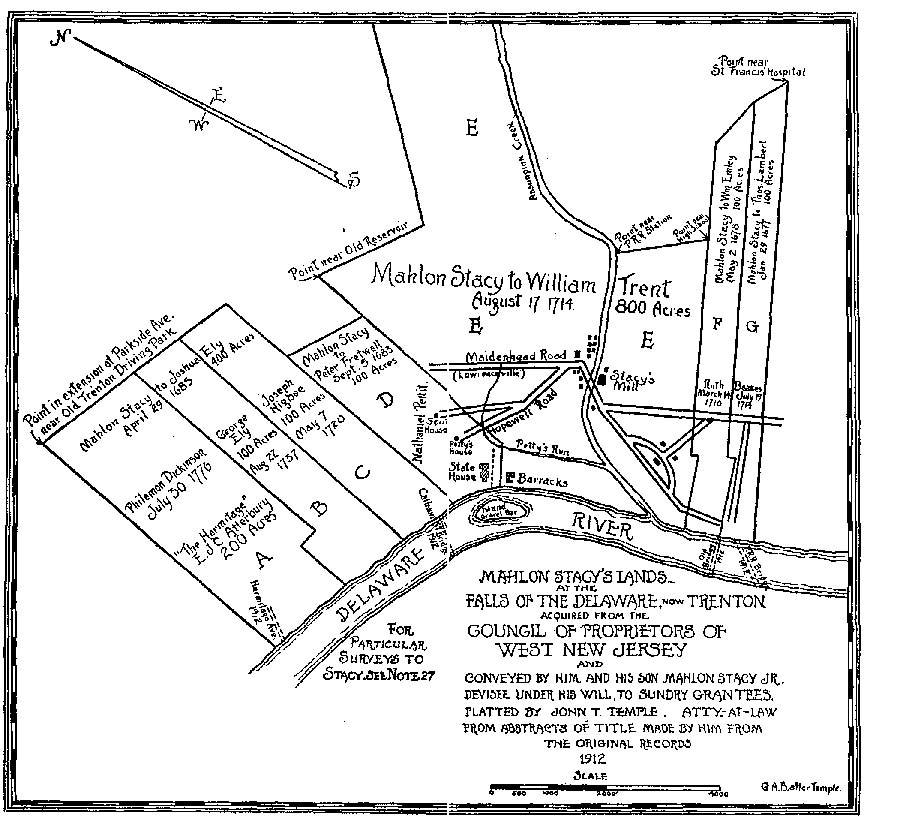 |
27 See map just above, made by John T. Temple, Esquire, counsellor at law, and published in the Trenton Times, Trenton, April 30, 1913. See also, Revell’s Book of Surveys, pp. 69, 76, 109, 134, Secretary of State’s Office; also Leed’s Book of Surveys, p. 23; Book A of .Surveys, pp. 6, 17, 35; Book M-1 of Surveys, p. 36, .Surveyor General’s Office, Burlington; also New Jersey Archives, Vol. XXI, pp. 361, 362, 371, 381. It would also appear that some of these surveys to Stacy were made after the land had been deeded by him. And some of them indicate duplications, that is, duplications not as to surveys, but as to place of recordation; for instance, the survey of 1000 acres to Mahlon Stacy in New Jersey Archives, Vol. XXI, p. 361, appears to be a duplicate recording or entry of the survey found in Revell’s Book of Surveys, p. 69, also Book A of Surveys, p. 6. By calculating the quantity of land surveyed to Mahlon Stacy (omitting seeming duplications) it would appear that more than 3500 acres were taken up .by him at the Falls of Delaware, extending back along Assunpink to Shabbaconck creek, in all upwards of five square miles.
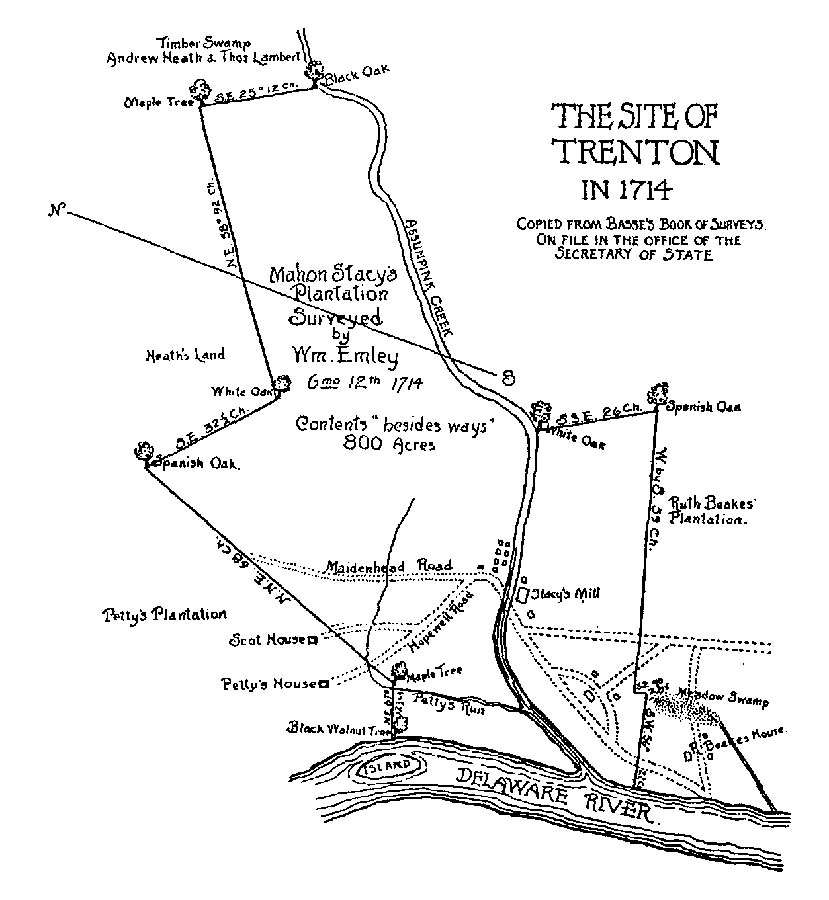
On plat “EEE,” Stacy to Trent, 1714, will be found seventeen markings apparently of buildings, besides the mill. On tract “D,” adjoining, will be found two similar markings, one labelled “Scot house” and the other “Petty’s house.” Also on the map of Trenton, 1714, below, are similar marings, labelled “R. Beakes house,” and two other smaller buildings. It may therefore fairly be assumed that the similar markings on the tract conveyed to Trent were houses, although such of them as might have been barns, granaries or other buildings cannot be told. However, it is fair to say that a considerable proportion of them were dwelling houses. This leads to the conclusion that Mahlon Stacy’s estate of Ballifield, which included tract “EEE,” was laid out and built somewhat upon the manor plan. A manor, says Mr. Blackstone, because the usual residence of the owner, seems to have been a district of ground, held by lords or great personages, who kept in their own hands so much land as was necessary for the use of their families and servants. The other lands they distributed among their tenants. (See Blackstone, Commentaries, Vol. II, p. *90.) A manor in America is defined to be a tract of land occupied by tenants who paid rent to the proprietors.) (.See Webster, New International Dictionary, 1928, p. 1313.)
So it would appear that Mahlon Stacy, the proprietor of Ballifield, built tenements which were occupied by renters. The houses and buildings are clustered together, doubtless for protection, for it could not be known in the very beginning what sort of trouble the settlers might have with the Indians. They doubtless went forth to cultivate the lands without their houses being scattered over the territory near to the place of their operations, just as is done in many places, notably in Europe at the present time.
A description of the land in the plat “F and G,” will be found in the conveyance from Samuel Atkinson and Ruth (Beakes), his wife, to William Trent, March 12, 1718, recorded in Book DD of Deeds, pages 378 and 379, in the office of the Secretary of State.
The markings indicating the State House, Old Barracks and Delaware Street, were put in by Mr. Temple at the time the plat was made, for greater certainty of starting point, location, etc.
Mahlon Stacy died April 3, 1704, leaving a last will and testament 28 wherein he gave and devised unto his son, Mahlon Stacy, the younger, his plantation Ballifield, together with the mill and other houses and buildings, lands and meadows, which remained to him, the older Stacy, at the time of his death. By deeds of lease and release 29 on August 16 and 17, 1714, Mahlon Stacy the younger conveyed unto William Trent eight hundred acres of land lying on both sides of the Assunpink Creek, being the Stacy plantation, Ballifield, of five hundred acres, and three hundred other acres adjoining thereto, which passed to him by the will; and which were the remainder of the elder Stacy’s lands here.
 |
28 Will bound in Vol. IV of Unrecorded Wills, p. 87, Office of the Secretary of State. This means that the original, not a copy, was bound up.
29 Release recorded in the Office of the Secretary of State in Book BBB of Deeds, pp. 123, &c.
A description of what Mahlon Stacy the younger sold and William Trent purchased, will be found in the deed just mentioned, from which the following is taken:
Now this indenture witnesseth that the said Mahlon Stacy for and in consideration of the sume of fourteen hundred pounds money according to the Queen’s most Royal proclamation . . . Hath granted bargained and sold aliened enfeofed conveyed and confirmed and doth by these presents fully and clearly and absolutely grant Bargain sell aliene Enfeofe Convey and Confirm unto the said William Trent his heirs and assignes for ever all that his plantation and Tract of land whereon he now dwelleth lying by the river Delaware in the Counties of Burlington and Hunterdon aforesaid containing 800 ackers of land and swamp with all and all manner of buildings Houses out houses Sellers storehouses Grist mills Boulting Mills and there apurtenaunces Mill stones Stables Orchards Gardens Meadows pastures Water courses Rivers Springs fencings hedgings ditchings and all and singuler other improvements be what they will belonging or appertaineing to the said plantation and tract of land.
Out of the tract, however, were excepted sixty acres sold by Mahlon Stacy, the elder, to Hugh Staniland, and afterwards by his son and heir Thomas Staniland to several persons (not named); and also a lot whereon William Yard dwelt, containing one acre more or less; and another small lot whereon Jacob Bailerjeau dwelt, containing one acre more or less; the latter two lots being sold by Mahlon Stacy the younger.
The eight hundred acres conveyed by the deed are expressed to begin by the river Delaware at a black walnut tree, corner of Nathaniel Petit’s plantation. 30 Roughly speaking, the tract extended from the Delaware River, between the State House and the Old Barracks, to a point near the old reservoir adjacent to Pennington Avenue; thence back into the country a long distance, and over to the Assunpink Creek; thence down the creek to a point near the present Pennsylvania Railroad station; thence over to a place near the high school on Hamilton Avenue; thence by a line down to the Delaware River, below the mouth of the Assunpink Creek; and thence up the river to the place of beginning. 31
30 See tract “D,” map, which was originally in the ownership of Mahlon Stacy, and came to Nathaniel Petit mediately from Mahlon Stacy himself. Platting reveals the fact that the black walnut tree stood between the State House lot and the lot of the Old Barracks; so there was the starting point.
31 See tract “EEE” on the map.
William Trent being thus seized in fee of 800 acres of land which was for many years in the heart of Trenton (and which has now expanded beyond it), he, and afterwards others claiming under him, made deeds to various people for lands here.
Title here, shortly, is derived thus: King Charles II to his brother, James, Duke of York; the Duke of York to John Lord Berkeley and Sir George Carteret; Lord Berkeley to John Fenwick in trust for Edward Byllynge, as to his undivided half; Sir George Carteret, William Penn, Gawen Lawrie and Nicholas Lucas, in trust for Edward Byllynge (the Quintipartite Deed, which divided the Province into East and West Jersey, East Jersey going to Sir George, and West Jersey to Penn, Lawrie and Lucas in trust for Byllynge); Penn, Lawrie, Lucas (added trustees) and Byllynge to Thomas Hutchinson, Thomas Pierson, Joseph Helmsley, George Hutchinson and Mahlon Stacy; the last five named to John Robinson and Thomas Lambert in trust to convey two whole and entire proprieties to Mahlon Stacy, which they did; Mahlon Stacy to sundry parties. 32 Some conveyances having been made by him before he left England, and Mahlon Stacy the younger, devisee of Mahlon Stacy the elder, conveyed to William Trent the 800 acres of remaining lands situate on both sides of the Assunpink Creek, Trenton. 33
32 See map, pp. 22-3, and explanation E, p. 25.
33 It is a common mistake to say that Mahlon Stacy purchased 800 acres on both sides of the Assunpink Creek (though it is never stated from whom). This mistake even appears in histories. What the elder Stacy did was to take up more than 3500 acres here by survey from the Council of Proprietors, and his son, Mahlon Stacy the younger, sold the remaining 800 acres to William Trent.
Such being the history of land titles in this vicinity, it will now interest us to know exactly how the Province was reduced into possession by the English.
After the making of the letters patent whereby title to Nova Caesarea or New Jersey, among other lands, was conveyed by Charles II in his brother James, Duke of York, and before the deeds of lease and release by the duke to Lord Berkeley and Sir George Carteret, and on April 26, 1664, before any formal declaration of war, Sir Robert Carre was sent to America with a small fleet and some land forces, to put the duke in possession of the country. 34 The expedition arrived at the Hudson River in the latter part of 1664. The land forces, consisting of 300 men, were under the command of Colonel Nicolls. The Dutch governor, Peter Stuyvesant, being unprepared for this attack, and knowing of defects of the Dutch title and their inability to make defense, after some argument was prevailed upon to surrender. The treaty on behalf of the English and Dutch contained many covenants, among them that the States General. 34a should freely enjoy all farms and houses; that all people should continue denizens, 35 and enjoy their lands, houses, goods, ships, wheresoever they were within the country and dispose of them as they pleased; that the Dutch should enjoy the liberty of their consciences in divine worship and Dutch discipline.
34 Smith, History of New Jersey, P. 35.
34a Generally known as Holland. Nelson’s Encyclopaedia, Vol. VIII, P. 457.
35 A denizen is an alien born, but who has obtained letters patent to make him an English subject. See I Blackstone’s Commentaries, *374.
The fort and city of New Amsterdam (New York) having been surrendered, most of the Dutch inhabitants remained and took the oath of allegiance to the British government, and many of them and their descendants have remained there ever since; hence the Knickerbockers of New York.
Colonel Carre and the commissioners, with the ships under his command, were then sent on an expedition into the Delaware Bay and River, to reduce the inhabitants there. 36 On his arrival at New Castle (Delaware) the Dutch and Swedes, following the example of their capital, New Amsterdam, capitulated and surrendered their fort. Articles were duly signed and contained, among other provisions, one that the people should enjoy liberty of conscience in church discipline, as formerly. 37 The parties to this agreement were Sir Robert Carre, on behalf of His Britannic Majesty, and the burgomasters, on behalf of themselves and all the Dutch and Swedes, inhabitants on Delaware Bay and River. 38
36 Smith, History of New Jersey, pp. 46, 47.
37 ibid., p. 48.
38 ibid., p. 49.
There was some sort of recapture by the Dutch of New York and New Jersey in 1673, largely theoretical, however, and they were again yielded to King Charles II by the treaty of peace, February 9, 1674, signed at Westminster; the sixth article of the treaty restored this country to the English. To prevent any dispute that might arise upon the plea of the property being alienated from the first purchasers, the King by his letters patent bearing date June 29, 1674, granted unto the Duke of York, his heirs and assigns, the several tracts of land in America which by the former letters patent had been granted to him, of which New Jersey was a part; and in this year, upon the application of those to whom Lord Berkeley had assigned the land, the duke made them a new grant of West New Jersey. 39
39 Smith, History of New Jersey, pp. 110, 111.
This last-mentioned conquest is not treated seriously by the historians, and the grants of confirmation are rarely referred to. They were doubtless unnecessary in view of the uninterrupted possession of the grantees here. They certainly are now of no legal, and very little historical, value. They may be waved aside without further ado.
Nothing has been said about the title of the Indians to the land in the Province of Nova Caesarea or New Jersey; nor has it been shown how they were quieted with reference to their claims of title in West Jersey. Some statement therefore on that subject should be made. Actual title to the soil was derived from the King of England, who claimed it by right of discovery and conquest. The Indian title was a possessory one, that of an occupant only, and was not of the fee, which is absolute ownership. Taking deeds from the Indians was therefore a sort of buying one’s peace in the possession and occupancy of the soil in which the grantee or purchaser had the fee. The Indians had no ownership in “severalty,” which means that they did not own lots or tracts whereon they dwelt themselves or which were in possession of their tenants, but their ownership of the land, such as it was, was common to the tribe. 40 Purchasers and settlers were obliged to obtain deeds for the Indian title, which they did, and usually for very inconsiderable amounts, being generally paid in such things as blankets, looking-glasses, fishhooks, firearms, fire-water, and so on.
40 “The Lenni Lenape or Delaware Indians,” Proceedings of the New Jersey Historical Society, New Series, Vol. II, No. 4, p. 193.
The council of proprietors of whom Mahlon Stacy, Thomas Gardner, John Wills, George Deacon, Christopher Wetherill, Samuel Jennings and John Reading were members, in session at Burlington June 28, 1703, certified that the council having taken into consideration the request of proprietors for a third dividend or taking up of land, answered by saying that they had lately made an Indian purchase of land situate above the Falls of Delaware, and that those persons were required to meet with the council that they might be more particularly informed concerning the purchase, its terms and conditions. 41 The proprietors were entitled to take up shares out of this purchase. 42 Doubtless many did, though such particular conveyances do not concern our history.
41 Smith, History of New Jersey, p. 96 and note.
42 ibid., p. 97.
IN THE tenth month (December) Old Style, 1678, the ship Shield arrived from Hull, England; Mr. Raum in his history says that it was December 10. 43 The Shield entered Delaware Bay and sailed up to Burlington, where it stopped. The river froze during the night and the people from the boat went ashore across the ice in the morning. In her came Mahlon Stacy, his wife and children and several servants, men and women. The others who came in the same ship were: William Emley (for the second time), with his wife, two children (one of whom was born on the way), and two men and two women servants; Thomas Lambert, his wife, children and several men and women servants; John Lambert and servant; Thomas Revell, his wife, children and servants; Godfrey Hancock, his wife, children and servants; Thomas Potts, his wife and children; John Wood and four children; Thomas Wood, his wife and children; Robert Murfin, his wife and two children; Robert Schooly, his wife and children; James Pharo, his wife and children; Susannah Fairnsworth, her children and two servants; Richard Tattersal, his wife and children; Godfrey Newbold; John Dewsbury; Richard Green; Peter Fretwell; John Fretwell; John Newbold; one Barns, a merchant from Hull; Francis Barwick; George Parks; George Hill; John Heyres; and several more. 44
43 Raum, History of Trenton, p. 42. This is apparently the only place that that exact date in December 1678 appears; and no authority is cited in verification. The “10” undoubtedly refers to the month only.
44 Smith, History of New Jersey, p. 108.
While in England Mahlon Stacy had acquired his interest in West Jersey, and was one of the Quakers from Yorkshire who selected the Yorkshire tenth as a place of residence; he settled at the Falls of the Delaware, apparently the most eligible spot, where he built a grist mill. He and his family and some of the other Quakers, who intended to settle at the Falls, must have stayed with their friends all winter at Burlington, where there was a town and houses already erected, and doubtless he and they came to the Assunpink in the early spring of the year 1679, on the breaking up of the winter. 45 This would appear from the book called Journal o f a Voyage 1679‑1680, previously referred to herein, and published by the Long Island Historical Society in their Memoirs, 1867. And the reason is obvious. The Quakers did not arrive in Burlington until December 1678, and it would have been quite impossible to start to build the mill and houses until after the spring thaw in 1679. The principals in that adventure were Jasper Dankers and Peter Sluyter, two priests of a sect called Labadists which taught a mysticism as primitive Christianity and believed in community of property among Christians. 46 These men were sent on a tour of observation through New York and adjoining Provinces for the purpose of the settling of a colony of their coreligionists. 47 They sailed from Amsterdam, Holland, June 14, 1679, 48 and sailed for home from Boston July 23, 1680. 49
45 In Raum’s History of Trenton it is stated, p. 50, that the first settlements were made by Friends at the Falls of the Delaware about the year 1676, but this appears to be a palpable error. No authority is given for it, and it is at variance with all the authorities, documentary and otherwise. The true date is 1679.
46 Webster’s New International Dictionary, p. 1200.
47 Journal of a Voyage, Introduction, p. xxx.
48 ibid., p. 14.
49 ibid., p. 392.
In the course of their journey through New Jersey Dankers and Sluyter arrived at the Falls of the South River (the Delaware), on Friday, November 17, 1679, according to the date given in the Journal. Their account of the place, being as it is the first written narrative of the settlement, is so important that it is here given in full:
Resuming our route, we arrived at the falls of the South river about sundown, passing a creek where a new grist-mill was erected by the quakers, who live hereabouts in great numbers, and daily increase. But it seems to us as if this mill could not stand long, especially if the flow of water were heavy, because the work was not well arranged. We rode over here, and went directly to the house of the person who had constructed it, who was a quaker, where we dismounted, and willingly dismissed our horses. The house was very small, and from the incivility of the inmates and the unfitness of the place, we expected poor lodgings. As it was still daylight, and we had heard so much of the falls of the South river, or, at least, we ourselves had imagined it, that we went back to the river, in order to look at them; but we discovered we had deceived ourselves in our ideas. We had supposed it was a place where the water came tumbling down in great quantity and force from a great height above, over a rock into an abyss, as the word falls would seem to imply, and as we had heard and read of the falls of the North river, and other rivers. But these falls of the South river are nothing more than a place of about two English miles in length, or not so much, where the river is full of stones, almost across it, which are not very large, but in consequence of the shallowness, the water runs rapidly and breaks against them, causing some noise, but not very much, which place, if it were necessary, could be made navigable on one side. As no Europeans live above the falls, they may so remain. This miller’s house is the highest up the river, hitherto inhabited. Here we had to lodge; and although we were too tired to eat, we had to remain sitting upright the whole night, not being able to find room enough to lie upon the ground. We had a fire, however, but the dwellings are so wretchedly constructed, that if you are not so close to the fire as almost to burn yourself, you cannot keep warm, for the wind blows through them everywhere. Most of the English, and many others, have their houses made of nothing but clapboards, as they call them there, in this manner: they first make a wooden frame, the same as they do in Westphalia, and at Altona, but not so strong; they then split the board of clapwood, so that they are like cooper’s pipe staves, except they are not bent. These are made very thin, with a large knife, so that the thickest end is about a pinck (little finger) thick, and the other is made sharp, like the edge of a knife. They are about five or six feet long, and are nailed on the outside of the frame, with the ends lapped over each other. They are not usually laid so close together, as to prevent you from sticking a finger between them, in consequence either of their not being well joined, or the boards being crooked. When it is cold and windy the best people plaster them with clay. Such are most all the English houses in the country, except those they have which were built by people of other nations. Now this house was new and airy; and as the night was very windy from the north, and extremely cold with clear moonshine, I will not readily forget it. Ephraim and his wife obtained a bed; but we passed through the night without sleeping much. 50
50 Journal of a Voyage, p. 172. There is another Journal of this voyage. It is entitled Journal of Jasper Danckaerts, 1679-1680. It was published in 1913, and is in the New Jersey State Library. It attributes the writing of the Journal to Danckaerts, spelling the name differently from that in the former and other edition, and giving authority for it. In the introduction it says that the translation differs very little from that made in the copy published by the Long Island Historical Society; and, by comparison, the translation concerning Friday; November 17, 1679, giving an account of the visit of the priests to the house of Mahlon Stacy at the Falls of the Delaware, is exactly the same.
In the succeeding entry, which concerns the next day, Saturday, the eighteenth of November, 1679, the Journal commences by the statement that after breakfast, about ten o’clock, they embarked for their journey down the river. So it will be seen that everything that is pertinent here has been included.
In a note to Smith’s History of New Jersey 51 under a letter from Mahlon Stacy to William Cook of Sheffield, dated at the Falls of the Delaware, 1680, it is stated that the inhabitants of West Jersey had theretofore either pounded their corn or ground it with hand mills; but about that time Olive built his water-mill near Rancocas Creek; and “this year” (not stating what year) Stacy finished his mill at Trenton; the two were the only mills that ground for the country for several years after their arrival. Although it has been generally thought, by reason of this note being under a letter dated 1680 (which makes no mention of the mill), that the date of the letter indicates that the mill was finished in 1680, this is not necessarily the case, and there is no real conflict in dates between the statement in the Journal of a Voyage and that in the note to Smith’s History. Therefore, the conclusion is that the mill was built in 1679 and finished late in that year, certainly on or before November 17, 1679, and it could not well have been started until the spring of the same year.
51 p. 114.
 |
Lossing, the historian, as is well known was also an artist, and visited the scenes of the battles and other places of interest of the Revolution and made sketches of the principal objects. He visited Trenton in November 1848 (as appears by a marginal note in his book) and made a drawing showing that portion of the mill still standing, as well as a portion of the creek. He said:
This view is from the north side of the Assanpink, a few rods above the bridge, looking south. The bridge, seen upon the right, is built of stone, and very strong, and is upon the site of the old one. The creek is curbed by a dam near the bridge and forms the sheet of water seen in the picture. The old “Stacy Mill” of the Revolution, the largest building in the sketch, was quite dilapidated from the effects of fire and flood, when I was there. 52
52 Lossing, Field Book of the Revolution, Vol. II, p. 233.
The building of the mill is also referred to by the late Rev. Dr. John Hall, Francis B. Lee, Esq., General William S. Stryker and Mr. Raum. 53
53 Hall, History of the Presbyterian Church, Trenton (2nd ed.), p. 10; Lee, History of Trenton, 1895, pp. 16, 17; Stryker, Trenton One Hundred Years Ago, p. 19; Raum, History of Trenton, p. 180 n., and p. 235.
The Journal of a Voyage says the mill was erected when they (Dankers and Sluyter) were here, and that the house was small and the inmates uncivil. That the house was small and airy and the wind came in through the crevices, was undoubtedly due to the fact that the dwelling must have been hastily constructed along with the mill and other houses in the spring and summer of 1679, and was only temporary, as we shall see hereafter. The incivility of the inmates toward their guests, if a fact, seems reprehensible to us of a more refined generation, but undoubtedly was due to the Stacys being austere Quakers, and Dankers and Sluyter clergymen of a very peculiar sect, for Quakers and ministers of the Gospel had very little regard for each other in those days. Probably something was said by somebody present which provoked some disagreeable controversy, and which led to the caustic remark of the voyager. Dankers and Sluyter were not mild men. It is stated in the Journal of a Voyage 54 that they went on board the Amsterdam packet, on which there were different kinds of people, “all wicked.” In particular, they frequently disparaged the Quakers and said derogatory things of them. 55 Of course everybody with whom they disagreed was “wicked,” and they doubtless shared the prevailing opinion, which was decidedly against the Quakers. The Rev. John Talbot, a minister of the Church of England, residing in Burlington, in 1703 wrote the Society for the Propagation of the Gospel:
The Quakers compass sea and land to make proselytes; they send out yearly a parcel of vagabond Fellows that ought to be taken up and put in Bedlam rather than suffered to go about raving and railing against the Laws and Orders of Christ and His Church and for why: Their preaching is of cursing and Lyes, poysoning the souls of the people with damnable errors and heresies. 56
54 p 4.
55 See pp. 176, 182, 244.
56 Schuyler, History of St. Michael’s Church, Trenton, pp. 4, 5.
The Quakers were no more tolerant or courteous toward their opponents. In the title page of one of their books they express the abhorrence they felt toward one of their former associates, as follows:
The Apostate convicted . . . in which his apostacy from the Truth and enmity against it is manifested, his Deceits, Hypocracie and manifold prevarications are discovered, his false Quotations, Lyes and Forgeries out of the Quaker Books are detected, etc. 57
57 ibid., p. 5.
In what contrast was the comparatively spacious house in which Mahlon Stacy died twenty-five years after the visit of Dankers and Sluyter, is attested by his will, 58 in which he said:
And also I give the use and benefit of the two Parlours and the chamber over the Parlours to Rebecca, my wife, and all the orchards on the south side of the dwelling house, and free liberty at all times to use the pump for Water, and also of her own choice to keep Cows and Cut Hay for winter fodder &c. during her life.
58 Office of the Secretary of State, Vol. 4 of Unrecorded Wills, p. 87.
As stated in the Journal of a Voyage, in the late fall of 1679 there were many Quakers at Trenton and they daily increased. This undoubtedly means that many of the Friends who accompanied Stacy on the Shield in 1678 came up from Burlington to the Falls of the Delaware with him in the spring of 1679, for the purpose of forming a settlement here, which is further evidenced by his building a grist mill at this place at that time; and many other habitations also must have been built.
This locality was then known, and its name was quaintly written, as “ye ffalles of ye De La Warr,” and was called for short “The Falls.” By 1685 a number of people, says the historian Francis B. Lee, came to the new town to join their fortunes with those of Stacy. 59
59 Lee, History of Trenton, 1895, pp. 17, 18.
The list of proprietors was for the first time printed in Mr. Lee’s History, which gives all the landholders of the first (Yorkshire) tenth. It includes the names of plantation holders in Trenton and vicinity as the record stood in 1684, as follows:
| Robt Stacy | John Shinn | Marmaduke Hawsman |
| Tho Revell | Tho : Budd | Antho : Woodhouse |
| Seth Smith | Tho : Curtise | Willm Black |
| the 3 brothers | John Butcher | Tho :ffarnsworth |
Wheelwrights |
Samuel Barker | Peter Harrison |
| Tho Bowman | John Curtise | Byran Morehouse |
| Tho Budd | John Browne | Tho Theakes |
| Richard Guy | Michael Newbold | Mathew Watson |
| Nathaniell West | Persifall Towle | Thomas Wood |
| Tho : Singleton | John Antram | John Wood |
| Tho Terry | John Woolston | Robt Wilson |
| Mordecay Bowden | Godfrey Hancock | Willm Hickson |
| John Goslinge | Henry Stacy 59a | Roger Parke |
| John Cripps | Willm Biddle | Thomas ffoulke |
| Joseph Blowdes | Jno Underhill | ff rancis Davenport |
| Tho Wright | Samll Andrews | Samuell Wright |
| Edmund Stuart | Samll Borden | Thomas Wright |
| John Long | Willm Beard | Joseph Stone |
| Samll Oldale | John.Snoden | Thomas Lambert |
| Elias ffare | John Hooten | Thomas Tindall |
| ffrancis Boswock | Henry Stacy 59a | George Hutchinson |
| Daniel Leeds | John Horner | Jno Pattison |
| Robert Young | Willm Barnes | Willm Lasswell |
| John Daye | Daniel Bason | Robt & John Murfin |
| Eleazer ffenton | George Goforth | Robt Pearson |
| Tho Sharman | John ffullwood | Joshua Wright |
| Robt & Tho : Scholey | Andrew Smith | Tho : Lambert |
| John Rogers | Peter ffretwell | Willm Emley |
| James Pharoe | Hugh Staniland | Thomas Bartin |
| George Hutcheson | Mahlon Stacy | John Pancras |
| John Lambert |
59a This name (Henry Stacy) is repeated in the original minutes of the Supreme Court, called the “Court Booke,” once for 500 acres, and once for 100 acres, and it probably refers to the same person owning different lots. - The Author.
North of the Assunpink was practically terra incognita, says Mr. Lee; one authentic record remains, throwing light upon the life of the people at the Falls, and that is the Court Book, wherein the first officers elected by the people of Burlington County, to serve for Trenton 60 as well as for Burlington, are set out. It shows that William Emley was elected sheriff for one year to serve from St. Pink (Assunpink) to Old Man’s Creek; Thomas Wood was elected constable at “ye Falls and ye Liberties thereof”; Thomas Revell, registrar; and Daniel Leeds, surveyor. 61 That the Falls and its vicinity had grown to sufficient size to require the services of a constable proves that the population of what is now Trenton had increased with considerable rapidity. 62
60 So called by Mr. Lee for certainty of locality, but not then so named.
61 Lee, History of Trenton, p. 18.
62 It is pertinent to make some observations on the office of constable. That, like justice of the peace, has indeed sunk to a low estate in some instances in present times, but in ancient times it was a high office. High constables were first ordained, according to Blackstone, by the statute of Westminster (13 Edw. I, A.D. 1285), though they were known as efficient public officers long before that time. They were appointed for each franchise or hundred, by the leet (court), or, in default of such appointment, by the justices of the quarter sessions. Their first duty was that of keeping the King’s peace, and in addition they served warrants, returned lists of jurors, and performed various other services enumerated in Coke’s Institutes. (See Bouvier, Law Dictionary, Rawle’s 3d rev., Vol. 1, p. 625.) And James, Duke of York, in his release to Berkeley and Carteret, describes himself as Constable of Dover Castle. - The Author.
The use of liquor and sundry regulations in early Burlington are of interest, says Mr. Lee:
Upon the eighth and ninth of August, 1682, it was “ordered by the Co’rt that noe Person or Persons keeping or that shall keep an ordinary or Inne within the jurisdiction of this Court shall from & after ye Tenth day of August instant, take more than two pence for an Ale Quart (Winchester meazure) of good wholesome Ale or strong beere. And Benjamin Wheat and Henry Grubb are by ye Co’rt appointed to bee Ale Tasters and to goe to ye measures for Ale and beere, according to ye order above, untill ye next Gen’all Assembly or further order.” Again, upon the twentieth of February, 1682, the court ordered that after the first day of March "”cyder shall not be sold for more than four pence ye Quart and yt Rumme from and after ye tyme afores’d shall not be sold for more than one shilling six pense ye Quart.” 63
63 Lee, History of Trenton, p. 18.
64 Leaming and Spicer, Grants and Concessions (1664-1702), p. 442.
65 ibid., p. 443.
66 ibid., p. 489.
67 ibid., p. 498.
Mahlon Stacy’s home plantation comprised five hundred acres on both sides of the creek at the Falls, which he called “Ballifield,” for his ancestral home in England. His own dwelling there was called “Dore House.” His mill was built on the south bank of the Assunpink Creek, adjacent to the road called York Road, afterwards Queen Street, then Greene, and now Broad Street. As already stated, he died at his home, Ballifield, April 3, 1704. In the record of burials in Liber K of the Friends Chesterfield Monthly Meeting (Trenton and Crosswicks being subsidiary to the Chesterfield Meeting) is an entry that Mahlon Stacy was buried the 5th day of the 2nd month (April) 1704, at the burying place in Nottingham in the county of Burlington. This refers to the early Quaker burying ground in the extreme southwesterly part of Riverview Cemetery. His grave is now unmarked, although originally there probably was a very small stone erected over it after the manner of marking graves by the Quakers of those days. The inventory of his estate, bound up with the will, shows he left personal property valued at £1034 0s. 6d. Beside the provision for his wife he said in his will:
I give and bequeath unto my sonn Mahlon Stacy his heirs and assigns forever, all that my plantation whereon I now dwell, called “Ballifield,” together with the Mill, and all other houses, and Buildings, Lands, Meadows, and pastures, &c. containing 500 Acres of Land, more or less, when he shall attain the age of one and twenty years, and also, all my Land lying on the south side of greater Shabba-cunck, and all other lotts, shares or portions of Land throughout the sd province of Nova Cesarea aforesd, not yet taken up, and which shall at any time hereafter become due, and of right to me, belonging.
Mahlon Stacy married in England Rebecca Ely, and left surviving him one son, Mahlon, the younger, and five daughters. Two daughters were born in England, but two others and the son were born at the Falls. Mahlon Stacy, the younger, the one continuing to bear the surname, married Sarah Bainbridge, but died childless in 1742, and the name Stacy of this family became extinct. The daughters all married and numerous descendants of theirs are still living in New Jersey, Pennsylvania and elsewhere. 68
68 Mackenzie, Colonial Families of the United States, Vol. V, p. 524; see also Ely, Revell and Stacy Families, Fleming H. Revell Co., p. 138.
Mahlon Stacy appears to have been considerable of a letter writer, and his epistles were probably numerous and quite lengthy. In Smith’s History of New Jersey 69 is an abstract of a letter from himself to his brother Revell 69a and some others, dated the 26th of the 4th month (June), 1680 (O.S.), together with an abstract of one of his letters to William Cook of Sheffield, England. 70 Even as abstracts they are very voluminous. Another letter of Stacy’s, to his friend George Hutcheson of England, is in possession of the New Jersey Historical Society of Newark. It is dated at the Falls of the Delaware, the 12th of the 6th Month (August), 1680 (O.S.). While it is principally devoted to religious utterances it nevertheless has an eye to the main chance, namely, the prosperity of the Province in general and of the Friends in particular. As it has never before been published in full it is here so given:
DEARLY BELOVED FREIND, & BROTHER:
In the Blessed Truth of Jesus do I dearly Salute Thee, thy dear Wife, and all tender Freinds, with whom I have been Conversant, and amongst whom my Spirit hath been Refreshed; my dear Love in the Lord salutes them all, desiring as one traveling for the Good and Prosperity of all that love the Lord Jesus; that Grace, Mercy, and Peace from God the Father and our Lord Jesus Christ, may be multiplied amongst them abundantly, that they all may be compleatly furnished, wanting nothing, being made able to stand in the Stormy Day, which is hasting on to try the Foundation of all Proffessions: In which it shall be said, Woe to the Wicked; for it shall go ill with them in that Day, when they shall come to receive the Reward of their Doings. But to the Righteous, it may be well said; It shall go well with you, even all of you, that have born the Name of Jesus; for the Reward of my Love is given you, saith the Lord; and great shall be your Peace and Portion for ever. Amen.
Dear Friend, Thine of the 23d, iith moneth, 1679, I have Received with great Gladness and Acceptations, as a Token of thy endeared Love and Care, with thy tender Desires for us, and grave Counsel to us: all which I dearly accept of, knowing it was the Flowings-forth of a Soul Fil’d with Love to the Heritage of God in these Parts. For the watering of whom God had fil’d the Hearts of His Servants with His pure Love, precious Life, and Streams of Living Refreshment, for the Comforting of Jacob in his Travels and Tryals, and for the gladding of Israel in the Day of Exercise. So, although we are separated as to the Outward, (a little Scattering as I
may say) yet the God of Life abounds in His Love to His Little Flock, dayly extending His Peace (as a River) to His Remnant; And is determined, of a small Number, to make a Great and Strong Nation: And this I plainly saw before I left my Native Country; and the Lord is Mightily bringing it to pass, in His Removing the Heathen that know Him not, and making Room for a better People, that fears His Name. ‘Tis hardly credible to believe, how the Indians are wasted in Two Years Time; and especiall the last Summer: and how the English are encreased both in Cattle and Corn, in a little time.
Things go exceeding well with Friends, since they were settled, and our Meetings are duely Kept. The Lord our God is with us, and the Shout of a King is amongst us, Glory, Glory to the Lord our God for ever! I perceive you have strange Reports concerning Us, and our Country; yet our Condition is far otherwise than is represented unto you: for our Land yields its Strength to us in a plentiful manner and we enjoy Fulness of Good Things: The greatest want is that of our Friends; yet the Lord is adding to our Number greatly; and in a short Time, this Place will be Populated. Friends are generally Healthful and well. Mine, and my wifes dear and tender Love salutes Thee and Thine, with all the Faithful in the Lord; and that the fountain of the Love of God may be your dayly Refreshment and Consolation, prayeth
Thy Endeared, & Loving assured Friend,
MAHLON STACY.
69 p. 111.
69a This must have been his (wife’s) brother-in-law, Lionel Revell, who had married Ruth Ely and was then residing in Sheffield. See Ely, Revell and Stacy Families, pp. 142, 143.
70 ibid., p. 113.
Stacy was a canny citizen himself, for in his letter to William Cook of Sheffield, above referred to, he said among other things:
I, with eight more last winter, bought a good ketch [a fore-and-aft-rigged vessel] of fifty tons, freighted her out at our own charge, and sent her to Barbados, and so to sail to Saltertugas, to take in part of her lading in salt, and the rest in Barbados goods as she came back; which said voyage she hath accomplished very well, and now rides before Burlington, discharging her lading, and so to go to the West-Indies again; and we intend to freight her out with our own corn. 71
71 Smith, History of New Jersey, p. l14.
There is another letter, 1680, from Mahlon Stacy to his brother Revell (probably his wife’s brother-in-law, see note 69a), in which he says he had travelled through most of the places that were settled and had seen orchards laden with fruit. 71a Now, some people might think that there were orchards hereabout, which indicated earlier settlers. Not so. In the first place, Stacy does not declare that he found orchards here, and in the second place, there could not have been any orchards laid out by Englishmen because it takes several years for fruit trees to bear. The first English settlements were at Salem, 1675, Burlington, 1677, and Trenton, 1679, so that even at Salem, settled four years before Trenton, there could have been no bearing orchards there planted by the English; but we must remember that the Dutch and Swedes were in South Jersey (south of here) many years before the English and they remained and amalgamated with the permanent English settlers. It may have been their orchards that are referred to; besides, Stacy likely visited the English settlements in East Jersey which had been established several years before, and some orchards might have been seen there.
71a ibid., p. 111.
This, it will be observed, was in 1680, within the second year of his arrival here. He continued to be a man of energy and prosperity, as the land he owned and left and the inventory of his estate abundantly show. He lived here a quarter of a century - from 1679 to 1704 - and his son and devisee sold the remnant of his land in this community to William Trent ten years after his death, namely, in 1714. The Stacys, father and son, lived here altogether thirty-five years; the son moving to Mount Holly after selling to William Trent, who, unfortunately, lived only three years after becoming a resident at the Falls in 1721, though the place was afterwards named “Trenton” in his honor.
THERE will now be considered the advent and life in these parts of William Trent, a man of address, ability and property; one who attained high office in the Colony, and if the memoir concerning him be somewhat brief, it is due to the fact that he lived here only three years, - from 1721 to 1724. While his accomplishments here were great, they were crowded into a comparatively short time and, necessarily, are briefly told.
William Trent came to Philadelphia soon after it was settled in 1682, from Inverness, Scotland, where he had been born. He was a merchant and man of considerable wealth. He became a member of the Provincial Council of Pennsylvania in 1703, and member of the Assembly there in 1710, 1715, 1719, and was speaker in 1718-19. He, with another, fitted out in 1709 a sloop of war for service in the war of England against France, and with others owned a sloop at Burlington. In 1714 he purchased from Mahlon Stacy, the younger, eight hundred acres of land, which had passed to him under his father’s will; it lay on both sides of the Assunpink Creek at the Falls of the Delaware, and afterwards he bought still additional land from others in 1718-21. He removed to his new purchase in 1721, and had a township laid out which he called Trent’s Town. He was commissioned by Governor Burnet of New Jersey to be Colonel of the Hunterdon County Militia, and represented Burlington County in the Assembly in 1722, becoming speaker in 1723. He was made judge of the Court of Common Pleas of Hunterdon County in 1719, and was appointed chief justice of New Jersey in 1723; he died in 1724. He was twice married; first, to Mary Burge, by whom he had three sons, James, John and Morris, and one daughter, Mary; second, to Mary Coddington, by whom he had two sons, Thomas and William. The first died in infancy, but William became known as Major Trent. 72
72 Schuyler, History of St. Michael’s Church, Trenton, Appendix I, pp. 339, 340. For further particulars, see also pp. 337-44.
Chief Justice Trent built Bloomsbury Court, still standing on South Warren Street, Trenton. This was before he moved here, and is said to have been in 1719. He probably spent the summers here before coming permanently. The mansion is of bricks brought here from England as ballast. A wooden addition was made by Mr. Redman during his occupancy of the dwelling which might well be torn down and thus leave the property standing exactly as built by Colonel Trent. 73 It is a splendid mansion of purely Colonial design, formerly having extensive grounds surrounding it, which, though greatly encroached upon, are still substantial; once a park it is now but a large lawn. 73a
73 ibid, p. 343.
73a There is a movement afoot in Trenton to have the city acquire it, as it is the oldest house here, built and resided in by the early chief justice of the Colony and the residence of several governors since that time.
Shortly after he had made the appointment, Governor Burnet wrote to the Lords of Trade saying: “The present Chief Justice, Mr. William Trent, is universally beloved, as your Lordships may observe by his being chosen their Speaker, and I doubt not will answer my expectations in executing the office.” 74
74 Keasbey, Courts and Lawyers of New fersey, Vol. I, p. 275.
Colonel Trent was a devoted member of the Church of England, and was originally associated with Christ Church, Philadelphia, of which he was for a time a vestryman; his name appears in the list of the church’s benefactors who contributed to the parish needs. He was also interested in the church at Burlington. 75 While he was not a lawyer he was an able, rich and active man of affairs, and was the first chief justice of New Jersey to be appointed independent of New York.
75 Schuyler, History of St. Michael’s Church, Trenton, pp. 12, 13.
The burial place of William Trent is unknown. That he died in Trenton, December 25, 1724, is well known. The following appeared in the Philadelphia Weekly Mercury, December 29, 1724: “On Friday, 25th of this instant, William Trent, Esquire, Chief judge of the Province of New Jersey, departed this life, being seized with a fit of apoplexy in Trent-town.” It is surmised by many that he was interred in the Quaker graveyard, now a part of Riverview Cemetery, but there are no records showing this to be the case. It seems to the Rev. Dr. Hamilton Schuyler well-nigh certain that the body of William Trent will be found in the consecrated graveyard of the Hopewell Church. Strong corroboration of this is afforded by an article in the Trenton State Gazette, December 6, 1842, speaking of the old Hopewell burying ground, in which it was stated that the remains of the widow of Colonel William Trent were buried there; and tradition came to the Rev. Dr. John Hall, who wrote a History of the Presbyterian Church in Trenton, to the effect that Mrs. Trent was buried in the graveyard mentioned, which is also corroborative of the apparent fact that her husband, the Colonel, was himself buried there. 76 The writer of this chapter concurs in the view entertained by the Rev. Dr. Schuyler.
76 Schuyler, History of St. Michael’s Church, Trenton, pp. 241, 243.
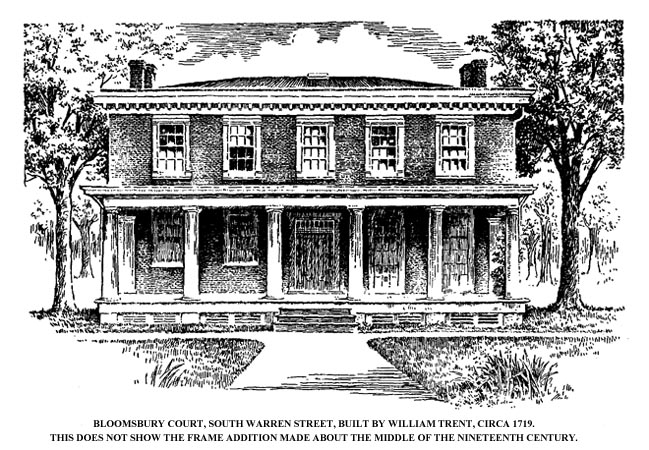 |
As already stated, Chief Justice Trent died on December 25, 1724. He left no will. His widow, Mary, renounced her right to administer, and James Trent, eldest son of the late chief justice, was appointed by Samuel Bustill, surrogate of the Western Division of the Province of New Jersey, to be administrator of the decedent’s estate. James Trent, the administrator, entered into bond to His Excellency William Burnet, who was Governor and Ordinary, in the sum of £1500, to make a true and perfect inventory, to well and truly administer the estate according to law, and to cause a just and true account of his administration thereafter to be made, and to distribute to such person or persons respectively as by the decree or sentence of the court should be limited and appointed. Daniel Cox and Alexander Lockhart executed the bond, as sureties, along with James Trent, the administrator. The bond to perform his duties faithfully was filed, together with the oath of the administrator, on or about March 16, 1725. The inventory shows a total estate left by William Trent, deceased, amounting to £1100 18s. 1/2d. This, of course, includes only personal property, and the real estate holdings, which were left by the deceased, descended to and vested in James Trent, his eldest son and heir-at-law, it being a rule of the English law which then obtained in the Province of New Jersey that the eldest son of a person dying seized of real estate should inherit to the exclusion of other children. 77
77 2 Blackstone’s Commentaries, p. 214.
The real estate of course included the mansion and estate of Bloomsbury Court. This fine old house was the scene of many social gatherings in Colonial days and afterwards. 78 It is said that: “General Washington and his lady enjoyed the hospitality of Bloomsbury Court, and the Marquis de La Fayette, Rochambeau, and other noted Frenchmen, were entertained there.” 79
78 For a description of the house and the entertainments, see Mills, Historic Houses of New Jersey, 1902, p. 264.
79 ibid., p. 267.
Much of what Chief Justice Trent did for Trenton is recited in the ferry patent granted to his son James Trent, by Governor Burnet, February 7, 1726. 80 An account of this ferry will more properly come later in another chapter under an appropriate head, but it is here given in some detail as it largely concerns the life and work of Chief Justice Trent himself.
80 Book AAA of Commissions, Office of the Secretary of State, p. 220.
The patent recites that William Trent in his lifetime had expended and laid out a great part of his estate in purchasing lands and making improvements on them, near, and adjoining to, Delaware Falls, and that by his industry, application and encouragement given for building, there had been erected a pretty considerable town which had theretofore been created into a township by letters patent to William Trent, by the name of the township of Trent Town, and that it would be a great security and convenience to travellers if a regular ferry or ferries could be kept for carrying of passengers and goods over the Delaware near to the town of Trent Town. The grant then proceeds:
Know ye that by our Especial Grace certain knowledge and mere motion, wee have Given And Granted and by these presents do give and Grant unto Our said Loveing Subject James Trent, his Heirs and Assigns the Sole Liberty and Privilege of Erecting and Keeping of a fferry or fferreys for transportation of Goods and Passengers over the River Dellaware in any Place or Places within two Miles above or two Miles below the ff als of Dellaware River near Trent Town aforesaid . . . . IN TESTIMONY WHEREOF We have caused these our Letters to be made patent and the Great Seal of our province of New Jersey to be hereunto affixed. WITNESS our trusty and well beloved William Burnet Esquire our Captain General and Governor in Chief of our Province of New Jersey New York and Territories Thereon depending in America and Vice Admiral of the same &c. the Seventh day of february in the Thirteenth Year of our Reign Anno Dei (Domini) 1726.
This patent for the ferry was sold and conveyed by James Trent to William Morris by deed (other than that conveying Bloomsbury Court) May 28, 1729. 81
81 Recorded in the Office of the Secretary of State, Liber D of Deeds, p. 686, &c.
It is interesting to note that James Trent, son and heir-at-law of Chief Justice Trent, sold and conveyed to William Morris, on March 28, 1729, about three hundred acres of the land he inherited from his father, and this included Bloomsbury Court. 82 The following appears in the conveyance itself:
Between James Trent Esquire Son & heir at Law of William Trent late of Nottingham in ye County of Burlington in ye western Division of the Province of New Jersey Esquire deced of the one part And William Morris of the Island of Barbadoes in ye English West Indies in America Merchant of ye other part WHEREAS . . . Mahlon Stacy of Nottingham aforesd son and heir at Law of Mahlon Stacy . . . became seized in his demesne as of flee of & in one certain Tract of Land and plantacon containing by a resurvey thereof eight hundred Acres (which was conveyed by Mahlon Stacy to William Trent, who died seized thereof, whereby the premises descended to James Trent, his eldest son and heir at law) . . . . NOW THIS INDENTURE WITNESSETH that the said James Trent for and in consideracon of the sum of two Thousand eight hundred pounds of good lawful Money of America according to the late Queen Anns Royal proclamacon to him in hand paid by the said William Morris... Doth fully freely & absolutely grant bargain Sell alien and enfeoffe convey & Confirm unto the said William Morris his heirs & assigns forever three hundred acres of land or thereabouts more or less being part and parcel of ye Above mentioned & above described eight hundred Acres of Land and is Scituate lying & being in ye Township of Nottingham and County of Burlington aforesaid & South side of Assunpink Creek aforesaid [description of land] . . . Together with that Brik Messuage or dwelling House lately erected by ye said William Trent wherein ye said James Trent now Liveth with ye appurtenances Together also with ye Water grist Mill or Mills being three grist Mills under one Roof comonly called & known by the name of Trent’s Mills and ye Mill stones and other Ghear to ye Mills belonging or appertaining or with ye same now used occupied enjoyed or reputed as part or member thereof and one Pulling Mill now or late in ye Tenure & occupacon of Jonas Ingham, and one Saw Mill or such part as remaineth thereof and all boultings Mills Sett up & Erected in ye mill house of the said Grist Mill and Boulting cloths & Appurtenances to the land belonging with all Houses Mill Houses Out houses Barns Stables Orchards Gardens Meadows Pastures Woods under Woods Timbers & trees, Water Courses Dams Mill ponds and soil there &c.
82 Deed recorded in the Secretary of State’s Office in Liber D of Deeds, P. 382, &c.
This deed is signed and sealed by James Trent and is witnessed by Tho. Lambert, Samuel Bustill and Anthony Morris, Jun.
It will be observed that James Trent in this deed recites the property as being in Nottingham, not in Trenton, and he herein solemnly asserts over his hand and seal that it is together with the brick dwelling house lately erected by William Trent, his father. This is none other than Bloomsbury Court, and while all other statements concerning it are but hearsay, here, of record, we have positive proof of its erection by Chief Justice Trent. And by this conveyance Bloomsbury Court passed forever from the family of its builder.
It is pertinent to call attention to another deed between James Trent and William Morris, made June 12, 1734, 83 which affords documentary proof that Mahlon Stacy, the younger, conveyed to William Trent only part of the land he had by devise from his father, and this deed contains the following recital:
Witnesseth that whereas Mahlon Stacy Late of the Province aforesaid, In his life Time Had surveyed unto him a Certain Parcel of Land Lying on Assanpink within the Province of new Jersey, as may more at Large appear in the Surveyor Genels office of said Province Relation being thereunto had, Who being thereof Seised did afterwards depart this life by reason whereof the Same Devolved unto [this devolution was by will, and the deed should properly have so recited] and became the Right in Law of his Son Mahlon Stacy, who being thereof thus Seised did convey a Part of the Same unto William Trent, and some time after the Purchase thereof the Said William Trent died Intestate, whereby the Said James Trent party to these presents became Lawfully Seised of the Same as Son and heir at Law to the said William Trent Deceasd Now this Indenture Further Witnesseth that, &c. 84
83 Recorded in the Secretary’s Office at Burlington, Liber I-K, folio 9 &c.
84 This was a conveyance of a lot in Trenton for £6. 8s. current money. The original deed is in possession of the author. It is on parchment.
The Trent family, by that name at least, has disappeared from Trenton. 84a Descendants by the name of Trent are known to be still living in the South.
84a Some years ago a descendant of Chief Justice Trent, through the female line, Miss Anna Rossell, was living in Trenton, but she is now deceased.
THE names of Stacy, the pioneer of Trenton who owned all the land in what was for many years the old city, and William Trent, the patron of the old town, are indissolubly linked together in the history of this city. In “Trenton” we find the name Trent; and the beautiful and extensive park on the river front, including the grounds of the State House and the Old Barracks and extending from them up the river on the southwesterly side of the Sanhican Creek, as far as the city limits, is named “Mahlon Stacy Park.” Then, too, the names of these worthy men are hyphenated in that of the “Stacy-Trent” hotel, at State and Willow Streets, the leading hostelry of the town.
Both men were rich and owned and left slaves. In the inventory of Stacy, appraised April 25, 1704, and filed in the office of the Secretary of State, amounting in all to £1034 0s. 6d., the appraisers being Abel Janney, Samuel Beakes, Will. Beakes, and ffrancis Davenport, appears the following: “Item: ffour Negros.”
In the inventory of Trent, filed in the office of the Secretary of State November 2, 1726 (with addition filed April 15, 1727), amounting in all to £1100 0s. 1/2d., Peter Bard and Natha. Leonard being the appraisers, are the following items: “Accot of Negroes Vizt. A man nam’d Yaff; a woman nam’d Joan; a boy nam’d Bob; 1 Do. Dick; a Girle Nanny; a child Tom. Three Negro Men as follows Vizt. Julius, Bossin, Harry; Two Indian Men Vizt. Cupid, Pedro.”
Mr. Lee, speaking of slavery in Trenton says: “During the Colonial period, slavery in New Jersey was a thoroughly recognized institution. In the formative period of provincial existence, so much has been written concerning the slavery of negroes and Indians that especial reference here would be superfluous.” 85 The New York Gazette and the American Weekly Mercury contained many advertisements during the Colonial period of runaway slaves from Trenton homes and families. It is pertinent, however, to remark that slavery was not ended in New Jersey until 1846, when the Legislature passed an Act to abolish that institution. It provided “that slavery in this State be and it is hereby abolished, and every person who is now holden in slavery by the laws thereof, be and hereby is made free, subject, however, to the restrictions and obligations hereinafter mentioned and imposed; and the children hereafter to be born to all such persons shall be absolutely free from their birth, and discharged of and from all manner of service whatsoever.” The restrictions and obligations were that every slave should become and be an apprentice, bound to serve his or her then present owner until discharged; and, further, that they might be discharged only in certain ways. 85a Of course when not discharged they continued apprentices for the rest of their natural lives.
85 History of Trenton, p. 27.
85a Revision, Approved April 18, 1846, State Library.
There was another class of servants, namely, redemptioners. All strata of society were represented among them. Once landed they were offered to the highest bidder and hurried off to nearby farms; the redemptioner practically agreed to sell himself or herself for such time as necessary to earn the money to pay passage over sea; and then too there were many apprenticed and bound servants. 85b
85b Lee, New Jersey as a Colony and as a State, Vol. 1, pp. 199, 202.
If these two, Stacy and Trent, could return from the tomb, and with amazement view the many and marvellous improvements upon the site where they lived and died, and could they meet upon the spot, there would doubtless be no misunderstanding between them as to the town, its settlement and improvement in the olden time. Some historians who have come after them have mentioned one or the other as being the founder of Trenton (but without citing authorities for their statements), and it would seem apparent that something should be said upon the subject. No one can read this narrative and not be convinced that Mahlon Stacy was the first Englishman to settle permanently at the Falls of the Delaware (1679), who was the owner of all the land in this locality, others coming here with him; and that ten years after his death William Trent bought (1714) from his son and devisee under his will, all the land left by the older Stacy at the Falls, and that Trent lent the weight of his name and enterprise to the laying out and upbuilding of the town.
The following appreciation of Mahlon Stacy was written by the historian, Mr. Lee. 85c
Of the early settlers of West New Jersey none stands in more striking light than does Mahlon Stacy, of Hansworth, in the county of York, in Old England. To him must be given the credit for the practical settling of the northern portion of the Yorkshire Xth, which extended, by virtue of the purchase of 1677, from the Rancocas to the Assunpink. Mahlon Stacy reached America in the Shield, from Hull, Daniel Towes, master, which, in December 1678, landed her passengers at Burlington. With Mahlon Stacy were his wife, children and men and women servants. That he at once came to the site of Trenton is shown by the fact that he began the erection of his grist mill in 1679, and in 1679-80 Jasper Dankers and Peter Sluyter, Dutch Labadists, speak in their Journal of Mahlon Stacy’s house on the site of Trenton. He was the representative man in the vicinity of “Ye ffalles.” Mahlon Stacy was influential in the Society of Friends, of which body he was a faithful member. His large plantation interests and his wealth made him rank easily among the half score of men who framed the destinies of Burlington County between 1676 and 1715. In the political life of the time, he held, from one year to another, nearly every office of profit and trust in the Province. He appears as commissioner in 1681-82, and as a member of Assembly in 1682, 1683, 1684 and 1685. He was also a member of Council in 1682 and 1683. In 1683, 1684, 1685 he was an Indian Land commissioner, and in 1683 was selected to write to the members of the Society of Friends, in London, describing the condition of the new settlement. As a justice, he sat in the 1st Xth in 1685, and continuously remained on the Burlington bench as His Majesty’s justice from May 1685 to May 1701.
85c History of Trenton, p. 34.
William Trent, for whom the city of Trenton was named, was of ancient Scotch family. Emigrating from Inverness, young in life, with his brother James, he settled in Philadelphia about 1682. Here he identified himself in business with the Quakers. As a man of intelligence, industry, thrift and integrity he soon became a large wholesale and retail merchant, being a shipowner in partnership with William Penn and his partner, James Logan. Although not a lawyer, William Trent, from 1703 to 1721, continued a member of the Pennsylvania Provincial Council. In 1706 he was one of the persons selected to systematize the courts, and was later one of the five Supreme Court justices. This is all the more remarkable in that he was a Church of England man, whilst the government of Pennsylvania was in the control of the Society of Friends. In 1710, 1715, 1719, he was a member of Assembly, and in 1717-18 was speaker of the House. In Philadelphia, as in Trenton, William Trent was a large landowner. His residence in that city was the famous “Slate Roof House,” on Second Street, which had been William Penn’s mansion - the most elegant in the city. It was built of brick, surrounded by rare and beautiful plants and flowers, and a lawn extending to the Delaware River 85d
85d Lee, History of Trenton, p. 35.
AS has already been told, the earliest settlers for the Yorkshire tenth - that is, from the Assunpink Creek down to Burlington - came over in the ship Shield, which sailed from Hull, England, and landed at Burlington in December 1678. 86
86 Smith, History of New Jersey, p. io8.
It is stated in Smith’s History that among the passengers were “Robert Murfin, his wife and two children.” One of them, Mary Murfin, was at the time four years and eight months old according to her own narrative, afterwards written, which is given below. She stayed and grew up in Burlington. A recent historian has the following to say of her:
Mary Murfin, who became the wife of Daniel Smith, survived him but four years. She is an interesting character in the history of the Smith house. Her parents came from Eaton, in Nottinghamshire, England. When Mary arrived with them in the ship Shield she was but a child of three or four years. Having come to America at such a tender age she gained no other schooling than that which her mother could give her in their pioneer home among the Indians. It is said she became as proficient in the language of the red man as she did in her parents’ English tongue. She was twenty-one years of age when she married Daniel Smith. They lived together in great harmony nearly fifty years, and nine children were born to them. It is recorded that she was a “notable housewife and a distinguished minister in the Society of Friends.” 87
87 Schermerhorn, History of Burlington, N.J., 1927, p. 55.
The following is copied from her holograph autobiography. She was an adult when she wrote the account and drew upon her recollection, such as it was, and what she must have constantly heard from fellow passengers living in Burlington and vicinity:
Robert Murfin and Ann, his wife, living in Nottinghamshire, England, had one daughter born there in the year 1674, the 4th of the 2d month, named Mary [the writer of this account, who married the first Daniel Smith, of Burlington]. After that they had a son called Robert.
Some time after it came in their minds to move themselves and family into West Jersey in America; and in order thereto they went to Hull and provided provisions suitable for their necessary occasions, such as fine flour, butter, cheese, with other suitable commodities in good store; then took their passage in the good ship, the Shield of Stockton, with Mahlon Stacy, Thomas Lambert, and many more families of good repute and worth; and in the voyage there were two died and two born, so that they landed as many as they took on board. And after about sixteen weeks’ sailing or on board, they arrived at Burlington in the year 1678, this being the first ship that ever was known to come so high up the Delaware River. Then they landed and made some such dwelling as they could for the present time, some in caves and others in palisade-houses secured. With that the Indians, very numerous but very civil, for the most part brought corn and venison and sold the English for such things as they needed, so that the said English had some new supply to help out their old stock, which may well be attributed to the good hand of Providence so to preserve and provide in such a wilderness.
I may not omit some English that came the year before, which landed lower down the river and were gotten to Burlington, who came in some small vessels up to Burlington before us, and was so consented to by the Indians.
The first comers, with the others that came near that time, made an agreement with the Indians for their land, being after this manner: From the river to such and such creeks, and was to be paid in goods after this manner, say, so many matchcoats, guns, hatchets, hoes, kettles - two full boxes - with other materials, all in number as agreed upon by both Indians and English. When these goods were gotten from England and the Indians paid, then the above-mentioned people surrendered some part of the land to settle themselves near the river, for they did not dare to go far from it at first.
I must not forget that these valiant subjects, both to God and their king, did buy their land in old England before they entered [upon this engagement], and after all this did submit themselves to mean living, taking it with thankfulness, mean and coarse, as pounding Indian corn one day for the next day, for there was no mill 88 except some few steed-mills, and [we] thought so well of this kind of hard living that I never heard them say, “I would I had never come !” which is worth observing, considering how plentifully they lived in England. It seems no other than the hand of God so to send them to prepare a place for the future generations. I wish they that come after may consider these things, and not be like the children of Israel after they were settled in the land of Canaan, forgetting the God of their fathers and following their own vanities, and so bring displeasure instead of the blessing of God upon themselves, which fall and loss will be very great on all such.
It may be observed how God’s providence made room for us in a wonderful manner in taking away the Indians. There came a distemper among them so mortal that they could not bury all the dead. Others went away, leaving the town. It was said that the old Indian king spoke prophetically before his death, and said, “the English should increase and the Indians decrease.” 89
88 This was in Burlington, where she lived.
89 Woodward and Hageman, History of Burlington and Mercer Counties, 1883, p. 11.
What Mary Murfin Smith says about the hardships experienced by the early settlers at Burlington applies equally of course to those that first settled at the Falls. That establishment was, doubtless, little better than a camp. The houses must have been merely temporary shelters, - shacks, if you please. It was in such that Mahlon Stacy entertained, or, rather, suffered Dankers and Sluyter to stay over night on Friday, November 17, 1679. The Stacys must have filled the habitation itself and Dankers and Sluyter, as we have seen, could find no bed but had to sit up all night.
IT BECOMES important to inquire of the source and the sort of government that prevailed here from earliest times; for the Falls and Trenton were part of the Province and subject to its laws. In the grant of letters patent from Charles II to his brother James, the Duke of York, not only was the land granted, but the government thereof set out in full in the letters themselves, and the King, for himself, his heirs and successors, gave and granted unto his brother, the Duke of York, his heirs, deputies, agents, commissioners and assigns, full and absolute power to correct, punish, pardon, govern and rule all the subjects who from time to time should adventure themselves into any of the places conveyed, which included New Jersey, and inhabit within the same, according to such laws and ordinances as the Duke of York or his assigns should establish, in all causes and matters criminal, civil and marine, according to the laws, statutes and government of England, reserving to the King, his heirs and successors, the hearing and determination of appeals of all persons in or belonging to the territories or islands conveyed; and, further, that it might be lawful for the duke, his heirs and assigns, from time to time to nominate, constitute and confirm governors, officers and ministers fit and needful within the aforesaid parts and islands, and also to make and establish all laws, directions and instructions of government or magistracy fit and necessary concerning the government, so always as the same be not contrary to the laws and statutes of England but as nearly as might be agreeable thereunto.
So here we have a complete grant of government by the King to the duke; but it is noticeable that in the next conveyance, the one by the duke to Lord Berkeley and Sir George Carteret, there is no grant of the right of government in express terms, and none I think is derivable by way of implication from any language used in the grant. And I do not think it can be spelled out of such words as that there is conveyed by the lease all the profits, commodities and hereditaments to the lands and premises belonging, or by the release and conveyance in as full and ample a manner as the same is granted to the duke in the letters patent. These things are restricted to what is conveyed, namely, the land. However, I desire not to state any legal objections that might exist to the grant of government by the Duke of York to Berkeley and Carteret.
Things moved very expeditiously for a time. Let it be observed that the patent from King Charles II to James, Duke of York, for the tract of land in New England, including New Jersey, was made March 12, 1664, and the lease from James, Duke of York, to John Lord Berkeley and Sir George Carteret for Nova Caesarea, or New Jersey, was made June 23, 1664, and the release the day after. Now on February 10, 1664, not only before they received their lease and release from the Duke of York, but prior to the Duke of York’s receiving the patent from his brother, Charles II, Berkeley and Carteret, in contemplation doubtless of the grant from the duke to them, made and dated what they called “The Concessions and Agreements of the Lord Proprietors of the Province of Nova-Caesarea, or New-Jersey, to and with all and every of the adventurers, and all such as shall settle or plant there.” 90 Beyond doubt it was never promulgated until after the conveyance to them was made; to have given it publicity earlier would have been without legal efficacy and would have opened them to censure at least. It is significant that they did not recite any grant, because it was not then in fact made, but commenced abruptly with the assertion that they consent and agree that the governor of the Province has power, by the advice of his council, to depute one in his place and authority, in case of death or removal, to continue until their further order. This was an extremely liberal document and made the following, among other, provisions:
That all persons that should become subjects of the King of England and swear allegiance to him and faithfulness to the lords, should be admitted to plant and become freemen of the said Province, until some stop or contradiction be made by the lords, or the governor, council or assembly; provided, that no stop should in anywise prejudice the right or continuance of any person that had been received; that all and every the persons within the Province should freely and fully have and enjoy their judgments and consciences in matters of religion, not using their liberty to licentiousness, any law, usage or custom of the realm of England to the contrary notwithstanding; that the General Assembly of the Province should have power to act, constitute and appoint ministers and preachers as they should think fit; the Assembly to have power to appoint their own time of meeting and to adjourn; to enact and make all laws, acts and constitutions as should be necessary for the well government of the Province, the same to receive publication from the governor and council and be in force for one year, within which time they should be presented to the lords proprietors for ratification, and being confirmed, should continue in force until expired by their own limitation or repeal; to constitute all courts, together with the limits, powers and jurisdictions of the same, as also the several officers and number of several officers belonging to each court, with their respective salaries, appellations and perquisites; to erect within the Province so many manors, and to divide the Province into one-hundredths, parishes, tribes or such other divisions as they should think fit; to fortify and furnish with provisions and proportions of ordnance, powder, shot, armor, and all other weapons, ammunition and habiliments of war, both offensive and defensive, as should be thought necessary and convenient for the safety and welfare of the Province; to constitute trained bands and companies with a number of soldiers for the safety, strength and defense of the Province and of the forts, castles, cities, &c. ; to make offensive and defensive war with all Indians, strangers and foreigners as they should see cause; to give to strangers, as should seem meet, naturalizations and all freedoms and privilege within the Province as to His Majesty's subjects of right belong, they swearing allegiance; to prescribe the quantities of land which should from time to time be allotted to every head, free or servant, male or female, and to make and ordain rules for the casting of lots for land and the laying out of the same; to support the governor and constables of the Province, collect the lords’ rent and pay the same to the receiver that shall be appointed; the governor and council to nominate and commissionate the several judges, members and officers of court, whether magisterial or ministerial; and all other civil officers, coroners, &c., and their commissions to revoke at pleasure. And that the planting of the Province might be more speedily promoted, the lords in these concessions and agreements made certain provisions that the planters should be armed and that they should have certain grants of land made to them and pay one half-penny for every acre, the first payment to be made March 25, 1670. It may be observed that March 25 is still the first day of term leases made in Burlington County, and for the settlement thereof.
90 Smith, History of New Jersey, p. 512.
Doubts were expressed whether the government of , West Jersey had been granted with the soil, and reports were circulated in the Province as well as in England to the prejudice of the possessors of the title, as they thought. The Assembly in 1682, to obviate this difficulty, resolved that the land and government of West Jersey were purchased together, and that the concessions agreed upon by the proprietors and subscribed in London and West Jersey were the fundamentals and ground of the government. 91 However, before this time, on August 6, 1680, James, Duke of York, made a second grant for West Jersey to William Penn, Gawen Lawrie, Nicholas Lucas, Edmond Warner and Edward Byllynge for the soil and government of West Jersey, in which indenture it was recited that the King, by letters patent, had granted to James, Duke of York, &c., certain lands in North America; and for defending, guarding and keeping of the same, as also for the well governing of the same, and all of the inhabitants thereof, together with the making and ordaining and executing of necessary and - convenient laws and constitutions for the government thereof, &c 92
91 Smith, History of New Jersey, p. 163.
92 Learning and Spicer, Grants and Concessions, pp. 142 ff.
Whatever may have been the doubts as to the right of government in the assignees of the duke, namely, Berkeley and Carteret, there can be no doubt but that the government was assumed by those grantees and by the proprietors, freeholders and inhabitants of the Province who settled under them and in virtue of their grants. A memorial was sent to the Board of Trade in London in 1701, that East and West Jersey were granted with several other territories by letters patent from King Charles II, March 12, 1664, to the then Duke of York, his heirs and assigns, with full and absolute power to govern; that the Duke of York thereafter granted, conveyed and assigned the Province by the name of Nova Caesarea (or New Jersey) to John Lord Berkeley and Sir George Carteret, their heirs and assigns, with all appurtenances thereunto belonging; that His Majesty, the King, on the twenty-ninth of June, 1674, did again grant and convey to the Duke of York all the lands and territories in the same manner as before expressed; and the subdivisions and sales made by Berkeley and Carteret, and others claiming under them, the Duke of York did by indenture of August 6, 1680, grant and confirm the Province of West Jersey with all appurtenances thereunto belonging, to Edward Byllynge (he afterwards granted East Jersey to the Earl of Perth, William Penn and other persons) ; that the then present proprietors derived their titles to the several shares and portions of the Province by conveyance from and under the grants to Edward Byllynge and the Earl of Perth and other persons, to whom the Duke of York conveyed the same, and did claim the same powers and rights of government as were granted by the King to the Duke, and by him to others; that notwithstanding they did not find any sufficient form of government had ever been settled in the Province, either by the Duke of York or by those claiming under him; and not being satisfied that the grants from the Duke. of York (the only title upon which the proprietors claimed a right of government without any direct or immediate authority from the Crown) were or could be of any validity to convey the right which they had been informed was . a power inalienable from the person to whom it was granted, and not to be assigned unto any other, much less divided or subdivided and conveyed from one to another, as had been done in the present, they did thereupon humbly represent to His Majesty, April 18, 1689, that a trial be had in Westminster Hall upon a feigned issue, whereby their claim to the right of government might receive determination, but no such determination having been made, they were of opinion that it was expedient for the preservation of the territories to the Crown of England, and for securing the private interests of all concerned, that His Majesty might be pleased to appoint a governor over the Provinces by his immediate commission. 93 This was certified to the King October 2, 1701. King William III having died March 8, 1702, without acting, a surrender from the proprietors of East and West Jersey of their right to govern the Provinces was made to Queen Anne, April 15, 1702. This surrender recited, among other things, that the present proprietors claimed, by virtue of the letters patent and mesne conveyances, to exercise within the Provinces for the governing of the inhabitants thereof, all the power authorized for government granted by the letters patent to the Duke of York, his heirs and assigns; but that Her Majesty had been advised that they had no right nor could legally execute any of said powers, but that they belonged to Her Majesty in right of her Crown of England to govern the Provinces and to give directions for governing the inhabitants thereof ; whereupon they surrendered all their pretences to the powers of governing and prayed Her Majesty to appoint a governor or governors of the Provinces with powers, privileges and authorities for making such laws, with the consent of the Assembly and Her Majesty’s subsequent approbation thereof. 94
93 Leaming and Spicer, Grants and Concessions, pp. 603 ff.
94 ibid., p. 609.
Queen Anne acceded to this request, and, accepting the surrender, appointed Edward Hyde, Lord Cornbury, to be “Captain General and Governor in Chief, in and over the Province of Nova-Caesarea, or New-Jersey, viz., the divisions of East and West Jersey, which have thought fit to reunite into one Province and settle under one entire government,” and issued her commission to him at Westminster, December 5, 1702. 95 There were then issued to Lord Cornbury instructions as governor, which accompanied his commission. These instructions were very extensive, containing 103 separate articles. 96
95 ibid., p. 647.
96 ibid., p. 619; Smith, History of New Jersey, p. 230.
Let us now go back for a moment to the government established for West Jersey in and by the concessions and agreements of the proprietors, freeholders and inhabitants of the Province.
Before doing so, however, it may be well to observe that the concessions and agreements of the lords proprietors (Berkeley and Carteret, 1664) had little or no application in West Jersey, because while in East Jersey there were several settlements of English, Dutch, Scotch and others, there was no English settlement in West Jersey until 1675. In that year John Fenwick with a number of colonists sailed from London in a ship called the Griffith, and landed on the Delaware, and he then and there settled the town of Salem. 98 There was no other settlement for two years, or until 1677, when colonists sailed from England in the ship Wickaco and settled at Burlington. The town was first named by the commissioners New Beverly, and later Bridlington, but was soon changed to Burlington. 99 The next settlement was that at the Falls of the Delaware by Mahlon Stacy and some of the other passengers who came on the ship Shield, but as to the names of the others we are not informed. Not all came here.
97 Learning and Spicer, Grants and Concessions, p. 382.
98 Smith, History of New Jersey, p. 79.
99 ibid., p. 99.
One year before the settlement at Salem, and before any part of West Jersey was settled by the English, “The CONCESSIONS and AGREEMENTS of the Proprietors, Freeholders and Inhabitants of the Province of West New Jersey, in America,” were signed on the third day of March, 1676, by 151 specifically mentioned persons, for a form of government in West Jersey. This document was executed in London, 100 and it was after the promulgation of this, the most advanced and liberal charter of mankind written up to that time, the authorship of which has been attributed to William Penn, that the settlements at Burlington and the Falls of the Delaware and elsewhere in West Jersey were made. Former Governor Edward C. Stokes of this State, in an eloquent address in Burlington at the two hundred and fiftieth anniversary celebration of the founding of that city, delivered a panegyric on this great constitution. I here repeat it with his consent. 101
100 Smith, History of New Jersey, pp. 521 ff.
101 Address of The Honorable Edward C. Stokes, former Governor of New Jersey, at the Two Hundred and Fiftieth Anniversary Celebration of the Founding of the City of Burlington, N.J., U.S.A., Wednesday Evening, October 12, 1927.
The principles of the great organic law of our country are to be found in the Concessions and Agreements adopted and amplified by the settlers of Burlington. Placed side by side with the famous Bill of Rights of our Constitution, it anticipated the former 113 years by a declaration of principles of personal liberty perhaps infringed upon, but certainly not improved, in the years that have passed.
The right of trial by jury by men of the neighborhood, a jury of the vicinage; the principle that no proprietor, freeholder or inhabitant of the Province be deprived of life, limb, liberty or estate of property or privileges, freedoms, or franchise without due trial, or without due process of law, are the same as the Bill of Rights except in phraseology.
Prohibition against the levying of any tax, custom or assessment or any other duties whatsoever without the consent of the General Assembly anticipated the declaration “No taxation without representation.” No proprietor, freeholder or inhabitant was to be attached, arrested or imprisoned except in criminal or treasonable cases without a reasonable summons which he should have at least fourteen days to answer. This provided against unreasonable searches and seizures, a feature of the Bill of Rights now much under discussion.
The protection of the accused under indictment, the right to plead his own case, to punish false witnesses and to have his friends present during the trial in open court threw every safeguard around him and protected him from oppression and slavery.
Religious liberty provided the crowning declaration. Listen to the voices of the past: “No man or number of men on earth have power or authority to rule over men’s conscience in religious matters. No person whatsoever shall upon any pretense whatsoever be called in, questioned or in the least hurt either in personal estate or privilege for his opinion, faith or worship toward God in matters of religion.”
This declaration of religious liberty shines out like a star in the darkness of the night of prejudice. Prejudice had no place, intolerance was banished. Jew, Catholic, Negro and all religions were permitted on this free Quaker soil. Nowhere else in all the world could there be found such a liberal religious spirit. These concessions were even stronger than the Bill of Rights in their details and phraseology. Neither the Great Charter of Virginia nor the Mayflower Compact compare with them in liberality, tolerance and the protection of individual rights.
In Massachusetts, there were fifteen crimes punishable by death when in this Quaker colony there were possible two - murder and treason - and they were referred to the General Assembly for final decision. So sacred was this charter that it was to be written in every hall of justice within the Province and read in solemn manner four times a year in the presence of the people by the Chief Magistrate of the Courts and in the opening and dissolving of the free Assembly, a custom that might be profitably observed in the reading of our Constitution, in our Legislature and Congress.
Attention is called to the last paragraph of Chapter I, of these Concessions and Agreements, which reads as follows:
And it is further expressly provided and agreed to: that whereas there is a contract or agreement granted by William Penn, Gawen Lawry, and Nicholas Lucas, unto Thomas Hutchinson, Thomas Pearson, Joseph Helmsley, George Hutchinson, and Mahlon Stacy, dated the second day of the month called March, 1676, instant; wherein they grant unto the said persons, certain privileges for a town to be built, whereby they have liberty to choose their own magistrates and officers, for executing the laws, according to the Concessions within the said town: Which said contract or agreement, is to be held firm and good to all intents and purposes, and we do by these our Concessions confirm the same. 102
102 Leaming and Spicer, Grants and Concessions, p. 384.
The town provided for in the agreement mentioned appears never to have been built. Mahlon Stacy alone took up the land on the Delaware River on both sides of the Assunpink Creek and built his mill, and the settlement there made by him and those who accompanied him has grown steadily ever since. The Hutchinsons, Pearson and Helmsley do not appear to have been connected with the enterprise here.
At this stage of the narrative the names of the signers of the Grants and Concessions should, I think be published, so that the readers of this history may be informed who were the brave men who subscribed this fearless document which had such a large measure of influence upon our subsequent Constitutions and Bill of Rights, and embodies so much of the organic law under which we live and flourish to this day. The names are as follows: 103
| E. Byllynge | Michael Lackerouse | Isaac Smart |
| Richard Smith | Markus Algus | Andrew Thompson |
| Edward Nethorp | Evert Aldricks | Thomas Kent |
| John Penford | Hendrick Everson | Jenry Jenings |
| Daniel Wills | Jillis Tomesen | Henry Stubbens |
| Thomas Ollice | Claas Jauson | William Willis |
| Thomas Rudyard | Richard Warsan | George Hazelwood |
| William Biddle | Christopher White | Rodger Pedrick |
| Robert Stacy | Paul Doequet | William Hughes |
| John Farrington | John Maddocks | Abraham Vanhighst |
| William Roydon | John Forrist | Hipolitas Lefever |
| Richard Mew | James Vicary | William Wilkinson |
| Gawen Laurie | William Rumsey | Andrew Shennock |
| William Penn | Richard Robison | Lause Cornelious |
| William Emley | Mark Reeve | Samuel Hedge |
| Joshua Wright | Thomas Watson | William Master |
| Nicholas Lucas | Samuel Nicholson | John Grubb |
| William Haig | Daniel Smith | John Worlidge |
| William Peachee | Richard Daniel | E. Meyor |
| Richard Mathews | William Penton | Thomas Barton |
| John Haracis | William Daniel | Robert Powel |
| Francis Collins | Robert Zanr | Thomas Harding |
| William Kent | Walter Peiterson | Mathew Allen |
| Benjamin Scott | Anthony Page | R. Right |
| Percivall Towle | Thomas Lambert | Andrew Bartletson |
| Mahlon Stacy | Thomas Hooton | Woolley Woollison |
| Thomas Budd | Henry Stacy | Anthony Dickson |
| Samuel Jeninns | Aert. Jansen | John Denna |
| John Lambert | John Surege | Thomas Benson |
| William Heulings | Thomas Smith | John Paine |
| George Deason | James Pearce | Richard Buffington |
| John Thompson | Edward Web | Samuel Lovet |
| Edward Bradway | John Pledger | Barnard Devenish |
| Richard Guy | Richard Wilkinson | Thomas Stokes |
| James Nevill. | Christopher Sanders | Thomas French |
| William Cantwell | Reneare Vanhurst | Isaac Marriot |
| Fospe Ontstont | William Johnston | John Butcher |
| Machgyel Baron | Charles Bagley | Geo. Hutchinson |
| Gasp. Herman | Samuel Wade | Thomas Gardner |
| Turrse Plese | Thomas Woodrose | Thomas Eves |
| Robert Kemble | John Smith | John Borton |
| John Cornelise | Thomas Peirce | John Paine |
| Garret Van Jumne | William Warner | Richard Fenimore |
| William Gill Johnson | Joseph Warne | Thomas Schooley |
| Godfrey Hancock | John Wood | Daniel Leeds |
| John Petty | John Gosling | John Pancoast |
| Abraham Hewlings | Thomas Revel | Francis Beswick |
| John Newbold | Eliazer Fenton | William Laswall |
| John White | Samuel Oldale | John Snowden |
| John Roberts | William Black | Gruna Jacobson |
| Anthony Woodhouse |
103 Learning and Spicer, Grants and Concessions, pp. 409 ff.
After the rights of the government of East and West Jersey were surrendered to the Crown and accepted by the Queen, who appointed her cousin, Lord Cornbury, royal governor, the reunited Province of New Jersey thereafter became governed by the sovereign of England through governors appointed from time to time by the Crown, and by Acts passed by the Colonial Legislature, which latter restrained and modified the Crown within constitutional limits, until independence was wrested from the British in 1776.
IT IS extremely difficult to ascertain the amount and character of the money of any country in the more or less distant past, especially in a newly settled country. Accounts, such as we have, agree that money was scarce during the first century of the American Colonies. It consisted of a limited amount of English, together with some Spanish and Portuguese, coins. The most common were Spanish milled dollars, called “pieces of eight.” These were divided into halves, quarters and eighths. There was legislation in early Colonial times and during the separate existence of East and West Jersey, arbitrarily fixing and changing the value of these coins, but this proved of little or no efficacy, as the matter was regulated by supply and demand rather than by law. What farmers have to sell constitutes a supply. What city people buy to consume constitutes a demand. Demand and supply are the underlying factors of price. 104 This is a good illustration, and is of universal application.
104 The Farming Fever, p. 38.
At a meeting of the Assembly of West Jersey in 1682, Mark Newby and another were appointed to take measures for defraying public charges in the third, or Irish, tenth. Mark was evidently an Irishman; and an Act was passed that for the more convenient payment of small sums of money Mark Newby’s coppers, called Patrick’s half-pence, should pass for pence current pay, provided he gave security to the speaker of the General Assembly that he, his heirs and administrators would change them on demand, and provided, further, that none were obliged to take more than five shillings in one payment. Patrick’s half-pence were Irish half-pence, a parcel of which Newby had brought in with him. 105 This is curious, but not important. There is nothing to show the purchasing power of the half-pence or the real value for which they passed current.
105 Smith, History of New Jersey, p. 153, and note.
After the surrender of the Dutch government English pounds, shillings and pence became the fixed and established currency. The difference in value of the currency in the several Colonies caused so much confusion and inconvenience that Queen Anne issued a proclamation for settling and ascertaining the currency rates of foreign coins in America, in which it was declared that no pieces of eight should be passed or taken in the Colonies or plantations at above the rate of six shillings proportion; and this proclamation fixed the standard up to the Revolution. 106
106 Elmer, History of Cumberland County, New Jersey, pp. 119 ff.
The proclamation of Queen Anne (July 18, 1704) was based upon the assays of Spanish coins. The Seville piece of eight, or dollar, was rated at four shillings six pence, the Mexican piece of eight, at the same rate. Since the proclamation provided that they should not be received in the currency at above the rate of six shillings each, this was called “proclamation money.” 107 The parity with Sterling was £1 to $4.44 4/9. 108
107 Smith, History of New Jersey, p. 282.
108 Summer, Financiers and Finances of the American Revolution, Vol. II, p. 37.
This proclamation appears to have produced no real effect. The silver dollar usually passed for at least six shillings, so that the shilling was equal to sixteen and two-thirds cents, the pound to three and one-third dollars, and the penny to a little under two cents. 109 The proclamation of Queen Anne is recited in an Act of Parliament ascertaining the rates of foreign coins in the plantations (Colonies). 109a
109 R. Wayne Parker, “Taxes and Money in New Jersey before the Revolution;” Proceedings of New Jersey Historical Society, 2nd Series, Vol. VII, p. 143.
109a 6 Anne, Reg., Chap. XXX.
Because the proclamation of Queen Anne came to be disregarded, Governor Morris in 1740 proclaimed anew the rates established by Queen Anne relative to passing and accepting (exchanging) pieces of eight. 110
110 Lee, New Jersey as Colony and State, Vol. I, p. 249.
An interesting view of the value of money in the Colonies is to be found in the report to the Lords Commissioners of His Majesty’s Treasury, upon the account of expenses incurred in the Northern Colonies, on the intended expedition against Canada, 1749-50, 111 wherein it is said:
We shall now proceed to the Accounts of the four other Colonies whose Troops rendezvoused at Albany under the Command of Governor Clinton, & shall first lay before your Lordships the account of the Charges which have arisen in His Majesty’s Colony of NEW JERSEY on the intended Expedition, a Copy whereof is hereunto annexed, containing the Charge of Cloathing, Arms, Batteaux, Tents, Stores, and other incidental Expences distinguished under each of these Heads, amounting in the whole to £8748.4 PROCLAMATION Money, for which the said Colony has drawn a Bill upon your Lordships for £5302.1 Sterling.
111 New Jersey Archives, Vol. VII, pp. 383, 392.
And again: 112
As to the proper Rate of Exchange for regulating the New Jersey Account, it is observed by Mr Shirley, that they made use of three different Currencies in it, the New York Currency valued at 7/4 per oz., the East Jersey Currency at 8/ per oz. and the West Jersey Currency, which they call in their Account, Proclamation Money, and is valued at 6/10 per Ounce, all which is reduced into Proclamation Money, in which Currency the Balance of the Account is formed.
That upon Enquiry, he finds the West Jersey Exchange is constantly regulated by that of Philadelphia, which, in the year 1746, was from 180 to 185 for £100 Sterling, in private Bills of Exchange payable in London, as the Exchange of New York Currency was at the same time 190 to 195 for £100 Sterling in like Bills: And this Calculation nearly agrees with the Rule made use of in the Account itself, for computing the Difference between the New-York Currency and Proclamation Money, and the East Jersey Currency and Proclamation Money; so that upon the whole it seems to be an equal Exchange, between the Crown and the Province, to settle Proclamation Money at 180 to £100 Sterling; according to which Rate the aforementioned Sum of £4017.9. 03/4 Proclamation Money amounts in Sterling to £2231. 18 4 1/2. As to the bill drawn upon your Lordships by the said Colony, it does not appear to Us to have been paid.
112 ibid., p. 398.
So much for the rates of exchange and the comparative value of proclamation money as compared to pounds, shillings and pence, the money of England. It is quite impossible to determine what proclamation money, or any denomination, would purchase of a given commodity at a given time. That of course was regulated by supply and demand, just as such matters are regulated at present. Two centuries hence it may be practically as hard to compare the value of the money of today with the money of that time.
Paper money was emitted (issued from the printing press) in New Jersey as early as 1709 and several times thereafter. It was quite generally made legal tender in the Colony, but it did not regulate the rate of exchange, simply being substituted for hard money. 113 A consideration of the subject is quite useless in an attempted ascertainment of the purchasing power of money in Colonial times.
113 Smith, History of New Jersey, p. 360 and note.
THE courts established in the two Provinces of East and West Jersey under the proprietors were created by the people in town meeting, or by act of the Legislature; but on the surrender of the government to Queen Anne the courts of the united Provinces were established by ordinances by the first royal governor, Lord Cornbury, and later royal governors. 114 The Falls was under the jurisdiction of the courts of West Jersey, and afterwards it and Trenton were under them and those later established by ordinances; and the genius of their interpretation and application of the laws guided the destinies of the people.
114 Clevenger and Keasbey, The Courts of New Jersey, p. 81.
Under the proprietary government of West Jersey, they consisted in the first place of a court for the trial of small causes, held by a single justice of the peace having jurisdiction only in actions of debt under forty shillings, with right of appeal to the county court. 115 County courts, or courts of sessions, as they were called, were first established by act of assembly for Burlington and Salem in 1682. 116 They were to be held four times a year by the justices of the peace in each County. They seem to have had unlimited jurisdiction in all cases, civil and criminal, with the exception that they could not try cases of a capital nature. They were the great courts of the Province and for a long time there was no appeal from their decisions. But in 1693 a Supreme Court of Appeals was created, consisting of one or more of the justices of each County, and one or more of the governor’s council for the time being, any three of whom, one being of the council, were to constitute a quorum. 117 This court was strictly an appellate tribunal but in 1699 it was changed and called the Provincial Court, composed of three judges to be chosen by the House of Representatives, and one or more of the justices of each county, three of whom, in conjunction with two of the judges, were to be a quorum. It was to be held twice a year in each County, to have original as well as appellate jurisdiction, and when the matter amounted to more than twenty pounds there was an appeal from its judgments to the General Assembly. 118 By an Act of 1700 it was made the duty of the sheriff of each County to meet the provincial judges when riding the circuit, and to attend and conduct them safely through his bailiwick (county) to the place of sitting. This practice continued to prevail until many years after the Revolution. 119 In 1693, a court of Oyer and Terminer (“of hearing and determining”) was established for the trial of capital crimes, to be composed of a judge to be appointed by the governor and council, assisted by two or more justices of the County where the crime was committed. And, says judge Field, it is interesting that up to this time there was really no tribunal in West Jersey competent to try offenses of a capital nature, and that it is strongly reminiscent of the code of the great law giver of Athens (Solon), by which no provision was made for the punishment of parricide (killing of a parent), from an unwillingness to suppose that the crime so abhorrent to nature could be committed. Properly speaking, there were no capital offenses in West Jersey, that is, there were no crimes for which the punishment of death was prescribed. It was, however, provided that whenever a person should be found guilty of murder or treason, sentence and way of execution were to be left to the General Assembly to determine, as they in their wisdom of the Lord should judge meet and expedient. 120 These were the courts of justice in West Jersey, and no trace of a Court of Chancery under the proprietary government is to be found. The law was probably administered in all their courts upon very equitable principles. Its rigor was mitigated and its severe rules relaxed without the assistance of a Court of Chancery, says judge Field. He further says, referring to the Concessions of Berkeley and Carteret, that the Concessions of the Proprietors of West Jersey were still more liberal, that a more beautiful fabric of free government was never reared and that it should be forever embalmed in the memory of Jerseymen. 121
115 Field, Provincial Courts of New Jersey, p. 24; Learning and Spicer, Grants and Concessions, p. 509.
116 Field, Provincial Courts of New Jersey, p. 24; Learning and Spicer, Grants and Concessions, p. 448.
117 Field, Provincial Courts of New Jersey, p. 25; Learning and Spicer, Grants and Concessions, p. 517.
118 Field, Provincial Courts of New Jersey, p. 25; Learning and Spicer, Grants and Concessions, p. 563.
119 Field, p. 26.
120 Field, Provincial Courts of New Jersey, p. 26n.; Learning and Spicer, Grants and Concessions, p. 404.
121 Field, p. 27.
The claim of the proprietors to exercise the powers of government had been questioned, as narrated above 122 and a quo warranto was pending in the court of King’s Bench in England, to test its validity. When Queen Anne appointed her cousin Lord Cornbury as the first royal governor, he was forbidden to erect without special order, any court not before established. Nevertheless by his commission full power and authority were given to him, with the advice and consent of the council, to erect, constitute and establish courts of judicature in the Province for the hearing and determining of all causes, criminal as well as civil, according to law and equity. Similar authority was given to all succeeding governors. 123
122 See above, “The Government of Nova Caesarea or New Jersey.”
123 Field, Provincial Courts of New Jersey, p. 41.
Lord Cornbury adopted an ordinance in 1704 creating a supreme court of judicature, to be held alternately in Burlington and at Perth Amboy, fully empowered to have cognizance of all pleas, civil and criminal and mixed, as amply, to all intents and purposes, as the courts of Queen's Bench, Common Pleas and Exchequer in the Kingdom of England had, or ought to have. 124
124 ibid., p. 44.
The same ordinances provided that every justice of the peace residing within any town or County was fully empowered to have cognizance of all causes of debt or trespass to the value of forty shillings or under; he might try and determine without a jury. They provided also for process and its service, with an appeal to the judges of the next court of sessions held for the county allowed for any sum upwards of twenty shillings. They provided further that there should be held a court of common pleas in each County, with power to hear and try and finally determine all actions, matters and things triable at common law of whatever kind or nature, with an appeal or removal by habeas corpus where the judgment was upwards of ten pounds, with right to try the right or title to land; that general sessions of the peace should be held in each County at certain times and places mentioned, that for the county of Burlington at Burlington on certain dates named; that all the justices or judges of the several courts had power to make all rules and orders for more regularly practising and proceeding, as fully as any of the judges of the several courts of Queen's Bench, Common Pleas and Exchequer in England legally do; and that no person's right of property should by any court be determined unless found by verdict of twelve men of the neighborhood, as it ought to be done by law.
In 1705 Lord Cornbury, by virtue of his commission and by advice and consent of the council, passed an ordinance for the erection and establishment of a High Court of Chancery in the Province of New Jersey. The ordinance recites: “That it is absolutely necessary that a Court of Chancery should be established in this Province, that the subject may find remedy in such matters and things as are properly cognizable in the said Court, in which the common law by reason of its strict rules cannot give relief.” It provided that the governor or lieutenant-governor, for the time being, and any three of the council, should constitute the court; and authorized them to hear and determine all causes which from time to time should come before them, as nearly as might be according to the usage or custom of the High Court of Chancery in England. 125
125 Field, Provincial Courts of New Jersey, p. 114.
This ordinance continued in force until Governor Hunter’s administration (1710‑I9), when he claimed to exercise the powers of chancellor alone and without the aid of council. This was thought an undue exercise of authority, but met with the approbation of the King, and it appears that the governor continued to act as chancellor until 1770. 126 In that year, and by virtue of the powers and authority given to him in his commission, and with the advice of the Council, Governor Franklin adopted an ordinance in reference to the Court of Chancery, which recited that there always had been a Court of Chancery in the Province of New Jersey, and that the same required regulation, and it was ordained and declared that His Excellency William Franklin be constituted and appointed chancellor of the High Court of Chancery of New Jersey, and that he be empowered to appoint such masters, clerks, examiners, registers and other necessary officers, as should be needful in holding the said courts and doing the business thereof; and to make such rules, orders and regulations for carrying on the business of said courts as from time to time should seem necessary. 127
126 ibid., p. 114.
127 Field, Provincial Courts of New Jersey, pp. 124-5; Griffith, Law Register, New Jersey, Vol. IV, p. 1183.
These, then, were the courts whose jurisdiction extended over the Province of West Jersey (including the Falls of the Delaware, now Trenton) and afterwards the United Province of New Jersey, changed, as seen, by Lord Cornbury’s ordinances.
The courts that were established when the two Provinces were made one Colony under the Crown are the very same courts that were in operation when the Province became a State in 1776. 128
128 Field, p. 161.
A court at Burlington in 1681 was composed of Robert .Stacy, Tho: Olive, Sam’ll Jenings, Thomas Budde, John Thompson, Thomas Lambert, Mahlon Stacy, Richard Guy, Edward Bradway. 129 William Emley was elected sheriff, and Thomas Revell, register. The jurisdiction was from St. Pink (Assunpink) to Old Man's Creek. 130
129 Keasbey, Courts and Lawyers of New Jersey, Vol. I, p. 147.
130 ibid., p. 147.
In 1701 the justices of Burlington County were Mahlon Stacy, Francis Davenport, William Biddle, Thomas Gardner, William Emley and John Wills. 131
131 ibid., p. 251.
On August 21, 1703, Governor Cornbury appointed Samuel Jenings judge of the Inferior Court of Common Pleas for the County of Burlington, to be assisted by Thomas Revell, Francis Davenport, Daniel Leeds, George Deacon, Nathaniel Westland, Robert Wheeler, and Joshua Newbold, justices of the peace, or with any two of them, to hear and determine all causes and matters civil. On the same date a Commission of the Peace for the County of Burlington was issued and Samuel Jenings, Edward Revell, Francis Davenport, Daniel Leeds, George Deacon, Alexander Griffith, Jeremiah Bass, Nathan U. Westland, Robert Wheeler, Joshua Newbold, Ralph Hunt, Roger Parke, William Emley, William Wood, William Biddle, Michael Newbold, William Budd, Richard Ridgway and William Huling, were appointed to the office of justices of the peace. 132
132 ibid., p. 214.
There were very few among those who practised in the courts or sat on the Bench that made any pretense to legal learning. There was no requirement of special training for leave to practise law, and the capable men of every community appeared in such litigation as the parties could not manage for themselves. The leading men of the Colony were farmers and Quaker preachers, and the practice of law was not then a profession in West Jersey. The Concessions and Agreements of the colonists declare that no person should be compelled to fee any attorney to plead his cause, but that all persons should have free liberty to prosecute his own cause if he chose. 133
133 ibid., pp. 259-260.
Gabriel Thomas wrote of West Jersey and Pennsylvania that: “Of Lawyers and Physicians I shall say nothing, because this countrey is very peaceable and Healthy; long may it continue and never have occasion for the Tongue of one nor the Pen of the other, both equally destructive of Men’s Estates and Lives.” 134
134 ibid., p. 260.
William Trent, as already narrated, was appointed chief justice of the Colony in November 1723, taking his seat the following March.
Daniel Coxe was an associate justice of the Supreme Court. He was appointed November 6, 1706, and served a few years. 134a He was the son of Dr. Daniel Coxe, who was largely interested in the land of West Jersey, which he later conveyed to the West Jersey Society. Justice Coxe was a member of Lord Cornbury’s council, but strenuous opposition was made to him in Governor Hunter’s time and he was removed from the council, but was elected to the Assembly by the people and became Speaker in 1716. He was soon afterwards expelled from the House. It does not appear how long he remained in the Supreme Court, but he was again commissioned an associate justice on August 1, 1734, and served until his death in Trenton in 1739. 134b Judge Field says of him that “he was a man of enterprising character and of great activity of mind, and his name is entitled to a place in our Colonial history which it has not hitherto received.” 135
134a Appendix to Rules of Supreme Court, 1905.
134b Field, Provincial Courts of New Jersey, p. 137.
135 Keasbey, Courts and Lawyers of New Jersey, Vol. I, p. 296.
Thomas Revell and Daniel Leeds were commissioned as associate justices, June 7, 1708. Thomas Revell was one of those who came over in the Shield, landing at Burlington in 1678. He was provincial clerk and recorder of Burlington, and for many years register or recorder of the West Jersey Proprietors. He was closely associated with Daniel Coxe and he and Leeds were members of Governor Cornbury’s first counci1. 136
136 ibid., p. 296.
John Allen was commissioned associate justice November 6, 1736. He had been a member of the council for the Western Division, of which he was treasurer. 137
137 ibid., p. 300.
Richard Stockton, although not a Trentonian, was often here, living in Princeton only about ,ten miles distant, was a Signer of the Declaration of Independence, and such a prominent man not only in these parts but in the Colony as a whole that he deserves to be mentioned. He was appointed an associate justice of the Supreme Court February 28, 1774. Of his abilities as a lawyer judge Field says: “His fine natural powers had been highly cultivated and improved by study and discipline, and his success was rapid and brilliant. His practice soon became co-extensive with the Province and he was often invited to conduct causes in neighboring Colonies. Although as a lawyer he might still have been willing to acknowledge David Ogden as his master, yet as an eloquent and accomplished advocate he had no competitor.” He was also a member of council. 138 It is beyond the scope of this chapter to pursue his career after Colonial times.
138 ibid., pp. 308-9.
The governors of New Jersey of course exercised jurisdiction over the Falls, afterwards Trenton; and this history would doubtless be incomplete without some mention of at least two of them, although they did not live here. The first of these governors was Edward Hyde, Lord Cornbury, sometimes contemptuously referred to as the “Frocked Governor.” “It was not uncommon for him to dress himself in a woman’s habit, and then to patrole the fort in which he resided; such freaks of low humour exposed him to the universal contempt of the people; 139 but their indignation was kindled by his despotic rule, savage bigotry, insatiable avarice and injustice, not only to the publick, but even his private creditors; for he left some of the lowest tradesmen in his employment, in their just demands.” 140 It will be remembered that he was a cousin of Queen Anne, yet she removed him from his offices of governor of New York and New Jersey, after he had occupied those exalted positions from his appointment in 1702 until the year 1708. He was superseded and Lord Lovelace appointed in his place. 141 Although he received the credit for having formed the courts of New Jersey after their English prototype, he appears to have been only the spokesman and mouthpiece of their real and distinguished draughtsman, as the following will indicate. Judge Field, speaking of Lord Cornbury says: “It is really gratifying to find a single redeeming feature in the administration of this weak, corrupt, tyrannical man, who disgraced the sovereign whose representative he was, and dishonored the noble ancestry from which he was sprung. But he is entitled to the credit of having laid the foundation of our whole judicial system. 142 . . . By whom this ordinance was framed it is of course at this late day impossible to ascertain. That it was by one familiar with the common law, and conversant with the courts of Westminster Hall may fairly be inferred, and as we shall see presently Lord Cornbury had such a man in his Council (Roger Monpesson, Chief Justice). 143 . He became his principal adviser in all matters of law, and was no doubt the author of that ordinance to which reference has already been made.” 144
139 For a picturce of Governor Cornbury in female attire, see Lee, New Jersey as a Colony and as a State, p. 213; also, Ellis, Library of American History, p. 244.
140 Smith, History of New Jersey, note on p. 352.
141 ibid., p. 535.
142 Field, Provincial Courts of New Jersey, p. 42.
143 ibid., p. 50.
144 ibid., p. 6I.
The next was William Franklin, the last Colonial governor. His administration extended from 1762 to 1776. He was a natural son of Benjamin Franklin and was born in Pennsylvania. Educated under his father’s direction, he afterwards served as clerk of the Pennsylvania Assembly, as postmaster of Philadelphia, and Captain in the war with the French. He was at the battle of Ticonderoga. He was taken by his father to England and studied law there, where he was called to the Bar. He was appointed governor of New Jersey, September 9, 1762, at the age of thirty-one. He took sides with England in the turbulent times preceding the Revolutionary War, and when he called the Assembly to meet in June 1776 to present dispatches from the Ministry, he was declared by the Provincial Convention to be in contempt of the Continental Congress, was arrested at Perth Amboy, and sent under guard to Governor Turnbull in Connecticut. After two years he was exchanged and sent to New York, where he remained for five years and then sailed for England, where he was given a pension of £800 a year and lived to the age of eighty two. 145 It is to be regretted that so able and accomplished a man did not embrace the patriotic cause, as his celebrated father did, and thus share the glories of the Revolution.
145 ibid., pp. 335 ff.
New Jersey is much indebted to William Franklin for upholding and advancing the jurisdiction of the Court of Chancery by precept and by ordinance; but that is another matter.
Hunterdon County was created in 1714 and comprehended all that part of West Jersey which lay north of the Assunpink Creek. That will be more particularly referred to in another part of this history.
It is pertinent here to inquire as to the holding of the first courts at Trenton. The exact date of the building of the old Court House cannot be ascertained, and the account of it and of the building of the jail seems to be somewhat mixed, though they were undoubtedly built at the same time. Mr. Lee says that the establishing of the County Court in the village of Trenton was one of the most prominent, if not the most prominent, factors in the development of the town; that court days brought a varied population of many races and faiths, and formed the basis for a fair, from which grew much of the economic prosperity of all Colonial towns; that those buildings (Court House and jail) were undoubtedly located upon land owned by William Trent, who gave the property to the County; that the year in which the jail was built was probably 1721, and it stood upon the same spot where the Trenton Bank then stood (1895) ; that it was a two-story building erected of grey sandstone, with stuccoed front; that the cells were in the lower story and the upper story was used as a court room. 146 Mr. Raum gives the same account. 147 From these authorities it would appear that the buildings were erected at one and the same time.
146 Lee, History of Trenton, pp. 64, 65. In Lee’s History is a picture of the Court House bearing the date under the apex of the roof, “1730,” and the same picture is to be found in Mr. Podmore’s publication, Trenton Old and New, p. 40.
147 Raum, History of Trenton, p. 68.
As Trent died in 1724, he must have previously (if at all) given the land on Warren Street for the building of the Court House and jail; but whether there was a temporary structure made then and there, which was replaced by the one bearing the date 1730, can only be conjectured. No deed for the old Court House appears to be of record. Mr. Raum says that the courts were held here for the first time in 1719, but whether at the house of William Yard (where the courts were once held) we are not informed; at that time it does not appear that the Court House was built. 1488 The Declaration of Independence of July 4, 1776, and the New Jersey constitution of July 2, 1776, are said to have been read from the steps of this Court House on July 8, 1776, so it would appear that it lasted a long time. It should be stated that courts were held alternately at Maidenhead and Hopewell after the creation of Hunterdon County in 1714 until September 1719. 149
148 ibid., p. 67.
149 ibid., p. 59.
Notwithstanding the date of 1730 which was placed on the old Court House, that structure might have been an alteration or replacement, for which authority of record cannot now be found; nevertheless, the fact is that the first mention of the Court House in Trenton, taken from the original Minutes of the Hunterdon Court, shows that a session was there held December 21, 1722, and again on March 6, 1722-23. Under date of June 5, 1723, John Muirheid, high sheriff of Hunterdon, reported that the jail of the County was “very weake” and that a prisoner had unsuccessfully attempted to escape, being taken in the act. 150 By ordinance of Governor Burnet, April 23, 1724, it was ordained that the County Courts for the County of Hunterdon should be held at the Court House of the County 151 which was therein named as Trent Town. 152
150 Hunterdon County Minutes, pp. 33, 34.
151 Field, Provincial Courts of New Jersey, p. 274.
152 ibid., p. 279.
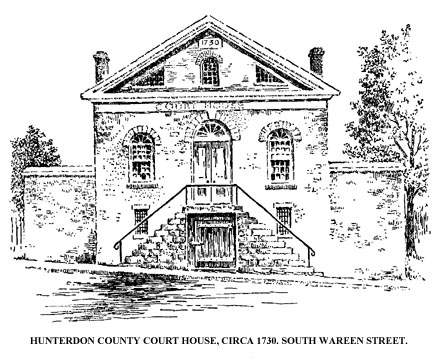 |
Trials are almost always interesting. They discover humor, pathos, comedy and tragedy. Many hearts have bled and many souls have sped by the necessarily given verdicts of juries. But it is not within the scope of this chapter to give an account of trials which took place in this Court House. That will be exploited to some extent at least in another chapter by another author.
In olden times capital executions took place within the public gaze, and many offenders convicted of capital crimes were hanged in public, here as elsewhere. Such scenes are by law no longer permitted; nor have they been for a considerable period of time. Executions now take place within prison walls and are witnessed by but few officials and newspaper reporters.
Some observation ought to be made upon the state of the criminal laws in Colonial times, showing what offenses were punishable with death, since all of them affected Trenton as well as the whole Colony. Blackstone, the great commentator on the laws of England, writing about the year 1765, said that it was a melancholy truth that no less than one hundred sixty actions which men were daily liable to commit had been declared crimes by Act of Parliament, punishable with death, 153 and that since the ninth year of the reign of Henry I (IIo9) persons guilty of larceny above the value of twelve pence were directed to be hanged. 154
153 Blackstone, Commentaries, Vol. IV, p. *18.
154 ibid., p. *238.
THE WEST JERSEY CODE RELATIVELY HUMANE
No such sanguinary code disfigured the name and fame of West Jersey. Our fathers brought with them from England the common law which, purified from corruption and redeemed from abuses which tyranny and misrule had engrafted upon it, had reached its highest vigor and perfection at the time of the settlement of this Colony. 155 We also had, besides this common law, the Concessions and Agreements of March 3, 1676, which modified and restrained it, and which provided, in Chapter XIII, that the Legislature should make no laws that did not conform thereto, and, in Chapter XXI, that sentences and the execution thereof in treason and murder were to be left to the Assembly. By Chapter XXIX, the Assembly was empowered to make all laws agreeably to those of England, provided that they were not against any of the Concessions mentioned. Judge Field, speaking of capital offenses in the Colonies, has said that while in East Jersey there were no less than thirteen offenses for which punishment of death might be inflicted, yet in West Jersey there were no capital crimes; that even after conviction in murder and treason the sentences and way of execution thereof were left to the Assembly. 156
155 Field, Provincial Courts of New Jersey, pp. 15, 16.
156 ibid., p. 207.
A fair difference between the laws of England and Colonial West Jersey will be found in the treatment of larceny: There, as we have seen, if the goods stolen were above the value of twelve pence (about a “quarter;” or twenty-five cents, of our present money) the punishment was death; here, any larceny was by Act of 1681 punished by compelling the offender to make restitution four-fold. Restitution also was provided for robbery (forcibly taking from the person of another his property by violence or putting the victim in fear), and in default of repayment the culprit was imprisoned and obliged to work out the amount. And for beating, hurting, wounding or assaulting any man, woman or child the perpetrator was to be punished according to the nature of the offense, to be determined by twelve men of the neighborhood - that is, by a jury. 157
157 Concessions and Agreements, Chap. XXVIII.
By the instrument of surrender from East and West Jersey to Queen Anne, April 17, 1702, there was yielded up to the Crown all power and authority to correct, punish, pardon, govern and rule the inhabitants of the Provinces; and to make, ordain and confirm any laws, ordinances, or to revoke or change those already made. 158 This arrangement “Her Majesty graciously accepted and was pleased to order . . . that the same be enrolled in her . . . High Court of Chancery.” 159 Since the proprietors had expressed themselves as desirous of submitting themselves to the Queen and were willing to surrender all pretence to the powers of government, so that Her Majesty might constitute a governor of the Provinces with authority for the government thereof and for the making of laws with the consent of the Assembly, subject to her approbation, 160 Queen Anne appointed Edward Hyde, Lord Cornbury, to be “Captain General and Governor in Chief in and over . . . Nova Caesaria or New Jersey.” 161 He was empowered to make, constitute and ordain laws, statutes and ordinances, with the consent of the Council and Assembly, 162 and in the Instructions accompanying his commission he was charged with the duty of collecting, revising and amending all laws of the Provinces. All Acts were to be transmitted to the Queen for approbation or disallowance. 163
158 Learning and Spicer, Grants and Concessions, p. 614.
159 ibid., pp. 617-18.
160 ibid., p. 613.
161 ibid., p. 647.
162 ibid., pp. 650 ff.
163 ibid., p. 623.
Thus it will be seen that at all times and in all instruments, whether emanating from the proprietors and freeholders of the soil, or from the crown, the power to make and amend or repeal laws in the Colony was always subject to the will of the representatives of the people in Assembly convened, without whose concurrence no law could be passed. While a veto was reserved to the Crown, its august wearer could only prevent by veto a given enactment having the force of law, but never could impose an affirmative statute upon the people without their consent. This shows clearly that the laws were to be enacted here, and we look to the Colonial Legislatures for the criminal statutes of those days.
Judge Field appears to have contented himself with comment on the penal laws of the Colonies at the time of the surrender in 1702, but does not appear to have examined the criminal statutes from that date until 1776. Now, after the acceptance of the surrender, the power of the Quaker element in West Jersey to control legislation for the Colony was forever gone, and the legislators from East Jersey of the United Province of New Jersey were able to have incorporated into the laws thereof several Acts visiting the punishment of death upon persons guilty of sundry crimes.
CAPITAL CRIMES
It appears that while at the time of the surrender there was no capital crime (one punishable with death) in West Jersey, save as the Assembly might adjudge after conviction in cases of treason and murder, yet after the surrender and between 1703 and 1776 there were added by the Legislature several penal statutes denouncing crimes which might be punishable with death. One especially (1774) is worthy of mention as showing the inhumanity and cruelty visited in that age of comparative education and enlightenment upon criminals falling into the hands of the law and convicted of crimes; the particular one concerned counterfeiting gold or silver coins of any foreign country current within this Colony. It provided that such criminals should be whipped, burned with the letter “R” in the brawn of the left thumb, by an iron sufficiently hot to make a lasting mark, fined, pilloried or cropped (clipping the ears), or one or more of those punishments, at the discretion of the court; and that if it should appear that such person was before convicted in this or any of the neighboring Colonies, such person should be adjudged guilty of felony without the benefit of clergy, and suffer death accordingly. 164
164 Laws of New Jersey, 1774, p. 82.
The statute just mentioned (and several others, too) took away from the defendants the benefit of clergy, which theretofore was allowable; and curiosity may exist as to exactly what the benefit of clergy was. It is as interesting as it was absurd, and will now be briefly stated.
“BENEFIT OF CLERGY”
The learned Sir William Blackstone says that after trial and conviction, the judgment of the court regularly follows, unless suspended or arrested by some intervening circumstance, and of which the principal is the benefit of clergy. Everyone that could read (a mark of great learning in those days of ignorance) was accounted a clerk or clericus, and allowed the benefit of clerkship, though not initiated into holy orders. But when learning, by means of the invention of printing and other concurrent causes, began to be more generally disseminated than formerly, and reading was no longer a competent proof of clerkship or being in holy orders, it was found that as many laymen as divines were admitted to the privilege. Therefore, by statute of 4 Henry VII, c. 13, a distinction was drawn between mere lay scholars and clerks that were really in orders. 165 It would be useless in a work of this kind to enumerate all of the many instances and kinds of privileges that were accorded. Suffice it to say that benefit of clergy gave certain privileges to the clerks in criminal cases, a thing that ought obviously never to have been allowed and is totally abolished at this time. Learning betokens intelligence (at least to a degree), and is rather an aggravation than an excuse for crime.
165 Blackstone, Commentaries, Vol. IV, pp. *365 ff.
It is interesting to note that in 1713 a statute was passed that solemn affirmation and declaration of the people called Quakers should be accepted instead of the oath in usual form, and for qualifying and enabling those people to serve as jurors and to execute any office or place of trust or profit within the Province. The preamble recited that in the western division of the Province a greater number of the people called Quakers had for some time past not been admitted to serve on juries or to exercise some of the places of trust and profit because they made a religious scruple of taking or giving an oath in the usual form. By reason of this, serving on juries and other places of trust had lain upon the smallest part of the inhabitants, to the great detriment and inconvenience of the other more numerous and wealthy part (the Quakers), who had, however, evinced their loyalty by their readiness to support the government. It was therefore enacted that all Quakers or reputed Quakers might take an affirmation instead of an oath in the usual form, which should be of the same force and effect as an oath required within the Province, and that the Quakers or reputed Quakers having taken the affirmation might and should be admitted to serve on juries (except on petit juries in causes criminal), and that on signing the declaration of allegiance, should be capable to serve in General Assembly or in any other post, place or office of trust or profit within the Province. 166 This applied with particular force to the population of Trenton, numerously composed of Quakers as it was in those times. Before the surrender the Quakers were in control of West Jersey and the Assembly and other officers were largely recruited from their ranks.
166 Laws of New Jersey, 1713, p. 83.
AUTHORITY TO PARDON
By Act of 1747 power was given to Governor Belcher to pardon any offender or offenders in criminal matters (treason and wilful murder only excepted). As great numbers of evil-disposed persons, inhabitants of the Province, had committed great and dangerous insurrections, riots and disorders, no persons indicted and prosecuted for such offenses should be entitled to pardon granted by the Act unless they should subscribe the oaths and declarations, or if Quakers, their solemn affirmations, for securing his Majesty’s government of New Jersey, and enter into bond for good behavior and to keep the peace. Further, all proceedings in law against any person or persons whatsoever, who at any time before the publication of the Act were concerned in committing and had been accused, indicted and prosecuted for high treason for breaking open the common gaol at Trenton, or any other common gaol, should be stayed until the intent of His Majesty or His Majesty’s royal pleasure might be known; such persons were to take and subscribe the oaths of affirmations and declarations and enter into bond and pay the fees of prosecution before they should be entitled to the benefit of the Act. 167 It would appear that the offending inhabitants secured immunity and pardon under this Act.
167 ibid., 1747 p. 22.
THE growth of Trenton for some time after the settlement in 1679 appears to have been slow. It is stated in Woodward and Hageman’s History o f Burlington and Mercer Counties 168 that prior to 1700 no great progress was made in the settlement here; that about that time purchases began to be made from the original proprietors or those who had taken up the land; and that most of the old deeds for lands in this vicinity bear date from 1699 to 1710. It is not made plain, however, just what these deeds were. A search of the records themselves discloses the true condition. It appears by the map (Stacy to Trent, 1714) that Mahlon Stacy was the only proprietor who took up all the land in old Trenton from the locality of Hermitage Avenue on the Delaware River down to just below the railroad bridge and for a considerable distance back into the country, and that all deeds for property on that vast tract were acquired from and under him. Hence any deeds that were made for tracts other than those by Stacy were made by Joshua Ely, Peter Fretwell, Ruth Beakes and others, grantees immediately and mediately from Mahlon Stacy. 169
168 p. 664.
169 It will be observed by reading the account herein of the settlement of Trenton by Mahlon Stacy and the Friends or Quakers accompanying him to the Falls of Delaware at the confluence of that river and the Assunpink Creek, where Stacy took up all the land, that it occurred in 1679. Mr. Raum, however (who contradicts himself on that score in his History of Trenton), says that the first settlement here took place in 1676 (which was three years before the actual settlement). At p. 39 he says that several of the first settlers of the Yorkshire tenth built near the Falls of Delaware in the year 1676; at p. 46, that settlements were made on lowlands above the Assunpink in 1676; and at p. 50, that the first settlements at the Falls were made by Friends on both sides of the river about the year 1676. It is noticeable, however, that he gives no names of settlers and no authority for his statements; and even if here, they had no title to the land, but were mere squatters. It is still more noticeable that he flatly contradicts himself as to these assertions, for, at p. 68, quoting from Gordon’s Gazetteer, at p. 254, says: “Trenton was founded by William Trent, a few years prior to 1720. The place that was then known as Trent’s-town received its name about this time, but was founded by Mahlon Stacy and others, about the year 1678-9.” The quotation is inaccurate in that Raum left out much that is said in the Gazetteer, and, anyway, the quotation marks should have stopped at “1720,” for the sentence, “The place that was then known as Trent’s-town received its name about this time, but was founded by Mahlon Stacy and others, about the year 1678-9,” is not in the Gazetteer, but is Raum’s own comment, and is entirely correct. A long article could be written in refutation of this unverified assertion that the first settlement was made about the year 1676, but that is deemed unnecessary. - The Author.
There is little mention of the numerical size of Trenton during the Colonial period, and accounts of it seem to vary somewhat from one another. However, by 1745 the place seems to have been of goodly size and very promising, and the inhabitants petitioned King George II for a royal charter of incorporation. The petition recited that Trenton was situate at the head of navigation, with a large and fruitful country adjacent, and these facts in all probability would tend to render Trenton a place of trade and importance. The charter of incorporation was issued creating Trenton a free borough town September 6, in the nineteenth year of the reign of George II (1745) . The dimensions of the town were very large, as appears by the description which was:
Beginning at the mouth of Crosswicks creek; thence up said creek to the mouth of Doctor’s creek; thence up said creek to Keith's line, between East and West Jersey; thence along said line including Maidenhead and Hopewell, between Hopewell and Amwell, to Delaware river; thence down said river to the place of beginning.
Provision was made in the charter for a chief burgess and recorder, twelve burgesses, sixteen councilmen, one marshal, one clerk, one treasurer and eight constables. The initial officers appointed by the charter were as follows:
Thomas Cadwallader, chief burgess; Nathaniel Ware, recorder; David Martin, marshal, and Andrew Reed, treasurer. The other burgesses were, William Morris, Joseph Warrell, Daniel Coxe, Andrew Smith, Alexander Lockhart, David Martin, Robert Pearson, Andrew Reed, Theophilus Phillips, Joseph Decou, Samuel Hunt and Reuben Armitage. The common councilmen were: Joseph Paxton, Theophilus Severns, Benjamin Biles, Jasper Smith, Cornelius Ringo, Jonathan Stout, Jonathan Waters, Thomas Burrowes, Jr., George Ely, John Hunt, John Dagworthy, Jr., Joseph Phillips, John Welling, William Plasket, Daniel Lanning, and Benjamin Green. The constables so appointed were: Robert Taylor, William Pearson, William Sprowls, John Abbot, Matthew Baker, Abner Phillipse, Vincent Runyon and Jonathan Hunt. 170
170 .See Book AAA of Commissions, pp. 266 ff., Secretary of State’s Office, see also, Lee, History of Trenton (1895), p. 65.
The charter conferred the usual powers to make reasonable laws; to impose mulcts and amercements upon breakers of laws and ordinances; for the establishing of market days and of the times of holding fairs, for the sale of livestock and goods, wares and merchandise; provided for a court to inquire into felonies, crimes and offenses not capital, and to hear, try and determine all petty larcenies, routs, riots and unlawful assemblages and all other crimes and offenses whatsoever, where the punishment did not extend to loss of life or member; provided for fines; and created a civil court with cognizance of all actions (except ejectment and all real actions). This charter is said to have been a royal charter and to have emanated from King George II, then upon the throne of England. It was, however, like all such grants, made by the royal governor, as is witnessed in the attestation clause, as follows:
Witness our said Trusty and well beloved Lewis Morris, Esqr., our said Captain General and Governor in chief in and over our said province of Nova Caesarea or New Jersey, and Territories thereon depending in America, and vice Admiral in the same &c., at Kingsbury, the sixth day of September in the nineteenth year of our reign.
However, by experience it was found that the charter did not answer the salutary purposes intended, but was found to be prejudicial to the interest and trade of Trenton, and the burgesses and council yielded to the Crown the charter of incorporation, together with the claims to exercise and administer the powers thereby conferred. The instrument of surrender was under the seal of the corporation, April 7, 1750, and was accepted by Governor Belcher. 171
171 See Book AAA of Commissions, p. 306 ; also, Lee, History of Trenton (1895), p. 67.
As we have seen, the Swedish traveller Kalm, writing in 1748, says that he was told that twenty-two years before, that is, in 1726, there was hardly more than one house in the town, but from that time Trenton increased so much that there were then (1748) near one hundred houses. 172 Five years later (1753) it was said by Acrelius 173 that “Trenton, with about one hundred thirty houses, lies at the Falls of the Delaware and has a ferry.” Six years later (1759) the Rev. Andrew Burnaby, an English clergyman, describes Trenton as containing about one hundred houses. 174 The late Adjutant-General William S. Stryker, who wrote extensively on historical subjects, in his monograph Trenton One Hundred Years Ago, 175 writing of 1776-77, places the number of houses in Trenton at about one hundred, seventy north and thirty south of the creek. He made a very careful survey of the subject, giving the names of individuals and locations of the houses, etc. If, therefore, there were about one hundred houses in 1776, there could not very well have been one hundred houses in 1759, as stated by Burnaby; nor one hundred thirty houses in 1753, as stated by Acrelius ; nor so few as Kalm relates as having been here in 1726. Accepting General Stryker’s estimate, which appears to have been a most careful and painstaking one, the reader must be left to judge what the accretion to the town in population was at various times from the settlement in 1679 to the close of the Colonial period in 1776. A helpful clue lies in the fact that the map made in 1714, showing lands conveyed by Stacy, the younger, to William Trent, delineated nineteen buildings thereon, exclusive of the mill, the number of houses and the number of outhouses shown not being stated; and that on the Pettit tract there were two other houses. It looks as though the marking apparently of a large building low down on the tract “EEE” was the dwelling of Mahlon Stacy himself, but what the two smaller buildings in the immediate vicinity were it is quite impossible to say; probably smaller dwellings.
172 Kalm, Travels into North America, Vol. I, pp. 220 ff
173 “History of New Sweden,” Memoirs of the Historical Society of Pennsylvania, Vol. XI, p. 144.
174 Hall, History of the Presbyterian Church (2nd ed.), p. 59.
175 p. 4.
Mr. Raum says that in 1814 a Mrs. Howell, who was born in 1724 and had consequently reached the age of ninety years, informed a citizen (unnamed) of this place that there were only two or three small houses within the limits of Trenton between 1730 and 1740. 176 This certainly must be attributed to the senility of the old lady repeating the story. At any rate, Dr. Hall’s refutation of the similar remarks made by Kalm is applicable here also; it could not have been a correct statement and is pure hearsay, conflicting sharply with our belief as to the situation of the town as founded upon the undisputed facts. It disagrees with Kalm himself, who says that in 1748 there were nearly one hundred houses here. If so, by 1740 there must have been at least half that number, or fifty, and one would think that by 1720 there must have been at least twenty-five. It disagrees also with Acrelius, who says that in 1753 there were one hundred thirty houses here, which would indicate a considerable place between 1730 and 1740, although there were doubtless fewer houses here than he mentions; and with the Rev. Burnaby, who in 1759 said Trenton contained about one hundred houses - apparently a little too high an estimate also, for the late Adjutant-General Stryker has said that in 1776, or nearly twenty years later, it contained about that same number, namely, one hundred. Indeed, if Mrs. Howell was correct, as well as Mr. Kalm in his statement about the size of Trenton in 1726, what have we to say of Governor Burnet’s commission to William Trent’s son James for a patent for a ferry in 1727, in which the governor solemnly recites that William Trent in his lifetime had purchased lands and made improvements on them near and adjoining Delaware Falls, and by his industry, application and encouragement there had been created a pretty considerable town, in consequence of which it would be a great convenience to travellers if a regular ferry or ferries could be kept for the carrying of passengers and goods over the Delaware near to the town of Trent-Town? The presence of about three houses here would most certainly not have provoked this patent from the governor. The truth appears to be that there must have been from twenty-five to fifty houses in the settlement at that time.
176 Raum, History of Trenton, p. 54.
It is to be regretted that it is impossible to give the names of the Friends or Quakers who came up here and settled with Stacy. It will be remembered that they landed at Burlington in December 1678. There they must have stayed, where their friends were, during the inclement winter, for building operations were quite impossible here until the advent of the spring of 1679. It will be remembered also that when Sluyter and Dankers were here in November 1679 they stayed all night at the house of the Friend who built the mill and said that there were many Quakers here and that “they daily increased.” They gave no names and are not helpful on that score except as to Stacy himself, for he it was who built the mill and they stayed at the miller’s house. This, then, describes him but no others.
The list of the arrivals in the Shield is not given in full, and diligence has failed to locate the missing names. The list actually gives twenty-five names and says there were others; some were described, as wife, children and servants. Probably there were more than one hundred, as the boats came over here very crowded, and two hundred thirty are mentioned as having landed from the ship Kent at Rackoon Creek in 1677. 177 Of the Shield’s named passengers, the Murfins are known to have always lived thereafter in Burlington. Godfrey Hancock, another of the passengers, we find built a house near Burlington on land he preempted there, 178 So it cannot be said who of the passengers of the Shield came to the Falls with Stacy, or who of those already in Burlington might also have come up here, even after more than a year’s residence there. It appears that their names must forever remain unknown.
177 Smith, History of New Jersey, p. 93.
178 Schermerhorn, History of Burlington, p. 9.
Incidentally, in the present chapter will be found mention of the names of Robert Stacy and Henry Stacy. Robert was a brother of Mahlon. 179
179 Hunter, History of Hallamshire, p. 488 (Hallamshire was a former manor, but has long since disappeared).
The progress of Trenton touches upon so much matter appropriate to other headings to follow in this History, where it will be found stated, that it will not be repeated here. There remain, however, several other subjects of which some mention should be made in this chapter on Colonial times, and to them are devoted the pages immediately following.
This community has always been noted for religion and religious worship. In a subsequent chapter of this History. 180 will be found a review of the churches and religious institutions in this community from earliest times, including the whole of the Colonial period.
180 See Chap. VIII below, “Churches and Religious Institutions.”
The schools that were conducted here in Colonial days will also be found in a subsequent chapter 181 which treats fully of schools and libraries.
181 See Chap. XIV below, “Schools and Libraries.”
While in a subsequent chapter 182 industries and trades in Colonial as well as in statehood days are reviewed, nevertheless some analytical account of the views of England concerning trade relations between that kingdom and the Colonies, with respect to the transportation of crude or raw materials to England and the purchase here of the manufactured products of the mother country, will now be given.
182 See Chap. X below, “Industries and Trades.”
It must be remembered that this was an agricultural community when first settled, and that England preferred to trade her manufactured products here rather than encourage manufactories in the Colonies. Hence there was a scarcity of such establishments here in the Colonial period. The attitude of England on that question is well illustrated by the following items:
On November 27, 1728, Sir William Keith wrote to the Secretary of the Lords of Trade, relative to certain manufactures in the Plantations:
I have heard that Some few Experiments have been made both for raising Silk, & Working Hemp up into Sail Cloth, with a view, as I Suppose, to Induce People to Enter into Some Projects of that nature; and as to any Manufactures of Woolen, Their Lordships very well know, That it is already prohibited by Act of Parliament, from being either Water born, or Transported by Land from one Colony to another, So that there is no Room to form any Considerable Project of that kind; nor did I ever hear, that Woolen Cloth has been made in any of the Plantations otherways, Than that every Farmer is by Industry led to employ his spare time in working up the wool of the few sheep he is obliged to keep on his Farm, for the Improvement of his Land, for the use of his .Family, and in like manner he often Raises a small Quantity of Flax, which is broke or dress’d commonly in the Winter Season, and Spun up into Course Cloth by the old Women and children, for the same use. 183
183 New Jersey Archives, Vol. V, p. 203.
In 1713 the feltmakers of England proffered a memorial to the Lords of Trade in which they concluded:
Wherefore it is humbly proposed That the Inhabitants of the said Plantations may be prevented from Wearing or Vending any Hats Save what are of the Manufacture of Great Britain which will Increase the Customs and Navigac’on and set to work great numbers of Poor Familys and enable the Hatmakers to revive their said Declining Trade. 184
184 New Jersey Archives, Vol. V, p. 307.
Governor Belcher, on September 15, 1750, issued a proclamation setting forth that he had received His Majesty’s commands to enforce the Act for encouraging the importation (into England) of iron from His Majesty’s Colonies in America. In accordance therewith and in order to prevent the erection of any mill or any engine for slitting or rolling of iron or any plating forge, or any furnace for making steel in any of the Colonies, he required the owner of any such mills erected before June 24, 1750, to present to the secretary’s office at Burlington an account of their respective works and the name of the owner, whether the same were used or not. The sheriffs of the several Counties were directed to notify him of the number of mills or engines for the purpose aforesaid, in their Counties, with an account of their situation, when erected, name of owner, and whether used. 185 In the same year John Allen, sheriff of Hunterdon, reported the existence of a mill in Trenton owned by Benjamin Yard, where it appeared that not only iron, but steel also, was manufactured.
185 ibid., Vol. XII, p. 674.
Governor Belcher, in answer to a query from the Lords of Trade on December 28, 1754, said, among other things, that the exports were in provisions and lumber to Europe and the West Indies, and that it was computed that the Province took from Great Britain “Woolens, - Cutlary, - Habidashiry, - Braisery, - Hats, - East India Goods.” 186
186 ibid., Vol. VIII, Part II, pp. 82-3.
Benjamin Franklin, writing from London to his son William Franklin, governor of New Jersey, March 13, 1768, said that complaint was made in the House of Commons that the governors of New Jersey and other Provinces had none of them obeyed the orders sent them to give an account of the manufactures carried on in their respective Provinces; and that after the House adjourned he looked up the reports made by the other governors and found all in the same strain, that there were no manufactures of any consequence. 187
187 New Jersey Archives, Vol. X, p. 29.
Governor Franklin in a letter to Secretary Hillsborough, dated June 14, 1768, himself said:
As to the Manufactures in this Colony I can assure your Lordship, that there are none either of woolen or Linen which deserve to be call’d by that Name. It is true that many Families who live on Farms make some coarse Cloathing for themselves or Servants, but it is by no means sufficient for their Consumption . . . . All the finer kind of Goods consum’d here are imported from Great Britain (except some Linen from Ireland) into the ports of New York or Philadelphia. There are indeed few articles but what may now be imported and sold cheaper than they can be manufactured here, owing to the high Price of .Labour. Some Persons, Indeed, out of a Zeal for what they conceive to be for the good of their Country, have ever since the Commencement of the late Differences between the Mother Country and the Colonies, persevered in wearing and encouraging their own Manufactures, tho’ to their manifest Loss in many Cases. 188
188 ibid., Vol. X, p. 304.
In a general way he repeats the very same statements in his “Answer to Heads of Enquiry relative to the State and Conditions of His Majesty’s Province of New Jersey in America in 1774.” 189189 ibid., p. 444.
The keeping of a tavern was an early enterprise among the settlers, here as elsewhere. Says Mr. Raum, “Every town was required to provide an ordinary for the relief of strangers, the keeper of which was to have a license and oblige himself to make sufficient provision of meat, drink and lodging.” 190 An “ordinary” was the name for a tavern or eating house where regular meals were served, or the dining room in such a house. These ordinaries were very fashionable in olden times, as much so as the clubhouses are amongst those of the present day. 191 This subject will be treated more fully hereafter. 192
190 Raum, History of Trenton, p. 20.
191 Webster’s New International Dictionary, 1928, p. 1516.
192 See Chap. VI, “Landmarks, Taverns, Markets and Fairs.”
Ferries were a most important link in the transportation system in Colonial times. There has already been detailed in this History an account of the patent granted by William Burnet, royal governor, to James Trent, his heirs and assigns, for the sole liberty and privilege of erecting and keeping of ferries over the river Delaware at any places within two miles above or two miles below the Falls of the Delaware near Trent Town; which patent was sold and conveyed by James Trent to William Morris. Where ferries were built in virtue of these letters patent, and what other ferries existed here, will be told in detail hereafter in this History. 193
193 See Chap. V below, “Transportation.”
Fairs, as such, in ancient times were associated with markets and were themselves an exalted sort of market, and were held in virtue of licenses or grants flowing from the sovereign power. 194 Blackstone, in his Commentaries on the Laws o f England, says of the establishment of public marts or places of buying and selling, such as markets and fairs, with the tolls thereunto belonging:
These can only be set up .by virtue of the King’s grant, or by long and immemorial usage and prescription, which presupposes such a grant. The limitation of these public resorts, to such time and place as may be most convenient for the neighborhood, forms a part of economics, or domestic polity; which considering the kingdom as a large family, and the King as master of it, he clearly has a right to dispose and order as he pleases. 195
194 The Encyclopedia Britannica, 13th ed., Vol. 10, pp. 127 ff.
195 Vol. I, *p. 274.
Fairs have now become largely agricultural exhibitions, in which shows, horse racing, and other amusements are held forth. The fairs that have been held here in Colonial times and later will be told of in a subsequent chapter. They are veritable landmarks. 196
196 See Chap. VI below, “Landmarks, Taverns, Markets and Fairs.”
Of course prior to any settlement here there was no municipality; nor was there any created by law in any way until several years after the settlement was formed. There was no incorporation of Trenton as a city until after the Revolution. 197 Municipal bounds were landmarks and will be fully treated hereafter. 198
197 See the later chapter, “Municipal and Corporate History from the Charter of 1792.” below.
198 See Chap. VI, “Landmarks, Taverns, Markets and Fairs.”
Transportation was an important, though a hard and tedious, process in Colonial times. None of the mechanical means now so successfully carried on in that regard were then available. Travelling, and the carriage of men, animals and goods were conducted on land and water; on land, largely by horse-drawn vehicles; and on water, by boats propelled by oars and sails. The subject will be fully treated in a later chapter of this History. 199
199 Chap. V, “Transportation.”
The Old Barracks in Trenton is the only one standing out of five erected pursuant to the statute of 1758, and has recently been restored to its pristine condition. It is the most distinguished landmark of Colonial times still left in Trenton. It is managed by the Old Barracks Association, a corporation composed exclusively of ladies; and many patriotic societies occupy rooms there furnished in Colonial style. It is the only institution of its kind known to exist today in the whole country. It will be fully treated of in the appropriate chapter which deals with landmarks. 200
200 Chap. VI, below.
It is of course difficult to ascertain all distinguished persons who visited the Falls and Trenton during the Colonial period, owing to the lack of available records kept on such subjects in olden times. Most of the visits, being fugitive, are lost in antiquity.
Trenton was not a very important town, nor the capital of the State, until after the Revolution, and the governors did not live here (except Governor Lewis Morris) but doubtless all of them visited this place on various occasions.
Jasper Dankers and Peter Sluyter, Labadist priests, were here and spent the night of Friday, November 17, 1679, at the house of the miller, Mahlon Stacy, as already told above.
Captain Arent Schuyler of New York was also an early visitor to the Falls of the Delaware. His father was one of the original settlers in .Albany in 1650, and the Captain was commissioned in 1692 by Lieutenant-Governor Ingoldsby of New York and New Jersey, and the Council of New York, to proceed to the Delaware River and meet a delegation of southern Indians, who had been at war with the Five Nations and had come hither to sue for peace and were waiting for permission to continue their journey. Captain Schuyler, who was then in New York, was dispatched to meet the Indians and conduct them to the Governor and Council there. He proceeded to the Falls and reached here on August 15, 1692, and here conferred with the Indians. The singular feature of the account of his expenses was its small amount, being only £12 5s. 11d. currency. The report of his first interview with the Indians on the Delaware River is an interesting document to the antiquarian. 201
201 Schuyler, Colonial New York, Vol. II, pp. 182-4.
Governor Cornbury of course was here. The Rev. John Sharpe, his chaplain, speaks several times of the Hopewell Church (of England) and of his ministrations there. Under date of April 23, i 7o6, he says that on Whitsunday he preached at Hopewell Church and that Lord Cornbury was present. 202
202 Schuyler, History of St. Michael’s Church, Trenton, p. 24.
Thomas Chalkley, a Quaker preacher, was here in 1725, and lodged with Captain Gould and was well treated. 203
203 Hall, History of the Presbyterian Church, Trenton (2nd ed.), Appendix, p. 323.
Governor Cosby with his wife and family were here on Tuesday, September 24, 1734, and went to Burlington where they were tendered a reception. In the evening he returned to Trent-Town. 204
204 New Jersey Archives, Vol. XI, p. 389.
The Rev. George Whitefield, a famous English evangelist and an associate of John Wesley, was in Trenton November 12 and 21, 1739. On the latter date he came here to preach to a condemned criminal, which he did in the Court House. He said that the unhappy criminal seemed hardened, but he hoped that some good was done in the place. He was here again in November 1740, conferring with ministers, and was probably here several times more. He was advertised to preach here on September 13 and 14, 1754. 205
205 Hall, History of the Presbyterian Church, Trenton (2nd ed.), pp. 53-5.
Governor Lewis Morris lived in Trenton from 1740 until his death in 1742. 206
206 Godfrey, Mechanics National Bank, Trenton, p. 7.
Dr. Alexander Hamilton was here in 1744, a fact which may be gleaned from a privately printed volume entitled Hamilton’s Itinerarium. It is the narrative of a journey in 1744 by Dr. Alexander Hamilton, a distinguished physician (not the Alexander Hamilton of the Revolution). The autobiographer says he came to Trenton on horseback from his residence in Annapolis, and put up at Elisha Bond’s at the Sign of the Wheat Sheaf. Dr. Cadwalader (of Trenton) came to see him, who he said he understood was a “fallen-off” Quaker. They supped together; their discourse was mixed and rambling. At first it was political, and Cadwalader gave him the character of the constitution and government, saying that the House of Assembly was composed (among others) of “ignorant wretches,” obstinate to the last degree, and that there were a number of proprietors in the government and a multitude of Quakers. He enlarged a little in praise of Governor Morris, who was then a very old man. Dr. Hamilton stayed over night here again at Bond’s on his return, September 12, 1744.
Peter Kalm, a professor in a university in Sweden, and a famous traveller, was here in 1748. Under date of October 28 of that year he wrote his observations of Trenton, which have been given in another part of this chapter.
John Woolman, a recorded (as they were then called) minister of the Society of Friends, who was a very celebrated man, lived at Mount Holly and must have been here repeatedly, although he does not say so in terms. He does, however, say in his Journal that in the year 1754 he found his mind drawn to join in a visit to Friends’ families belonging to the Chesterfield Monthly Meeting; that he spent several weeks that winter in the service, and again the following winter was several weeks in the same service. He must, therefore, have visited all of the families belonging to the Meeting, and, consequently, must have been here, as Trenton was subsidiary to that Meeting. 207
207 John Woolman’s Journal, pp. 47-8.
He tells of a curious incident that happened to him the year before. He says that someone came to him to write the will of a sick man who had slaves and intended to leave them to his children. He then says:
As writing is a profitable employ and offending sober people was disagreeable to my inclination, I was straitened in my mind, but as I looked to the Lord he inclined my heart to his testimony, and I told the man that I believed the practice of continuing slavery to this people was not right and had a scruple in my mind against doing writings of that kind: that though many in our Society kept them as slaves, still I was not easy to be concerned in it, and desired to be excused from going to write the will. 208
208 ibid., p. 46.
Benjamin Franklin visited Trenton in 1757, and doubtless on many other occasions. On April 5 of the year mentioned he dated a letter from this place while on his way from Philadelphia to New York to take passage for England. 209 On his famous journey from Boston to Philadelphia as a boy it would appear that Benjamin Franklin did not stop here but passed to the south. He landed in Perth Amboy by boat and set out to walk to Philadelphia. He proceeded on foot to Burlington where he was told he would find a boat to carry him the rest of the way. In his autobiography he says that that night he came to a poor inn where he stayed till morning (without saying where), and proceeded the next day and in the evening reached an inn eight or ten miles from Burlington kept by one Dr. Brown (not saying where that was). Although Trenton is more than ten miles from Burlington it may be that it was here he stopped at Dr. Brown’s, where he spent the night, and the next morning reached Burlington, where he spent a few days and then took boat for Philadelphia. 210
209 Sparks, Works of Franklin, Vol. VII, p. 134.
210 Autobiography of Benjamin Franklin, pp. 44-6.
General Dunbar and the British Army were in Trenton on its way to New York after the disastrous defeat and the death of General Braddock in the expedition against Fort Duquesne in 1755. Franklin had secured the enlistment of several servants of farmers of Lancaster County, Pennsylvania, and General Dunbar, who succeeded to command, told him that if the masters would come to Trenton, where he would be in a few days on his march to New York, he would there deliver their men to them. They accordingly were at the expense and trouble of coming here, where the General, however, refused to perform his promise. 211
211 ibid., p. 269.
Governor Wentworth of New Hampshire visited Governor William Franklin in June 1767 (at his house in Burlington) and next morning they came together to Trenton Falls, where they spent the day fishing and took supper together. 212
212 Duane, Franklin’s Correspondence, p. 35; Hall, History of Presbyterian Church, Trenton (2nd ed.), Appendix, p. 294.
John Fitch, afterwards famous as the inventor of the steamboat, came to Trenton in 1769, and was well established here as a silversmith even before the Revolution. Shortly thereafter he removed to Bucks County, Pennsylvania. 213
213 Hall, History of the Presbyterian Church, Trenton (2nd ed.), p. 152.
General Washington, the most distinguished of them all, being in Philadelphia May 23, 1773, on his way to New York, set out for that place with Lord Sterling, Major Bayard and Mr. Custis (the latter being his step-son), after breakfasting with Governor Penn. He (and presumably the party) dined with Governor Franklin at Burlington and lodged at Trenton (it not being known where). On his return from New York to Philadelphia on May 31, 1773, he proceeded to Princeton, then to Bristol; so he must have passed through Trenton on that occasion also. 214 As Washington went to Boston in 1756 to confer with General Shirley, commander-in-chief of the British forces in America, he probably passed through Trenton northward approximately February 14, and southward March 13, 1756, though there is no record of this.
214 Fitzpatrick, Colonial Traveler, pp. 333-8.
John Adams, afterwards the second President of the United States, was here in August 1774. He wrote in his journal that he rode to Trenton from Princeton, was at (Rensselaer) Williams’ tavern at Trenton Ferry; that Trenton “is a very pretty village and appears to be the largest town in the Jerseys.” 215
215 Hall, History of the Presbyterian Church, Trenton (2nd ed.), p. 168.
Trenton in Colonial days, as now, was a place through which travellers passed between New York and Philadelphia, and to points north and south on the Delaware and to and from the shore of the Atlantic and westward into Pennsylvania. In fact, in the Indians' day, before the advent of white settlers, the Falls was known as a stopping point and from which several Indian trails radiated. Naturally it was a place visited by travellers, distinguished and otherwise. While many more distinguished visitors were here than are detailed above, nevertheless rather careful investigation has failed to disclose their names and the time of their visits.
In 1775 and 1776 the Colonies were seething with revolt. The Battle of Lexington, said to have been the commencement of the Revolutionary War, had been fought April 19, 1775, but Independence had not yet been declared. The Declaration made by the thirteen original Colonies in Congress assembled is dated July 4, 1776, but New Jersey, be it said to her lasting glory, declared her independence two days earlier by the adoption of a completely autonomous constitution, setting up a State government in all its branches, legislative, executive and judicial. The Provincial Congress of New Jersey, assembled in convention at Burlington on July 2, 1776, adopted that constitution, breathing defiance to Great Britain in every line. Its Preamble is herewith given in full:
PREAMBLE TO THE STATE CONSTITUTION, JULY 2, 1776
WHEREAS all the constitutional authority ever possessed by the kings of Great Britain over these colonies, or their other dominions, was, by compact, derived from the people, and held of them for the common interest of the whole society; allegiance and protection are, in the nature of things, reciprocal ties, each equally depending upon the other, and liable to be dissolved by the other’s being refused or withdrawn. AND WHEREAS, George the third, king of Great Britain, has refused protection to the good people of these colonies; and, by assenting to sundry acts of the British parliament, attempted to subject them to the absolute dominion of that body; and has also made war upon them in the most cruel and unnatural manner, for no other cause than asserting their just rights; all civil authority under him is necessarily at an end, and a dissolution of government in each colony has consequently taken place.
AND WHEREAS, in the present deplorable situation of these colonies, exposed to the fury of a cruel and relentless enemy, some form of government is absolutely necessary, not only for the preservation of good order, but also the more effectually to unite the people, and enable them to exert their whole force in their own necessary defense; and as the honorable the continental congress, the supreme council of the American colonies, has advised such colonies as have not yet gone into the measure, to adopt for themselves respectively such government, as shall best conduce to their own happiness and safety, and the well-being of America in general; we, the representatives of the colony of New Jersey, having been elected by all the counties in the freest manner, and in congress assembled, have, after mature deliberation, agreed upon a set of charter rights, and the form of a constitution in manner following, videlicet.
Then follows the organic law under which New Jersey existed and flourished from 1776 until 1844, when a new constitution, the present one, was adopted.
And thus, on July 2, 1776, by this defiance of Great Britain and the adoption of a constitution for the State of New Jersey, ended the Colonial period of Trenton’s existence, as well as that of the commonwealth at large, and embarked both upon statehood days; and so, necessarily, ends this chapter of Trenton’s history. 216
216 The proceedings and vote on the adoption of the constitution may be found in the Journal of the Votes and Proceedings of the Convention of New Jersey, published by order, 1776, pp. 35, 36, State Library.
© 1929, TRENTON HISTORICAL SOCIETY
Up To Top /
Home
The Society : About Us / Artifacts
Committee / Education Committee / Preservation
Committee / Membership / Contact
Us / Events
Our History : Sights & Sounds
/ 1929 History / Old
& New / Hill Diaries / Chronological
Indexes / Trenton Made / Documents
Your Ancestors : Research Services
/ Obituaries / City
Directories / High School Yearbooks /
Cemeteries
The City : Buildings /
Historic Districts / North
Ward Survey / Street Names / Local
Links
Search Our Site
Up
To Top / Home
The Society : Preservation
Committee / Artifacts Committee / Membership / Contact
Us / Events
Our History : Sights & Sounds / 1929
History / Old & New / Hill Diaries/ Chronological
Indexes / Trenton Made
Your Ancestors : Research Services / Obituaries / City
Directories / High School Yearbooks / Cemeteries
The City : Historic Districts / North
Ward Survey / Street Names / Local Links